Huwebes, Pebrero 18, 2016

7 Ways to Get The Sales Team to Use Your Marketing Content

The evolution of content marketing as a discipline has made content creation a core marketing function. At the top of the sales funnel, effective presentations and web site content generate leads and build awareness. Farther along in the buyer's journey, finely tailored content such as case studies and white papers can help specific buyer personas build consensus for adoption of a vendor's solution - shortening sales cycles and increasing the likelihood of a successful close.


That's the ideal. The reality is that a lack of marketing and sales alignment often creates barriers to successful content marketing.


Research by SiriusDecisions shows that sales doesn't even use 60 to 70% of marketing content. That means that about two thirds of marketing's investment in content development -- often as much as 12% of the entire marketing budget -- can be going to waste. Content that should be impacting revenue by helping to close late-stage deals is just sitting unused.


How can marketing turn this around? How can you get sales to use the content that you spend valuable marketing time and resources developing?


To start, be sure you have a successful process set up with your sales organization for identifying, building, and using your content - before you start producing any content.


Below are 7 ways marketing can set up a better process with sales:


1) Know your buyer's journey


Understand who the buyer is and the purchasing process - so you can produce marketing content that aligns with that buyer's journey. Your reps need content that they can proactively use to overcome each obstacle in the buyer's path to successful adoption. Do you know the primary buyer objections and how your sales team typically overcomes them? Do you know the different stages in your sales team's buying process? Do you know what buyer actions move a lead from one sales stage to the next?
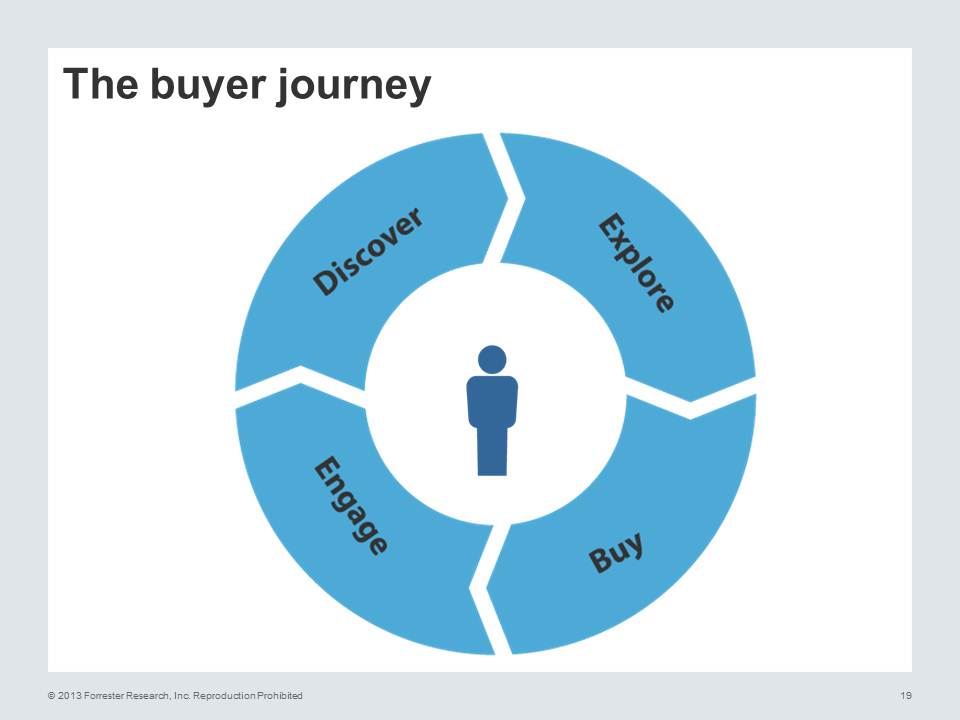

buyer-journey-forrester


Image Source


Understand the sales process specific for each buyer persona, and deliver content that supports that process. Create presentations that address the buyer's challenges and potential solutions, such as case studies that describe realistic scenarios to be relevant to the rep and resonate with the buyer.


2) Be sure your content is buyer-centric


Sales executives surveyed by Sirius say that too much marketing content is product-centric -- focused on selling product features. What sales really wants and needs is buyer-centric content -- content that communicates value that's matched to the needs of specific customer personas. Buyers need sales reps to help them understand how to solve a pragmatic business problem or exploit an opportunity - not just explain Feature A and Feature B.


3) Meet regularly with sales counterparts


At the very least, you need to be meeting monthly, and if you're organization is smaller, even more frequently. Use meetings to share what's working and what's not. Be transparent about the content that's being generated, allow the reps to give feedback - and listen. Why produce content they don't want?


Additionally, marketing should regularly attend sales meetings, to share campaigns and content under development or newly updated content, and deliver the analytics data.


4) Make content easily accessible to sales


Make it easy for sales to get the content you're producing. They should be able to get content right from their desktops. It should be easily accessed from whatever CRM tool they use. If they use cloud storage for materials, the repository should be able to pull content from cloud storage (like Box or Dropbox). Also, evolve in collaboration with sales a tagging and folder structure for content that makes it effortless for reps to find what they need, for each buyer persona and each stage in the buyer's journey (each level of the sales funnel).


5) Understand the metric for success


Understand what sales leadership is directing the reps to do - e.g., make as many phone calls as possible, or send as many emails as possible. If the content doesn't make it easier to hit the goal that gets measured, reps won't see value in it.


6) Deploy sales analytics tools to see what's working and what's not


Sales analytics tools that integrate with marketing automation systems give marketing insight into what a rep is doing with their content. You can see what collateral reps are using most frequently - and the content they're not using at all - and find out why. Is it because the content isn't helpful, or because they don't know it's there?


Sales engagement analytics also reveal how prospects are interacting with your content.
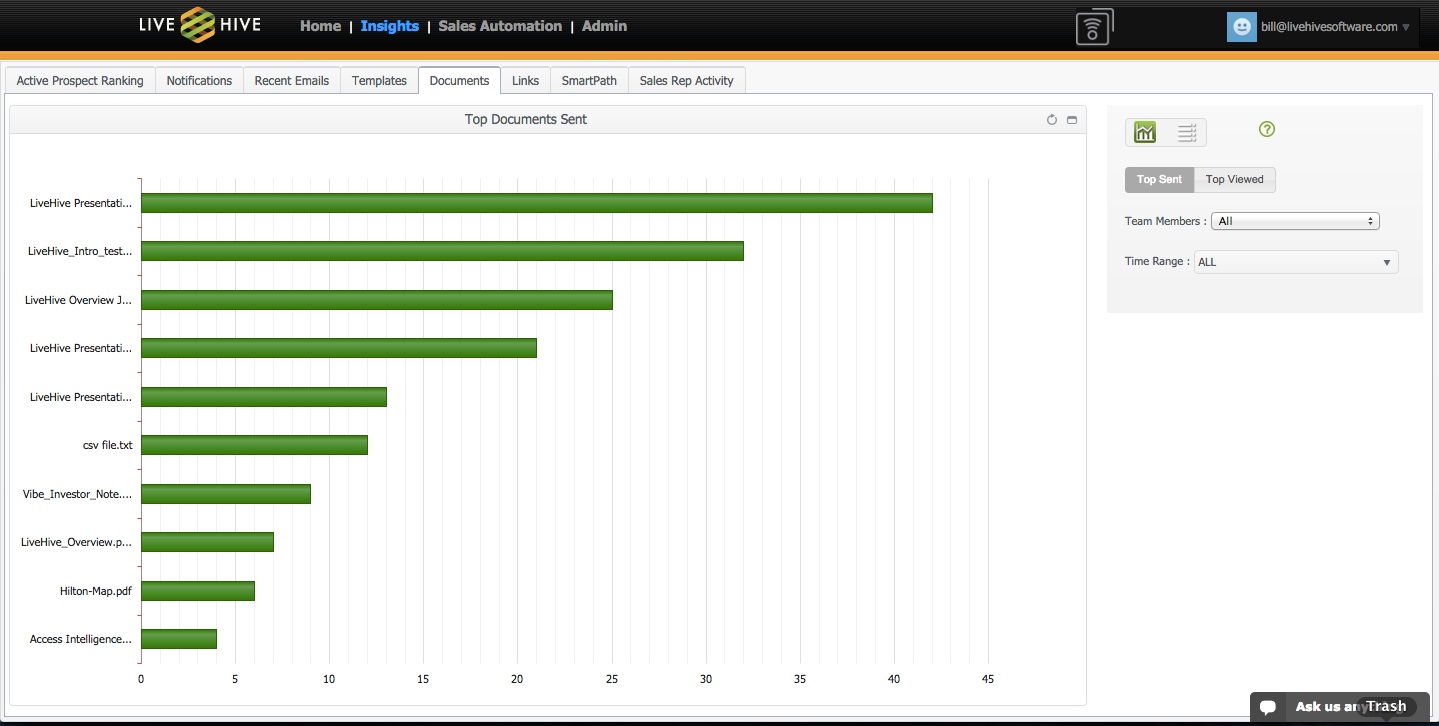

livehive-top-docs-sent


You can see what attachments are downloaded, what pages are viewed and for how long. This visibility gives you understanding into what messaging resonates most with prospects - so you can adjust future content.


7) Realize that sales reps want to personalize content


Even today, sales is as much of an art as it is a science - and sales reps want to personalize their engagement to strengthen the customer relationship. Personalization builds trust. Indeed, Aberdeen Group has found that the best performing organizations enable sales reps to personalize content for their customers. Marketing can't produce content to support thousands of different usage scenarios, but they can provide a library of content broken down - e.g., by industry or product feature or pain point -- as well as guidance, a general overview of the story, and branding compliance instruction.


Using sales email templates that allow for personalization - with marketing-approved key messaging in the email body - can also help ensure consistency.


Stronger alignment around content brings more value to the business


Aberdeen Group research shows that organizations that closely align marketing and sales around creation and deployment of buyer-oriented marketing content experience 21% better lead acceptance rates and 36% higher average conversion rates than more loosely aligned companies.
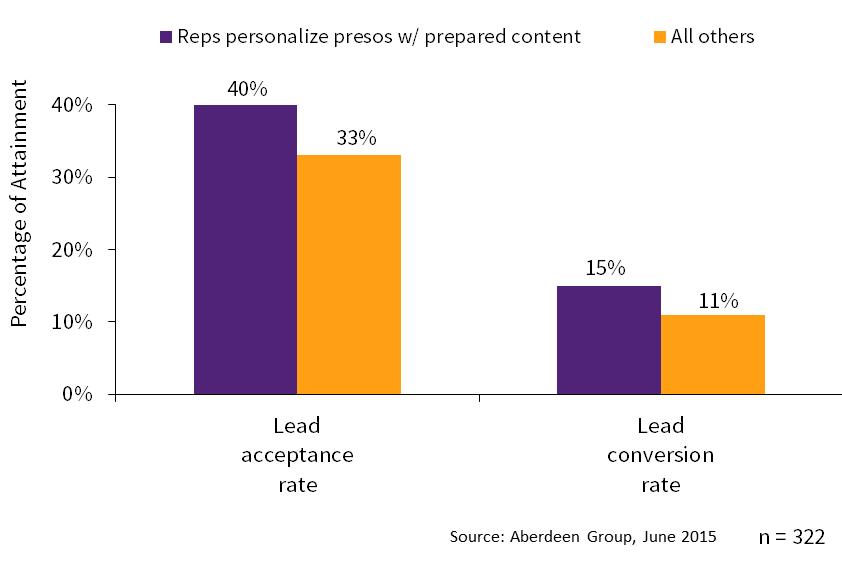

percentage-of-attainment-graph


Sales needs marketing to help buyers through the latter stages of their journey. Marketing needs to step up to the plate to:


  • Build content that addresses specific buyer needs

  • Put a process in place for content and communicate with sales - so they know it's there and how to get it!


The keys include closer collaboration between these two functions, including regular face-to-face interaction. Remember, marketing may own the messaging, but sales generally has the most immediate knowledge of changing customer needs and pain points. Embrace both perspectives in content development, and deploy tools and analytics to facilitate a common marketing-sales process for content creation and use.


About the Author: Micheline Nijmeh is the CMO for LiveHive, Inc., whose award-winning sales acceleration platform provides deep buyer-based engagement analytics and automated email sequencing. A seasoned Silicon Valley executive, Nijmeh has served as Senior Director, Integrated Global Campaigns at Salesforce.com, where she led the market launch of Salesforce's Chatter and Force platform.


Miyerkules, Pebrero 17, 2016

More Trial Users Is Not The Answer For Your Startup's Growth

As a startup, you're not just tight on budget.


You have to get users as fast as possible.


Marketers are often under a lot of pressure to get as many trial users as quickly as possible.


The CEO, investors and your teammates are counting on you to generate demand, regardless of product-market fit.


I'm here to explain why you don't need more trial subscribers.


The 40% Rule


product-market-fit-chart


Rule of thumb for reaching product-market fit is when 40% of surveyed customers would be significantly disappointed if all of a sudden they could no longer access that product.


If you already have several hundred or a thousand users, you don't need more until your startup has achieved product-market fit. Product-market fit can be defined as the point at which your target market finds your product attractive enough that you can scale up.


"The 40% Rule" suggests you've reached product-market fit once at least 40% of surveyed customers confirm that they would feel disappointed if they could no longer use your product.


Product-market fit and engagement go hand-in-hand. People are more likely to pay for your product or service if they're engaging with it frequently and it's crucial to their daily workflow.


Customer retention is a function of their satisfaction.


Retention = ?(Customer Satisfaction)


If trial users aren't excited or happy about your product or don't get enough benefits out of using it, they won't return. As simple as this sounds, countless startups fail to address this issue.


Instead, many startups do this:


product-dev-model-2


Image Source


The product development model as presented in Steve Blank's book, The Four Steps To The Epiphany, shows the backwards push marketing steps after building a product.


I'm sure you can see the pitfalls of this approach.


Eliminate Or Reduce Free Trials


What if one day, your team just decided to shut down your free trial accounts that were past 14 days since their sign up date? Would you suddenly go out of business?


No, you'd save money from server costs and force people to make a decision.


It's only when your free trials run out that you know whether the end user found your product worth paying for.


You need to figure out how to improve the engagement of your existing trial users to convert them to paid users.


ConvertKit and Edgar, which today generate millions of ARR, never offered free trials.


I often come across startups that give away free trials for 30 to 60 days. I just don't get it.


Two Exceptions To The Rule


One case where a free trial might make sense is if your startup's B2B software costs $200+/month. In this instance, a 14-day free trial is reasonable. Any longer than that is, more often than not, a fruitless giveaway.


One instance where an extended free trial makes sense is for a startup where personal data storage grows fast as the user engages with the product. Three startups come to mind: Slack, Evernote and Dropbox.


As each user uploads more personal data, the chance that that person will switch providers decreases. Moreover, frequent access to that personal information in the cloud is a necessity for the end user. Users engage frequently with these apps on a daily recurring basis and often need to upgrade to a premium subscription, in order to continue using the service as team headcount or storage needs grow.


Stop Aiming To Be A Unicorn


VC-Funnel-Graphic-2015


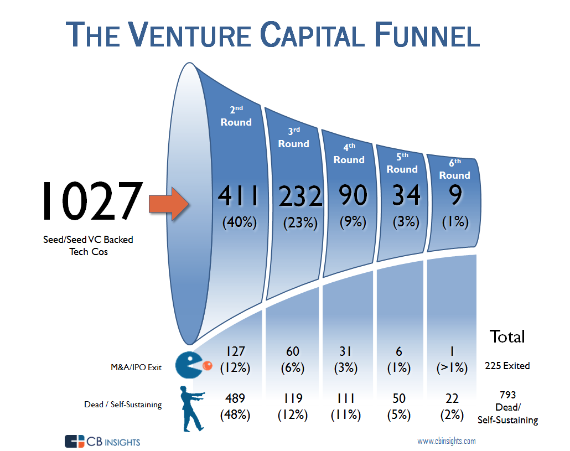
The venture capital funnel from CB Insights shows the average failure rates of venture-backed startups by financing round. Less than 2% of venture-backed startups ever reach unicorn status.


Neither exception suggests that your startup needs more trial subscribers. We all have a natural tendency to look at unicorns and glom on to their stories as validation for why we can do that.


According to CBInsights, your startup has a 1.28% chance of becoming a unicorn.


The one thing people forget when they hang their hat on the stories of unicorns is that these companies found product-market fit, had high levels of user engagement and most established clear sales funnels before they went off acquiring more free trial users.


Again, improve the product, the onboarding experience, and the sales funnel to convert more of your existing users.


If your customers love your product and rely on it to improve their daily workflow, they will serve as your fan club. Your engagement will skyrocket. You won't need to fudge community building or finding loyal users as word of mouth referrals come pouring in.


You can't force user engagement that doesn't exist.


Adopt The Customer Development Model


No marketer-no matter how good they are-can fix a broken product, such as one that few customers find valuable to their daily workflow.


Startups build a product or feature for the sake of building it, not on the basis of identifying their audience's thorny problems.


product-dev-model-1


Image Source


A second version of the product development model focuses on building the sales organization without ensuring that the product reaches product-market fit, which can lead to premature scaling.


If you've read Steve Blank's The Four Steps to the Epiphany, then you may remember reading about one of the following:


  • Premature scaling

  • The use of a product development methodology to measure sales and marketing activities

  • The pitfalls of getting the product launch wrong


Startups often go out of business because they rely on the product development methodology to measure all their sales and marketing efforts.


The product development methodology starts with building a product first and later engaging a sales and marketing team to push the product into the hands of the target customer, as opposed to building and iterating a product solution based on your target audience's needs.


customer-development-model


Image Source


The customer development model requires iteration through the customer discovery and customer validation stages until product-market fit has been achieved before acquiring more customers and scaling up.


In reality, they should use the customer development model and complement it with the product development model.


The customer development model involves iterating through the first two stages of customer discovery and customer validation until you reach product-market fit. Once you've reached product-market fit, then you can scale up, drawing more customers and building company infrastructure.


The customer development model helps ensure you don't scale up prematurely ahead of reaching product-market fit. As a result, your initial set of customers find your product so valuable that they can't help but recommend it to other companies.


Even in 2016, many startups still apply the archaic model of build first, validate last, or "build it and they will come."


Rather than apply the lean startup process, they develop a product no one cares enough to pay for. Worse, it doesn't even solve their target customer's pain points.


The Hubstaff Free Plan Mistake


Hubstaff-homepage-screenshot


Hubstaff, a startup for time tracking for remote teams, explained in its post SaaS Pricing: Our Big Free Plan Mistake why startups shouldn't feel implicit pressure to offer free trials to users and that user acquisition shouldn't be seen as a "money making arms race." They gave an insight glimpse into the reasons why free trials hurt most startups and why startups often rationalize them.


From their experience offering a free plan, they found that people take advantage of free accounts and that free users often skirt around the free account limits by signing up for multiple free accounts with different email addresses.

Even IP blocks can't solve this problem because customers have easy access to VPN software, like ExpressVPN.


Hubstaff also found that if someone values a product, they would pay for it.


If existing users aren't engaging with your product on a frequent recurring basis, then your product doesn't solve a hairy enough problem for the end user.


Two other takeaways:


  1. Free users tend to invite more free users

  2. Paid products carry more value in the consumer's eyes


I came across a blog post from ConversionXL that explains how not requiring credit card info during the free trial signup processes resulted in a lift to paid subscriber conversion rates.


It's important to take the company's business model in context relative to yours and assess whether that product is 10x better than a substitute.


If your product is easily replaceable or doesn't solve a big enough customer pain point, people will be less willing to pay for it.


Avoid acquiring more trial customers until your existing customers love engaging with your product every day and find it invaluable for their use case.


Get The CEO To Acquiesce


bigstock-hockey-stick-growth


If your startup is struggling to break even, convince the CEO to stop acquiring trial subscribers. Refocus your team's efforts on optimizing customer happiness with the right product feature set.


What are some factors that drive marketers to seek more trial subscribers?


  • Investors include a subscriber performance milestone with a liquidation preference in the equity agreement.

  • The C-Suite wants hockey stick growth so the company can raise additional capital at a higher valuation.


Even if marketers question the CEO or investor's judgment about trial user acquisition, it often doesn't change their minds. I've experienced it before. Founder CEOs can be pretty stubborn. Not because they don't mean well but it's often difficult for them to admit when their product isn't great.


As a result, the marketing team is forced to find more trial subscribers. It doesn't matter whether people actually find the product useful.


The venture-backed company CEO isn't worried about monetization in the short-run because "more trial subscribers" is the resolve for faster growth. This couldn't be further from the truth.


The truth is, you don't need more trial users...


... You need a product that solves a big need for your customer, not one that results from C-Suite groupthink.


If you care about your company and team, avoid letting your CEO put the company out of business. Sooner or later, your team will have to face the music and recognize that any underlying product engagement issues must be resolved first, or your team won't exist.


Customer Acquisition Cost and User Engagement are Inversely Proportional


Chart_Relationship_User_Engagment_v_CAC


The chart illustrates the inversely proportional relationship between Customer Acquisition Cost and user engagement shown as recurring site visits.


Customer acquisition cost, or the price you pay to attract a new customer, increases as user engagement decreases. To keep things simple, let's define user engagement as the number of recurring visits per unique user.


The cost of acquiring new customers goes down as word of mouth referrals increase.


Word of mouth customers tend to be much stickier than customers from other referral sources. So not only is it more expensive to acquire customers with fewer word of mouth referrals, non-word-of-mouth referral customers exhibit higher churn rates.


To confirm this, professors at three business schools teamed up to research the word-of-mouth effects in estimating customer lifetime value.


In short, they found that word-of-mouth referrals are more valuable than other types of referrals; their lifetime value is higher because customer churn is lower. Furthermore, customer acquisition costs are lower with higher word-of-mouth referrals.


Without high word-of-mouth referrals resulting from high user engagement and customer happiness, it becomes impossible to reach escape velocity, like Slack or Stripe.


On Virality


bigstock-Content-Virality-Concept


Virality can mask poor customer development.


Embedded viral loops are a misguided cure-all for chronically low word of mouth referrals.


Startups attempt to force trial subscriber acquisition with viral loops and other gimmicks. They hide any user engagement problems, providing an excuse for a product that doesn't solve its target customer's pain points.


One of my favorite quotes about virality comes from Laura Roeder's Observer article, Why I Don't Want My Startup to 'Go Viral':


"Word-of-mouth is like the stable, grown-up big brother of virality. Steady job, less impulsive, takes showers."


Weak User Engagement Is Killing Your Startup


Cohort_Analysis_-_Google_Analytics


With a few hundred or thousand existing trial subscribers, acquiring more trial subscribers is not the answer to unlock growth.


Your team's energy should be spent on customer discovery.


Install Kissmetrics and Hotjar. Collect as much data as possible about your trial users' in-app engagement. Setup custom reports in Google Analytics. Get serious about visitor and user segmentation.


Figure out why your users are not revisiting your site on a regular basis.


Here are some possible reasons why they aren't engaging with your application:


  • Is there a missing feature or capability that better addresses their daily workflow needs?

  • Are users getting stuck at a particular stage of the conversion funnel or onboarding process?

  • Do your transactional emails turn off subscribers, leading them to filter them out from their inbox with an email rule?

  • Is your site speed or data reporting causing subscribers to leave and never return?

  • Do users struggle to understand how your application works or what the benefits of using it are? Maybe they need better onboarding education or how-to help tutorials to learn how to use the interface as it applies to their specific use case.

  • Does the user interface cause visitors to flee the second they're inside the app?


Where To Go From Here


km-cohort-results-conversion-rate


Diagnose poor user engagement with cohort analyses.


Segment cohorts by demography, geography, traffic source, landing page, exit page, cohort size (day, month, year), date range, device and more.


Make a short list, call up your trial users and ask them what their day-to-day struggles are.


Revisit your customer personas. Email them surveys. Do everything you can to understand what the fundamental challenges are in their daily workflow.


Incorporate this into your "user engagement benchmarking toolkit."


A couple ways marketers try to get trial users to engage with their platform:


  • Email users asking them to return but if the product doesn't provide much value, they'll struggle to convert them.

  • Incentivize customers to leave their trial early or try a myriad of other tactics to get them to convert.


At the end of the day, if they convert to paid customers for the wrong reasons, you will see high churn and refund rates. Conversion rates won't matter.


Conclusion


Most trial subscribers are tire kickers, never to return to your website.


If your startup has a few 100 or 1,000 unconverted trial subscribers, your team should spend less time finding new ones. Focus on improving user engagement. Develop the right product feature set that solves your users' biggest workflow challenges.


That's what Edgar did off the bat. With their queue feature, small businesses and bloggers no longer waste social media updates. Their auto-refilling queue frees up their customers' time that was otherwise wasted.


Build one invaluable product feature that solves a big problem for your existing customers. Avoid wasting time and capital acquiring trial users to mask weak organic growth.


Address user engagement issues before going on a shopping spree for more trial users.


About the Author: Cody Lister is the founder of MarketDoc, a blog and digital marketing agency that optimizes pay per click advertising campaigns for high return on ad spend from search and social media. Grab his free user engagement checklist and get step-by-step marketing formulas, case studies and insights for explosive startup growth. Follow him on Twitter.


Martes, Pebrero 16, 2016

Conversion Rate Optimization--Are You Shooting Yourself in the Foot?

Conversion rate optimization (CRO) has become the go-to solution for online marketing performance woes.


Astronomical cost-per-click? Improve your conversion rate and it won't matter anymore.


Unsure about your website design? Test all your ideas...and see what works!


Limited budget? You don't have to pay for more traffic--just get more conversions from the traffic you already have.


Whatever ails your online marketing, it can be fixed with a little CRO, right?


riiight


With all the case studies out there touting results like 41% increase in sales, 400% more conversions, or 600% increase in social shares, it's easy to believe that the ROI of your dreams is just a few tests away.


Unfortunately, conversion rate optimization isn't quite that simple. Simply putting together a test is not enough to guarantee you a better conversion rate--in fact, according to VWO, only 1 in 7 A/B tests produce a winning result!


So, does that mean CRO isn't all that it's cracked up to be?


Why CRO Fails


Conversion rate optimization is an awesome way to get more conversions out of your web traffic, but only if you approach it the right way.


At Disruptive, we've run thousands of tests, so we've seen our fair share of both amazing and not so amazing results.


After helping so many companies improve their conversion rate, it's become clear that CRO often falls short of its potential because companies set their tests up to fail.


Of course, nobody intentionally rigs their tests to fail, but most companies fall victim to one of four CRO traps:


  1. No overall strategy

  2. Goal confusion

  3. Ending early

  4. Ignoring traffic


Each of these traps will ruin a CRO test, so it's important to understand each trap and how to avoid it.


Fortunately, if you can steer clear of these test-killers, you can expect a much higher success rate--in our case, about 5/7 of our tests improve conversion rate (and we learn something from every test).


Let's dive into the details.


1. No Overall Strategy


If you want to be successful at CRO, you need to look at each test as part of a bigger whole.


In general, most companies tend to look at tests in isolation. They have an idea and run a test to see if it performs better.


If it works, they cheer and switch everything to their new idea. If it fails, they assume the idea was bad and toss it.


Unfortunately, this sort of approach doesn't teach you why a specific page was a success or a failure. That means you can't effectively use that test to guide future CRO efforts.


Remember the old George Santayana quote?


george-santayana


Okay, so that's not exactly how George's original quote went...but the point still holds. If you don't learn from your tests, you're never going to make much progress with CRO.


Documentation--the Secret to Successful CRO


A good testing strategy ensures you learn something from every test. To do that, you need great documentation.


The problem with a haphazard approach to testing is that your tests become very difficult to track. It doesn't take many tests before it is hard to remember what you were testing with which tests and why.


To really get the most out of your tests, it's best to write out your strategy in advance. For example, if you want to know if a new CTA improves your conversion rate, you might put together a spreadsheet like this:


cta-test-documentation


See how each test sets up the next test? You learn something from each iteration and then use that to guide your next test.


Plus, everything is thoroughly documented, so if anyone ever wonders why you made a certain choice, you've always got a handy reference!


A lot of testing tools will document your results, which is helpful, but if you don't document the thinking behind the test, the results won't do you much good.


What Approach is Best for Your Business?


Once you've got a plan in place for documenting and analyzing your testing results, you need to decide how you want to approach testing.


Depending on the needs and constraints of your business, your testing strategy will probably fall into one of two camps:


The Dramatic Change Approach

Big page changes often result in big conversion rate changes (good or bad), so this approach is great when you need results fast.


For example, if your conversion rate is so low that there's nowhere to go but up, this approach can be a lifesaver.


So, try an entirely new page setup or interface. Experiment with new content or an alternate color scheme. The goal is to compare a radically different design with your current setup to see if you can figure out what your audience is looking for.


The problem with this approach, however, is that you can only learn about your audience in the broadest of ways.


Sure, you know that X is better than Y, but that's about all you know.


That being said, this approach can be an effective range-finding strategy if you don't know where to start or have limited traffic. You can try a variety of very different designs and then refine your best performer.


The Minor Adjustment Approach

On the other hand, if your site is producing fairly well and you want to truly optimize things, it's better to start small and work your way up.


Making relatively small changes to your site allows you to be truly methodical about CRO.


Each change reveals something new about your target audience and how they interact with your site, which makes it easy to come up with new ideas for improving your conversion rate.


Success won't come all at once, but all those little adjustments add up to truly impressive results.


when-did-that-happen


This approach is particularly effective for websites with more that 6,000 site visits/month. If you have fewer visits than that, it's hard to get your site optimized within a reasonable time frame.


Either approach is valid, but it's important to decide which strategy fits your needs before you start testing. Otherwise, you'll have a hard time making any real progress.


2. Goal Confusion


A lot of companies think they are testing one thing when they are actually testing something else.


For example, if you're taking the dramatic change approach, there's nothing wrong with simultaneously testing a new call-to-action, hero shot and page layout.


The problem is, if your new page design performs better, you can't assume it was due to the new CTA.


Sure, it could have been the CTA, but it also might have been the new hero shot, the page layout or a combination of all three!


This is where things get sticky for a lot of businesses.


They ran the test because they had an idea for a new CTA, but along the way they decided, hey, while I'm running this test, I should also try a new hero shot...and a new layout...and...


i-better-take-them-all


By the time the test runs, they are testing a lot more than their CTA. However, since the original goal was to test the new CTA, most of the benefit is ascribed to the new CTA.


Even when companies recognize that they've muddied the waters by testing extra stuff, they still tend to attribute most of the gain to whichever change they "feel" contributed the most.


However, if you're judging test results based on gut instinct, you just wasted a lot of time (and possibly money) on acquiring data you aren't even using.


In other words, if you aren't clear about what you're testing, you shouldn't be testing.


3. Ending Early


Testing can be a bit of an emotional roller coaster.


Often, if your variant design is producing better results, it can be easy to get excited! On the other hand, if it starts performing worse than your original design, there's a natural inclination to cut your losses.


While it can be tempting to call a test early, remember, CRO is all about data, not emotion. No matter how thrilling or chilling your results seem to be, you need to wait until you have meaningful data.


How Confident are You?


Ultimately, test duration boils down to statistics--the more traffic you push through your tests, the more accurate your results will be.


To make sure you get enough data, you need to decide in advance how much data you need to make an informed decision.


Typically, you'll want to set your confidence level at 95%. That being said, for low traffic sites or pages, achieving 95% confidence can take a really long time (eg, 6-12 months).


If you are only sending a few visitors per day to your site, you may need to set your confidence at around 75-80%.


In this case, the risk of not being able to run tests is often bigger than the risk of picking the wrong page, so you'll have to find a way to balance speed and accuracy.


That being said, the only time I recommend shooting for anything lower than 95% confidence is when waiting to achieve 95% confidence means you are only running a test every few months.


Otherwise, if you're getting decent traffic, don't pull the trigger early.


A few extra days isn't going to cost you all that much and it will save you from a lot of potential frustration.


Believe me, it's no fun to jump the gun, pick a winner and then watch your conversion rate slowly crumble as statistics asserts itself.


How Much Traffic Do You Need?


To put it simply, the faster you can get to 95% confidence, the faster you can learn from your results and start the next test.


How fast you can get to 95% confidence, however, depends on how much traffic you can herd onto your page and how much of that traffic you are willing to risk on your test.


herding-cats


To decide how much traffic to include in your test, you need to look at your goals and how your page is performing.


If you are just starting out or you're thoroughly unhappy with your current performance, you might as well go all in. Send 50% of your traffic to your variant and 50% to your original.


A 50/50 approach like this is the best way to quickly get out of the conversion rate doldrums. It allows you to rapidly test a large number of iterations, which means you'll quickly get your conversion rate to a more acceptable level.


Once your page is converting at an acceptable rate (or if it's already converting well), the risk-benefit equation starts to change. At this point, if your variant turns out to be a lemon, you could lose a lot of conversions.


In this situation, I generally recommend sending only 25-40% of your traffic to a new variant. That way, you've lowered your risk without overly limiting your testing ability.


If you really want to be conservative, you can cut back traffic to your variants to less than 25%. However, doing so makes it difficult to make any real progress with your tests, so I rarely encourage that sort of approach.


Testing and Waiting Go Hand-in-Hand


At the end of the day, if you want great test results, you can't afford to pull the plug early. Impatience ruins CRO.


So, once you've picked your target confidence and decided how to split your traffic, it's time to find your happy place and get used to waiting.


4. Ignoring Traffic


Finally, one of the biggest mistakes companies make with CRO is to assume that CRO will solve their conversion rate problems.


Unfortunately, your website is only part of the conversion rate equation. If you're sending the wrong traffic to your site, even a perfect page won't produce the conversions you're looking for.


For example, after conducting over 2,000 AdWords audits, I discovered that 61% of PPC budgets are spent on search terms that never convert.


throwing-money-away


That's a problem no amount of CRO will fix.


So, if you really want to make your CRO efforts effective, you have to look at your entire online marketing strategy. Do you have the right traffic? Are you sending it to the right page? Is that page providing an optimal experience?


CRO is just one piece of the marketing puzzle--don't expect it to solve all your conversion rate woes.


Conclusion


Does CRO have the potential to dramatically improve the performance of your website?


Absolutely, but a lot of companies make simple mistakes that end up shooting their CRO efforts in the foot.


However, if you can avoid some of the most common CRO pitfalls and put a great strategy in place with clear goals, appropriate timelines and great traffic, you can expect to be writing your own case study in no time!


That's my two cents, now I want to hear yours! Have you seen CRO tests fall prey to any of these traps? Are there any other common CRO mistakes you'd add to this list?


About the Author: Jacob Baadsgaard is the CEO and fearless leader of Disruptive Advertising, an online marketing agency dedicated to using PPC advertising and website optimization to drive sales. His face is as big as his heart and he loves to help businesses achieve their online potential. Connect with him on LinkedIn or Twitter.


Lunes, Pebrero 15, 2016

2015 Q4 Commercial Real Estate Market Survey

The REALTORS(R) Commercial Real Estate Market Trends measures quarterly activity in the commercial real estate markets, as reported in a national survey. The survey collects data from REALTORS(R) engaged in commercial real estate transactions. The survey is designed to provide an overview of market performance, sales and rental transactions, along with information on current economic challenges and future expectations.


2015.Q4 Survey Highlights


  • Sixty-six percent of commercial REALTORS(R) closed a sale.


  • Sales volume rose 7.4 percent from a year... Read More

Content Strategy: A Development Guide

User engagement metrics, which measure what users do on your website and how they do it (such as time on page, session duration, bounce rate, and returning users), have become unofficial ranking signals with Google.


Gone are the days when posting a 400-word article with a 2% keyword density could boost a page's search rankings. Now, poor quality content has a far more negative impact on a site, causing it to drown in a sea of content that was created just for SEO purposes.


Yes, the way content is interacted with online is definitely on Google's radar, as shown by Google's recent patent filing. So, while creating a sound content marketing strategy is necessary to attract and retain users, it also improves a site's Google search rankings. Therefore, focus on producing quality content, and you will reap a boost in SERP rankings as a secondary benefit.


The key is to always strategize before producing any content. Don't just simply churn out content for content's sake. Once you start producing great content and your users engage with it and boost rankings at the same time, you'll understand why this is the far superior approach.


It isn't as hard as it sounds, either. The tips in this article will help you. Now, let's get started on the first step, which is to define your goals.


Define Your Goals


Great content is created for a specific purpose, and this purpose needs to be defined. Ask yourself if you are creating content to boost brand awareness, generate leads, convert users, attract past customers, improve search ranking results, or something else altogether.


Once you have clearly defined your goals, you need to determine if a content strategy is in fact the best way to achieve them. Don't assume content is the best option in every situation. For instance, content might be of little use in converting users at the bottom of the sales funnel; however, it could be invaluable in boosting brand awareness and lead generation.


Different segments of the sales funnel warrant different types of content. So, you will need to decide what content is most appropriate for a person to receive at a given time. That way, you will have the right conversation with the right person at the right time.


HubSpot provides some useful information on the types of content that are needed in different parts of the sales funnel. The company divides the sales funnel into three key areas, and then lists the appropriate content asset types for each in the graphic below:


content-need-in-sales-funnel


Image Source


Research Your Audience


Your content strategy can be effective when you know who your audience is. Valuable information can be gleaned by checking what types of sites your prospects are already visiting, which content they engage with, and which social media platforms they share content on. This can be done by enabling Google Demographics and Interests for the types of sites prospects engage with and Google Analytics for the content they engage with, and by reviewing which social platforms are more popular for sharing on content pages.


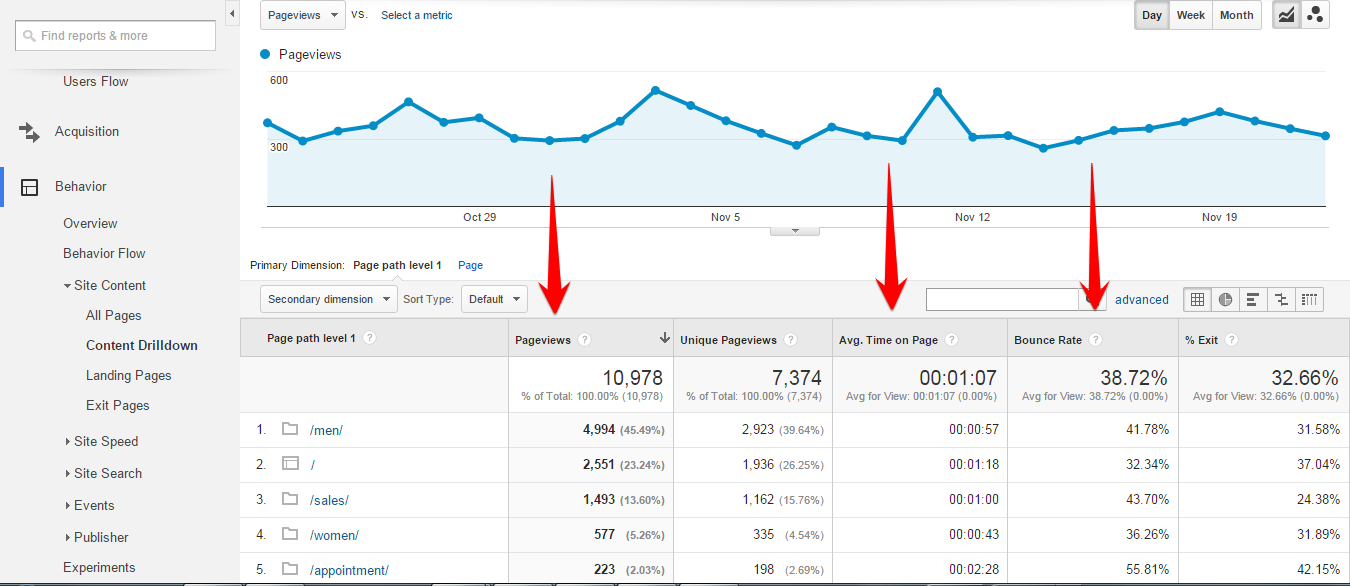
Delve into Google Analytics to determine which content is producing the best results. Click on Behavior>Site Content>Content Drilldown. To find the best results, sort by different factors such as Average Time on Page, Bounce Rate, and Pageviews. With this information, create content that is targeted to the user, rather than content that you want to read. Your goals for creating this content are to increase Average Time on Page, decrease Bounce Rate, and increase Pageviews.


Focus on Your Niche


It's a sad fact that the Internet is full of content that shouldn't even exist. This content either already exists elsewhere and is simply reposted or doesn't provide any real value. Most people don't see 99% of this useless content because it doesn't appear anywhere near the top of SERPs.


To avoid having your content lost in that pack, create content that stands out, is unique, has a distinct voice, and, most important, offers genuine value to readers.


The more specific you are and the more you focus on your niche, the greater your chances of establishing yourself as an authority in your field, whether your readers are looking for information or entertainment.


One business that has done this successfully is the rum brand Sailor Jerry (although this example isn't specifically about content marketing). The company hosted a marketing event in Brooklyn at which they gave away a free shot of Sailor Jerry to every fan who was willing to get inked permanently with a Sailor Jerry tattoo. This created a lot of brand exposure for Sailor Jerry, but the real benefit was creating a stronger link with its loyal fan base.


While most of the fans of your brand probably aren't about to tattoo your logo on their bodies any time soon, there are nonetheless important lessons to learn here about building a strong connection with a focused and loyal user base, which is usually more effective than having superficial links to a larger base that is more general in nature.


Measure Your Results


Measuring the results of your content marketing efforts is one of the most important aspects of developing an effective content strategy. Churning out content without analyzing your user feedback is akin to having a phone conversation on mute. You need to know what your audience liked as well as what they didn't like, and why. Here are some of the most important metrics to understand.


Consumption Metrics


This is the first layer of information you can gather when people view your content. As previously mentioned, and as shown in the screenshot below, you get this data from Google Analytics by clicking on Behavior>Site Content>Content Drilldown. You can sort by different factors such as Average Time on Page, Bounce Rate, and Pageviews.


With this data, you can find answers to questions like these: Did you craft a blog post that brought on a huge spike in traffic? Did your users spend more time on a particular piece or genre of content? Did a piece of content garner a large number of comments or shares on social media?


google-analytics-consumption-metrics


Social Sharing Metrics


Sharing on platforms like social media can be a great metric for judging how engaged your audience is. Ask yourself what types of content are being shared, who is sharing, which platforms are being used, and, most important, what content is converting. Below are the steps for how to find what content is converting:


  1. Log into Google Analytics.

  2. Click on Acquisition>Social>Overview.


acquisition-social-overview-google-analytics


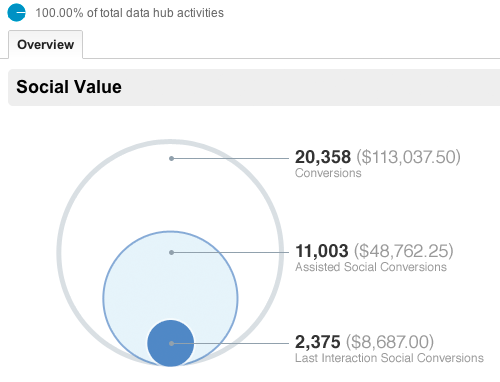
Then you will have a report similar to the one below (assuming you have goals set up):


social-value-google-analytics


Here, you have three important metrics:


Conversions: This shows you the total number and amount of conversions. They are from every traffic source, not only social.


Assisted Social Conversions: In order for an assisted social conversion to register, a visitor must have visited the social media site once, though they may have used another traffic source before the last part of the conversion.


Last Interaction Social Conversions: Visitors are attributed to this group if they came from social media and completed the assigned goal in the same session.


Once you have this data, it will yield insights into the style of content that needs to be created in order to get conversions. Also, you will be able to decipher which social media platforms are working best. (Take into account that some niches encourage sharing more than others, so compare your performance with those of competitors with a similar user base.)


Lead Metrics


If your content is part of a sales funnel, ask yourself which part of the sales funnel you are creating the content for. Content needs to be tailored to the specific audience at each segment of a sales funnel.


Your content could be either attracting or leaking leads, so monitor its performance and identify areas that could be improved to stop users from dropping out of the sales funnel and areas that could generate new leads. The quickest and easiest way to track leads is to use goals in Google Analytics.


The easiest type of goal to set up is a URL destination goal. Here are the steps:


  1. Log into Google Analytics.

  2. Click on Conversions>Goals>Goal URLs.

  3. goal-urls-google-analytics


  4. Then click the "Set up goals" button.

  5. set-up-goals-google-analytics


  6. Then click the "+NEW GOAL" button.

  7. new-goal-google-analytics


  8. Then select Template (shown in step 7 below).

  9. Then type in a description for your goal (shown in step 7 below).

  10. Then select Destination, and click the "Continue" button.

  11. goal-destination-google-analytics


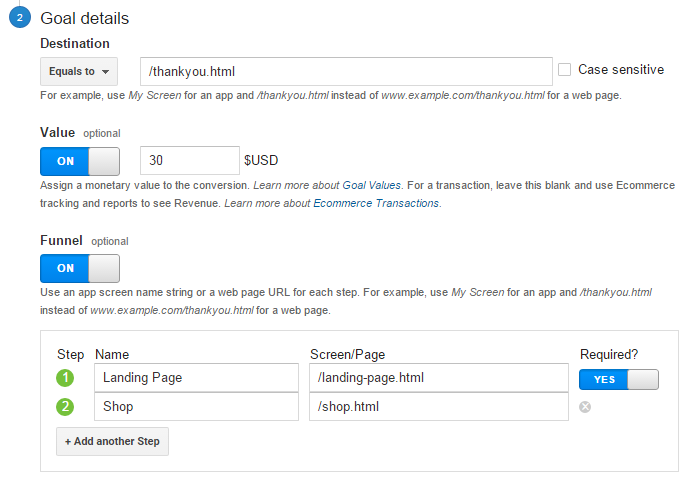
  12. In goal details, you need to add the URL of the goal you want to track. The whole URL is not needed, just the final path. For example, to track www.example.com/thankyou.html, input only /thankyou.html.

    Here, you will have two optional details:


    Value: It is possible to assign a value to the goal. For example, if you are selling a product for a specific price, you can add it here.


    Funnel: It is also possible to track a specific part of the sales funnel by adding it to the goal. For example, if you need to know how many people visit www.example.com/pricing.html before completing a goal, then add /pricing.html into the field.


  13. goal-details-google-analytics


  14. Then click save and that's it.

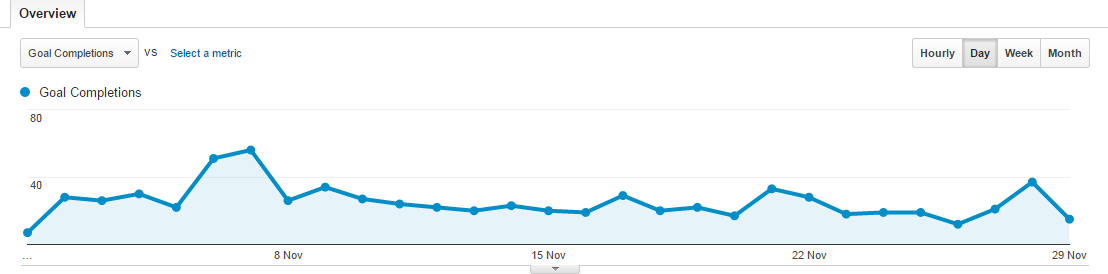
  15. To view goals once they are set up click Conversions>Goals>Goal URLs


goal-urls-google-analytics


You should see something like this:


goal-completions-google-analytics


Sales Metrics


For most businesses, content generation ultimately should boost revenue. Therefore, if your content strategy is revenue-based, you will need to find ways to measure the amount of revenue your content marketing has generated.


Below are the steps for how to find the amount of revenue your content has generated:


  1. Log into Google Analytics.

  2. Click on Behavior>Site Content>All Pages.


audience-all-pages-google-analytics


You should have something similar to this:


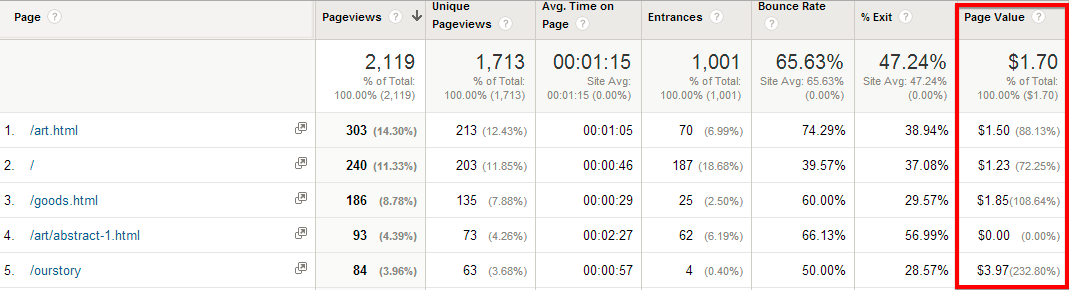
page-value-google-analytics


This will allow you to assign a value to a piece of content. If the content isn't performing as needed, then check out this great article by Neil Patel on how to increase engagement with content.


Now, here is a picture that visually represents the four content marketing strategy metrics outlined above:


content-marketing-metrics


Listen to Your Customers


While data analysis can be an immensely useful tool, it gives you only black and white figures on a spectrum that encompasses a lot of subtleties. Access the rest of that spectrum by really listening to your customers. Your customers need to know they are being heard on social media, so ask them for feedback and suggestions.


Also speak to other members of your staff to get a better understanding of the needs of your customers. Reaching out to your customers and responding to their feedback enables you to gather valuable data, and it also shows them that their opinion matters.


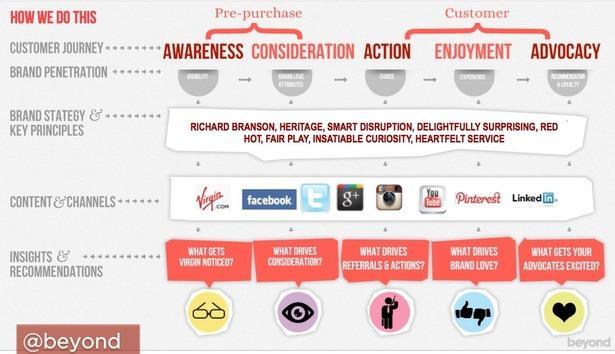
Virgin.com provided an excellent case study by showing how they utilized big data. They incorporated search terms used on the web, people being followed on social media platforms, and views and interests expressed online.


Using the data below, they dug deep and incorporated it into their communications, successfully giving audiences the right message at the appropriate parts of the customer journey. Find out more here.


Here is a flowchart of the results:


prepurchase-customer-jouney


Amplify Your Content


A sound content strategy and targeted content creation make up only the first part of the equation. The final part is amplification of the content.


To amplify your content, determine the places your audience is frequenting online, and then publish on those channels to reach them. You'll need to think strategically in order to identify all the resources available to you and then harness the power of employees, customers, and influencers to really amplify your content.


Conclusion


As you can see, creating a great content strategy isn't rocket science, but it can be quite challenging to implement. Expect to encounter roadblocks and go through lots of trial and error. Once you have a recipe for success, though, all you'll have to do is rinse and repeat to see the kind of audience growth you've always dreamed of.


About the Author: Brie Moreau is a Digital Marketing Analyst for DigitalAdvertisingWorks. DigitalAdvertisingWorks specializes in all areas of search engine optimization, has clients in many industries, and operates worldwide.