Lunes, Oktubre 26, 2015

Triggered Email: The Killer Conversion App

Marketers have been using “spray and pray” tactics for decades. The email equivalents are often called “blasts.” The idea: purchase a large list, push your message to the masses and hope some buckshot hits the target.

This form of email marketing is outdated and ineffective. It can backfire. Sending spam can tarnish your reputation and sever more relationships than it builds.

Email marketing that delivers results today reaches the right person with the right message to solve their immediate problem.

You aim more carefully. When a specific event or behavior occurs, a marketing automation system pulls the trigger and fires off an email. Conveniently, the practice has come to be known as “triggered” email.
Epsilon-triggered-emails

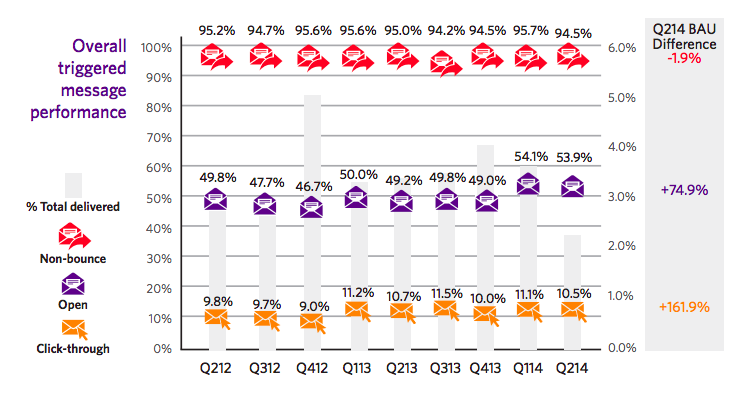
An Epsilon study from 2014 reveals triggered email messages average 74.9% higher open rates and 161.9% higher click-through rates than traditional bulk messages. (Image Source)

More automation… a more personal touch?

Marketing experts claim you can achieve new levels of personalization through automation. It sounds ironic. A robotic approach increases the personal touch?

The reason it’s true is you don’t simply automate the process. You use automation to understand buyer intent and engage with prospects based on their interests.

Your database is the engine room. The more data you put in it the more personalization you’re able to extract. Your objective is to perpetually update individual records with preferences, demographic, and behavioral information.

One approach is to ask for the information. You encourage prospects to update their records. Subsequent interactions employ prepopulated or progressive forms where users can update and add to the information you’ve collected.

Another approach is to gather behavioral data automatically. Your marketing automation platform will track who did what so you can respond accordingly with email.

Each touch point can become increasingly relevant to the individual’s journey to make your marketing dramatically more timely.

77% of online shoppers say they’re more likely to buy from a retailer when its
emails are personal. 82% of web shoppers say they’d likely buy more items from a retailer if its emails were more personally relevant.

Source: Listrak-sponsored Harris Interactive survey

Throughout the rest of this post, I’ll present a variety of ways to use triggered email programs and show you examples of each.

The idea is to nurture your leads

A very small percentage of first-time visitors to your website will make a purchase, but if you offer something of value, they may reward you with their email address. Essentially, you gain permission to market to them.

Of course, if you proceed to try to slay them with a hard sell, they’re likely to unsubscribe immediately. The better approach is to nurture the lead.

Email lead nurture programs give you opportunities to remain on your prospects’ radar and potentially convert them to customers. The approach tends to work best when you’re gentle. In most cases, you’ll aim to educate prospects by making offers and/or delivering useful content to help increase interest.

With lead nurturing, you have a variety of options for personalization and/or segmentation. A basic approach might simply include sending a pre-scripted series of emails.
autoresponder-emails

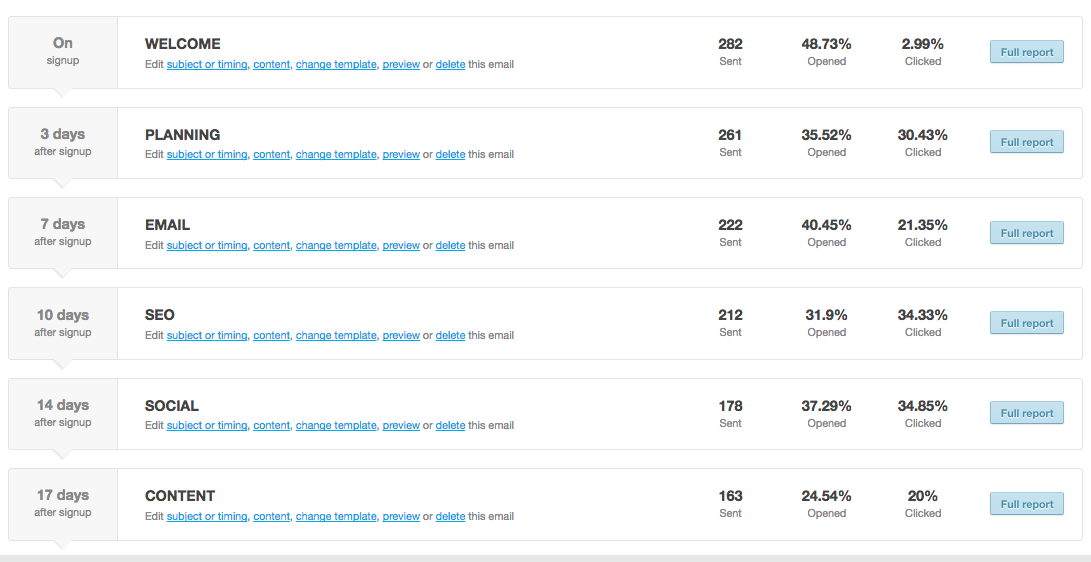
I recently put a new autoresponder series in place. New subscribers get a simple 6-part introduction to some of the most important elements of digital marketing. They’re invited to download free resources for deeper dives and learn a little more about my content marketing consulting and copywriting services.

A more data-driven approach might prescribe a set of emails based on the prospect’s behavior. For example, a visitor who watched a video might be sent a piece of content that makes for a practical sequel.

It’s conceivable a prospect spent a large amount of time in a specific section of your site indicating interest in a product line. Your nurturing sequence might deliver a special offer for the product or some form of “Did you know…?”
vero-behavioral-emails-email

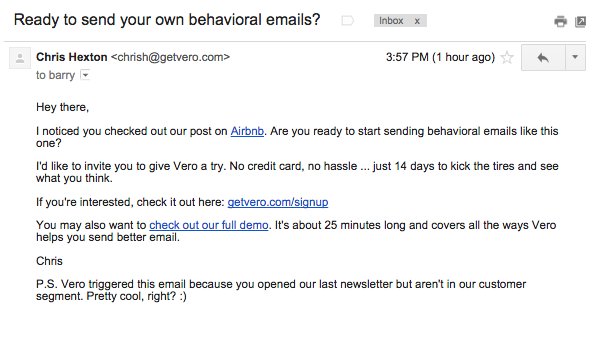
There’s nothing real fancy about this example, but note how Chris (the sender) is wise to my behavior on his company’s blog. His data shows him I’ve checked out a specific post, so he responded with a few offers: give Vero a try or watch a 25-minute demo.

eventbrite-get-started-email

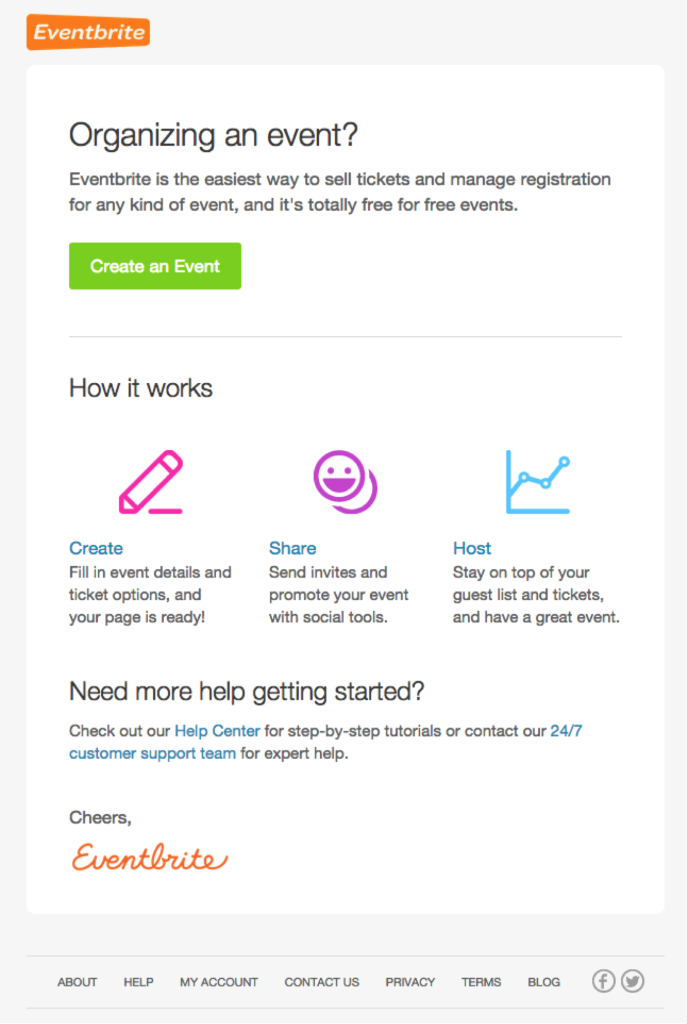
Lead nurturing of the “help get started” variety can be an effective tactic. The marketer’s hypothesis: when prospects understand how easy it is to use the service, they are likely to try it.

Abandonment follow-up email

When you nearly make a sale on an ecommerce site it can unfold into a successful outcome. The scenario in play here: a known contact clicks into a form, places a product in the cart, or nearly completes some desired action. In other words, the prospect stopped short of buying.

Thanks to marketing automation and integration with tracking systems, you can respond via email. The message will be based on actions your prospect did or didn’t take.

Messages triggered by cart or form abandonment may work to strengthen engagement and inspire the recipient to make another move. Email in situations such as cart abandonment should employ a friendly tone and offer helpful assistance.

For example, if someone abandons a white paper sign-up, you might send a message offering related pieces of content or offer similar content in different formats (e.g., a video or slideshow).

your-shopping-bad-misses-you-email

Note: (1) the fun tone and its attempt to be emotional, (2) the reminder that shipping is free and (3) the proactive call to action or “suggestive close.”

neiman-marcus-10-percent-off-email

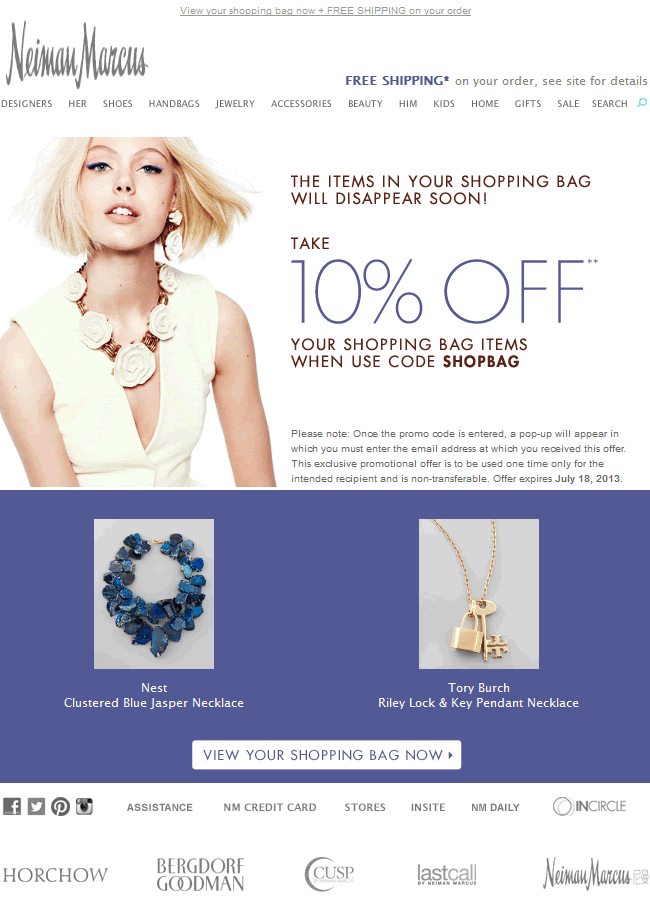
This abandonment email suggests some urgency and includes an additional discount. Photos of the nearly purchased items attempt to create abandoner’s remorse.

adidas-cart-email

Adidas cleverly toys with the customer’s competitive spirit: he hates to lose. Clearly, they’d like Andrew (the recipient) to come back or call. See, he also has the option to order by phone 24/7. Smart.

Welcome program email

New subscribers are more likely to open your emails. Sending personalized welcome emails creates a connection with first-timers, and hopefully, goodwill. Handled adeptly, welcome emails help establish a relationship and build trust.

Your emails might educate recipients about your value proposition, ask them to tell you more about themselves, and provide resources and helpful information personalized to address their interests.

Depending on the business, many savvy marketers are even moving beyond welcome messages to activation or onboarding programs that guide the prospect or new customer going forward.

Say you offer a free product trial. Inevitably, some prospects will sign up but not start their trial. In this scenario, you might set up an email to trigger after “X” days. Its messages could be, “We noticed you haven’t done (desired action) yet,” and then:

  • Here are the reasons you should try this out
  • Here is a great resource to make it easy to get started
  • Here’s a link if you want someone to call and assist you

realage-email

When a new customer opts-in at RealAge, a welcome email introduces him or her to their services. This email reminds the recipient he hasn’t completed the RealAge test and then offers a library of resources.

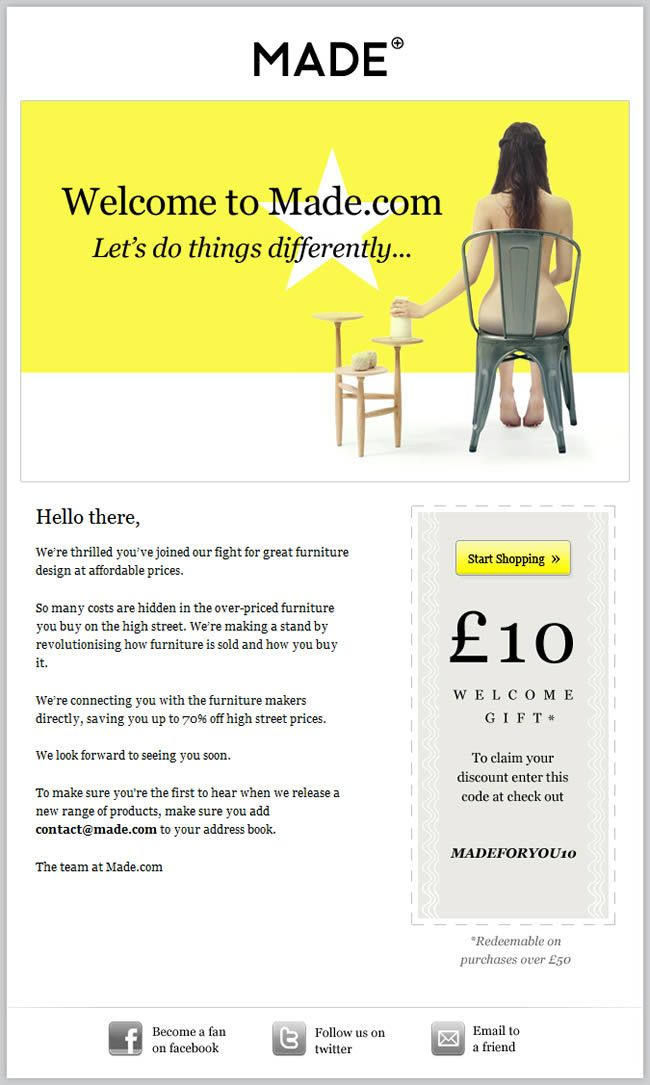
made-email

Made delivers a welcome gift and tries its hand at a form of “cause” marketing by writing, “We’re thrilled you’ve joined our fight for great furniture design at affordable prices.”

Reviews and testimonials email

Asking for reviews is a nurturing tactic—and then some. When it works, you can collect content, which may prove valuable in marketing programs outside of email. Of course, this type of “ask” could have a psychological appeal too, demonstrating to customers you care about their opinions (and perhaps you’re confident they’ll like your products).

As you collect positive reviews, you might include them in your content to help drive conversions. Also, with help from your marketing automation platform, you can use dynamic content to populate emails with testimonials in line with the prospect’s interest.

Reviews aren’t always easy to get, so don’t be boring with your request. Inject personality into the email. You might also attempt to be helpful with links to: customer service information, how-tos, FAQs and so forth.
the-body-shop-email

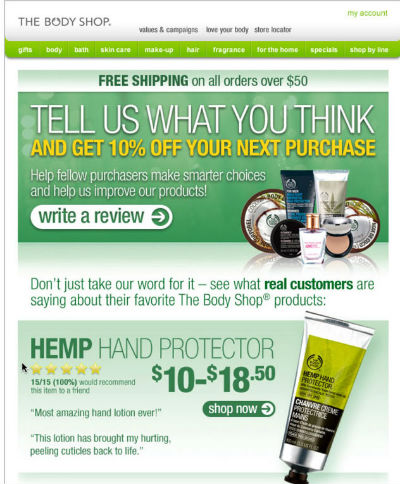
A smart play from The Body Shop: while soliciting reviews, they (1) provide an incentive for doing so and (2) showcase reviews from other customers.

Special occasion email

Special occasions are ideal triggers for sending email. Of course, you can look at special occasions two ways.

The first and most obvious are your customers’ special occasions: birthdays, anniversaries, holidays or important milestones in their lives. Second, the occasion being celebrated could be your own—an anniversary for your company or for the customer’s use of your products and services.

Of course, you need to put notices such as these into proper perspective. The one-year anniversary of a customer running your software may not be perceived as special. Your challenge is to make it special.

Be creative. Commemorate the occasion in a special way with a gift or offer that is perceived to be worthy of celebration.

Have fun with emails such as these taking care to make the extra touch points complement your nurturing and retention efforts.
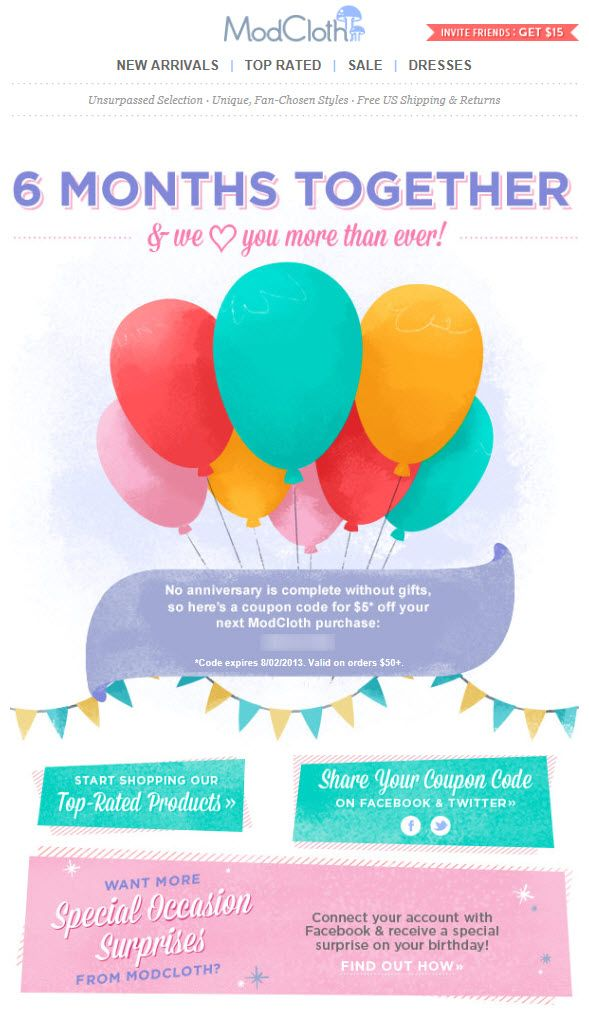
modcloth-email

At the six-month mark, ModCloth tells its customers they’re loved more than ever, marks the quasi-event with a coupon offer and encourages them to share the savings with friends via Facebook and Twitter.

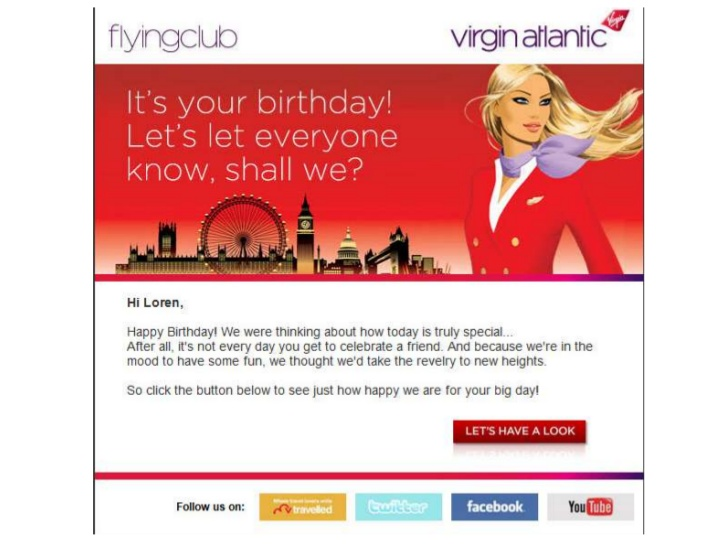
virgin-atlantic-flying-club

Known for going “extra miles” in creative ways, Virgin Atlantic not only recognizes your birthday, it offers to help you “take the revelry to new heights.” I don’t know where you land by clicking the “Let’s Have a Look” button, but I’m guessing it’s high above an exotic destination.

You may have to ask for a date

In some cases, the nature of the business may make it simple for you collect birthdays and other special occasions. In others, you may have to ask for it. Consider trying:

  • A progressive form approach
  • A special request in welcome or nurture emails
  • A survey

When asking for a birthdate or any type of personal information, explain to the subscriber they’ll be rewarded for complying.

Re-ordering email

Do you have a large product line or offer a multitude of optional services? Will customers need to replenish supplies at regular intervals or order per season?

If so, automating email appropriately can inspire additional sales, thereby increasing lifetime customer value. Consider some of the following ideas:

  • Delivering new product updates to business clients (e.g. software)
  • Seasonal product order reminders (e.g. calendars)
  • Updates for items that were out of supply (e.g. clothing)
  • Refill orders (e.g. foods, ink cartridges)

Sending seasonal messages enables you to maintain a more continuous dialogue with customers without creating additional work for sales people. It also provides a convenient opportunity to thank patrons for their business.

toner-email

Low on toner? Here, we’re not talking about laser printers, but a product from Annemarie Gianni. They claim if the toner spray has become a part of your everyday aromatherapy routine, your supply may need replenishment.

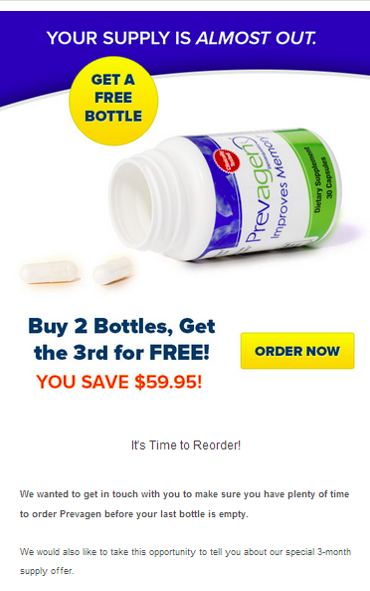
Prevagen-reorder-email

This re-order email from Prevagen is sent 10 days before the item purchased is scheduled to run out. If the order is not placed, they send a reminder email 10 days later.

Smart ideas for more effective reminders

  • Build replenishment emails around a standard purchase cycle
  • Go a step further in personalization by calculating your customer’s average re-order timeframe
  • A simple reminder may be effective for loyal customers
  • Consider discounts if the customer does not re-order
  • Includes details of what they purchased previously, a product image, reviews, and a URL for re-ordering
  • If your product itself isn’t consumable, there may be parts or accessories that are
  • Send your frequent buyers incentives to refer friends
  • Deliver content to help readers understand the benefits of continuing to use your products
  • Offer related products
  • Personalize the messages creatively and in useful ways

Transactional email

Ecommerce or otherwise, you gathered an email address based on a transaction—even if customers merely traded their email for a document.

Savvy email marketers follow-up on transactions of every sort, be they order status receipts, service request updates, shipping notices or confirmations.

Understand, the timing of the delivery is critical. Your customer should never have to wait. The good news is your marketing automation platform enables you to trigger the emails immediately.

Don’t settle simply for a branded transaction message. Share some love in the form of content that delivers value, such as:

  • Product usage tips
  • Answers to frequently asked questions
  • Delivery tracking information
  • Links to community forums
  • Invitations to connect via social networks
  • Requests for feedback

Of course, you should focus on the transaction first, but you can also use the emails to cross-sell and upsell products and services. Set up your application to populate the emails with information specifically related to the buyer’s purchase and/or preferences.
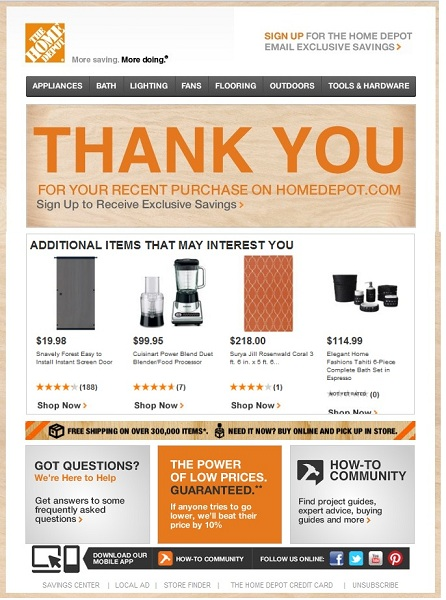
home-depot-thank-you-email

Home Depot packs a lot of resources they believe to helpful in this thank you email including product suggestions, links to FAQs, a low price guarantee, a how-to community, and an invitation to download their mobile app.

threadless-email

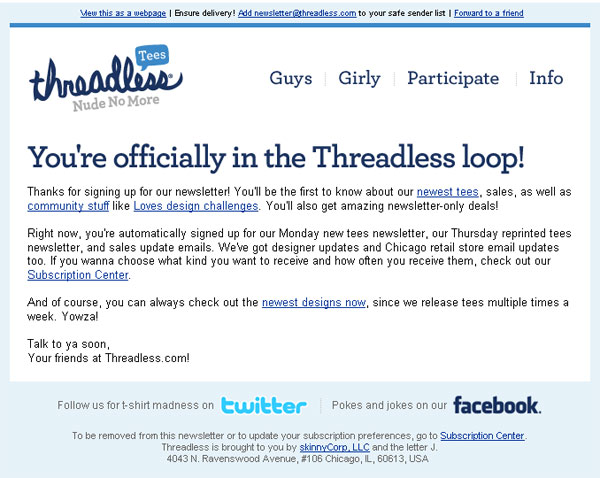
Threadless treats an email for new subscribers as an opportunity to promote product, community stuff and “amazing newsletter only deals.”

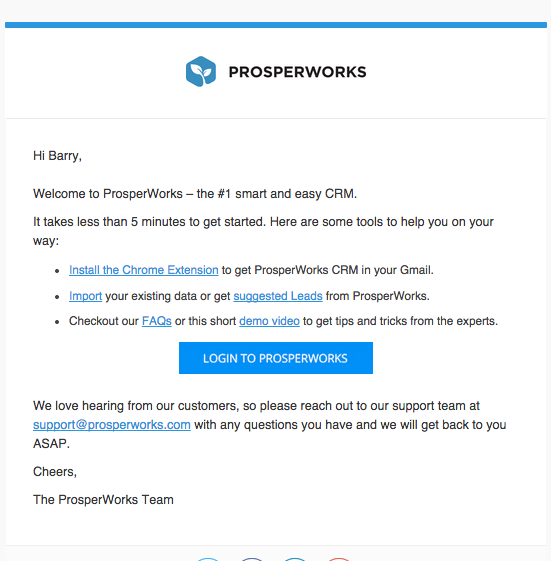
prosperworks-email

The transaction here was merely a free trial. ProsperWorks is wise to recognize this and sent me a welcome email highlighting tools to help get me get going with their CRM solution.

Lifecycle email

Customers need different content at different times in the buying cycle. Consider segmenting campaigns relative to phases in the relationship with email based on the individual’s history with your company.

Messaging might change throughout a customer lifecycle.

  • Interested prospects are sent welcome messages, educational content, or incentives to buy.
  • Engaged prospects are sent invitations to events, targeted content based on website activity, price information, customer case studies.
  • Lapsed or disengaged prospects are sent surveys, incentives to revisit website, promotions.

dropbox-onboarding-email

Dropbox encourages users to install Dropbox on more computers and also lists the benefits you get by doing so.

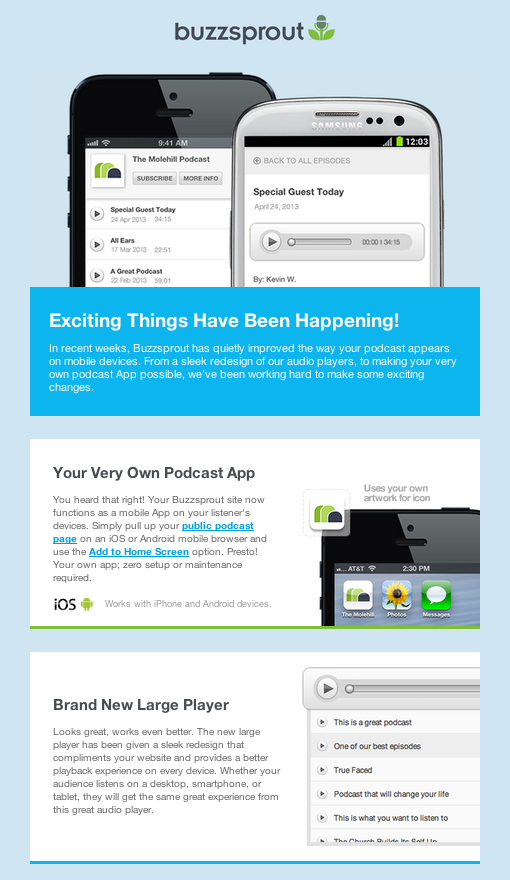
buzzsprout-email

BuzzSprout sent this email aiming to drive inactive users into action by informing them about design updates.

It may be time to pull the trigger

Triggered email continues to make-up a low percentage of overall email volume.
But even at a relatively low volume, well-conceived programs can make a significant mark on sales generated from email marketing.

Triggered campaigns can run on autopilot and continue to generate revenue over long periods of time. While you’ll need to invest in the initial setup of each email, once automated, triggered emails generate new levels of ROI.

About the Author: Barry Feldman operates Feldman Creative and provides clients content marketing strategies that rock and creative that rolls. Barry has recently been named a Top 40 Digital Strategist by Online Marketing Institute and one of 25 Social Media Marketing Experts You Need to Know by LinkedIn. Visit Feldman Creative and his blog, The Point.

Biyernes, Oktubre 23, 2015

Using Kissmetrics to Find Out If LiveChat Is Affecting Conversions

Live chat. If you don’t already have it installed on your website, you’ve undoubtedly spent hours contemplating and debating with your colleagues. But does it actually work at increasing conversions? If you don’t have an analytics tool that provides this data, you’re left in the dark. Kissmetrics is here to help.

Kissmetrics includes an integration with LiveChat. This integration can give a lot of different details; such as if/when a person sees a pre-chat survey, if it is filled out, when a chat is started, etc. Today, we’ll focus on using Kissmetrics to tell if customers that use LiveChat have a higher likelihood of converting. Of course, you will have to be using LiveChat to get any data.

Does Chat Increase Conversions?

Each business is different. I’m not going to make a blanket statement like “chat doesn’t increase conversions”. What works for some companies may not work for others. Since you have Kissmetrics, you’ll know what works for your company. Here’s how:

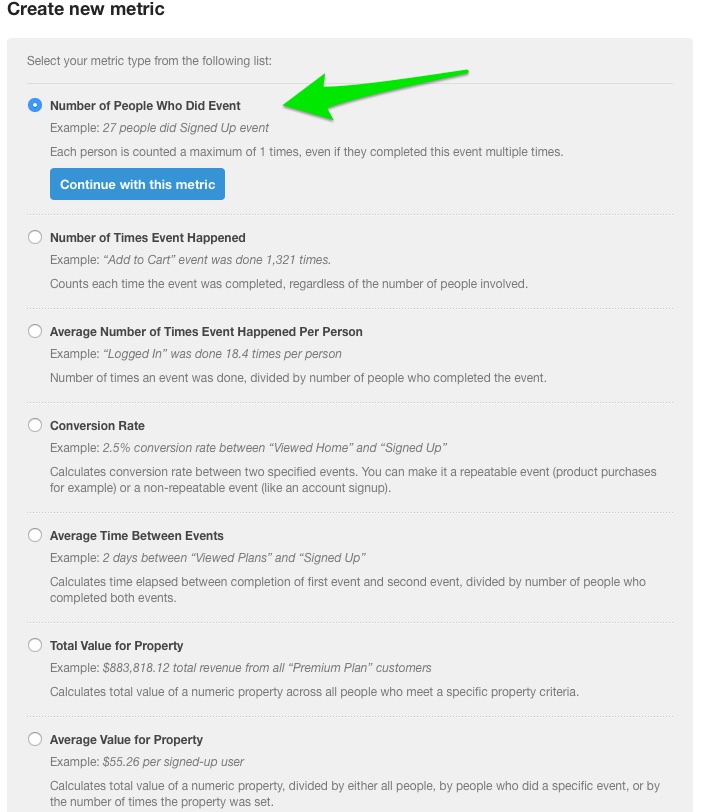
Using the Kissmetrics Metrics Dashboard, create a new metric. Select the option Number of People Who Did Event.

kissmetrics-number-of-people-who-did-event

Enter the name of your new metric and select the event you’ll be tracking. If you’re in SaaS, it may be something like sign up or demo requested. If you’re in eCommerce, it would be purchased or created account. Remember, we’re tracking conversions here, and you’re using LiveChat to see if it moves some needle. The needle you’re trying to move is the event you’re tracking.

For filter property, select Performed Chat. This will automatically be in your account once you connect LiveChat to Kissmetrics. Save your metric and you’ll get the data.

metric-details-kissmetrics-set-up

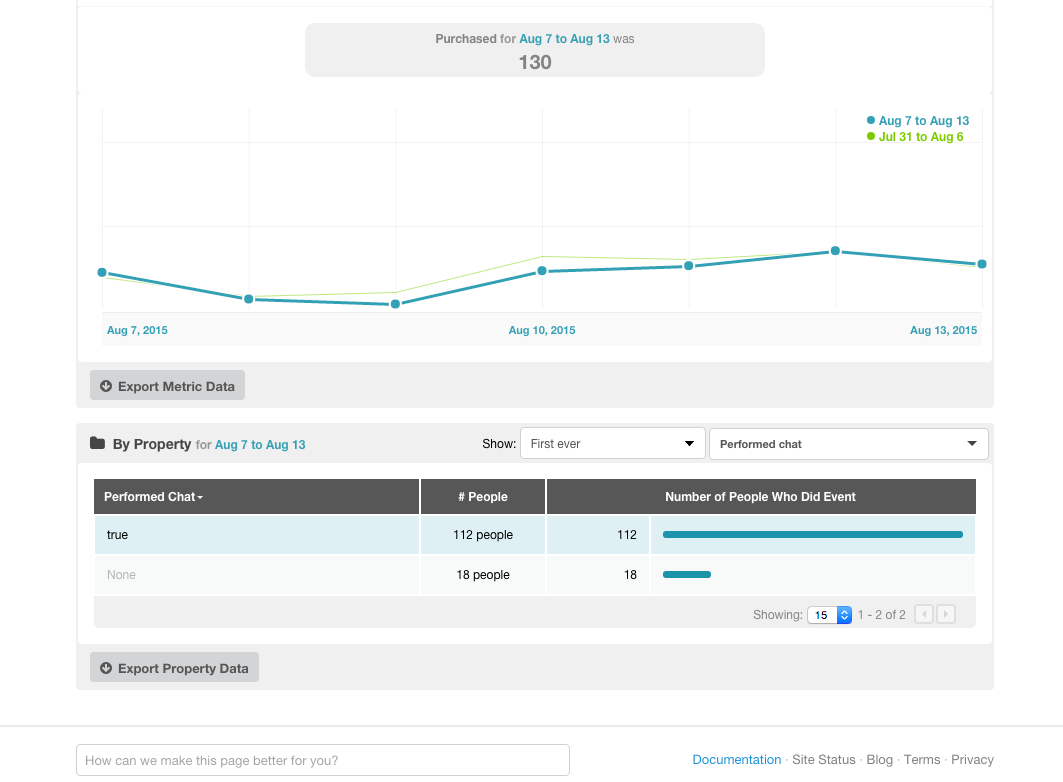
And you’ll get your data. True means they did chat, None means they did not. What you see below is just hypothetical data. Your results will vary.

livechat-kissmetrics-performed-chat

If you see that there is little effect, don’t give up on LiveChat yet. Here are some ideas of what to test in LiveChat:

  • Change your greetings – LiveChat allows automated greetings to popup before a visitor even types a word into the chat box. Do some automated greetings get better responses than others?
  • Compare chat agents – You may have 5 people that handle LiveChat. Does any one of them convert visitors better? With this integration, you can see the number of conversions each agent has delivered.
  • View the chat transcript – This one is a little more high-level and requires some manual work. But if you’re really curious, you can go back and view each transcript for the ones that converted and the ones that didn’t. The data is all within Kissmetrics. Here’s what you’ll need to do:

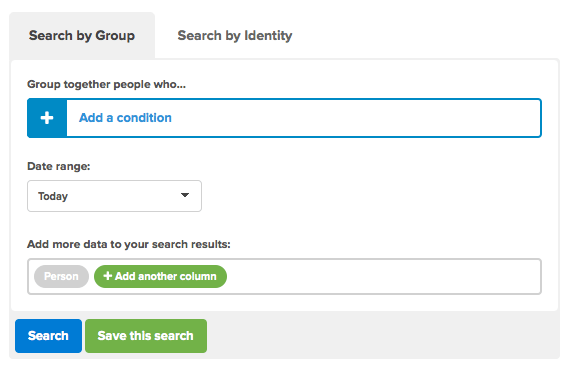
Use People Search to Find People Who Fit a Specified Criteria

livechat-kissmetrics-performed-chat

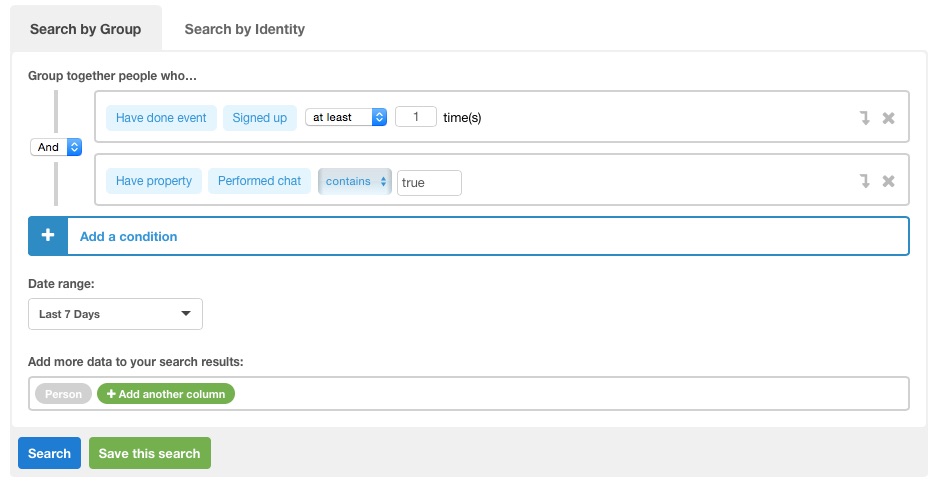
You’ll want to find the people that have done the event you’re using in the Metric. This can be signed up, purchased, etc. Next, find the people that have the property Performed Chat and it should contain true. You can make the date range whatever you’d like.

With this, you’ll find the people that signed up (or purchased, created account, started trial, etc) and have chatted. Click Search and get your list of people.

livechat-kissmetrics-people-search

Once you see the people, you can go back into LiveChat and see the chat transcripts. How did the agent manage to get the person to convert?

Compare these against the people that didn’t convert. To do that, just change the Have done event to Have not done event. This will show the people that have chatted but have not converted. You can then compare the transcripts of those that converted and didn’t. Compare the language and conversation and how they were addressed during the chat. You may be able to pick up some good nuggets on what triggers conversion and what doesn’t.

Recap

Here’s the takeaways:

  • Using chat on websites is a debated topic. Does it have any effect on conversions? Each website is different, and you’ll need to test it to see what effect it has for you.
  • Kissmetrics includes an integration with LiveChat.
  • Using Kissmetrics, you can see what effect LiveChat has on conversions. You’ll be able to compare conversions for people that used LiveChat and those that didn’t.
  • Go beyond just seeing if chat increased conversions. Look at chat transcripts, test different greetings, or see if one person on chat is better at converting users. You can also view chat transcripts to see if there are any trends in what questions people commonly ask.
  • If you’re already using Kissmetrics and LiveChat, you can view the instructions for integrating the two.

Questions? Feedback? Want to say hi? Put it in the comments.

About the Author: Zach Bulygo (Twitter) is the Blog Manager for Kissmetrics.

Increase Your AdWords ROI With These 5 Tips

If you’re a diehard AdWords campaign manager like me, then you’re always searching for an edge you can use to raise your rates of return. I have found dozens of different ways to do this over the years (by looking at literally hundreds of different campaigns), and today I would like to share five of the most commonly missed techniques and features, as a contribution back to the Kissmetrics community.

While the most substantial way to increase your campaign’s ROI still involves increasing your account’s overall average keyword quality score (as quality score and cost per lead metrics are directly correlated), your level of success in AdWords is heavily reliant on whether or not you have first acquired all the proper ingredients to create an overall bigger pie for yourself.

1. Target Consumers by Income Level

Half the battle with PPC has to do with understanding who can afford your products or services so you can properly target them.

I have outlined below the process for discovering which income classes are purchasing from you, at what rate, and how to make adjustments to target these people exclusively and increase your campaign ROI.

How Income Filtering Is Done in AdWords

While targeting B2B clients via PPC, we really can only guess who our customers are by what they type into Google (at least until Google rolls out their customer list targeting features). In B2C, however, it is rather simple and required in most cases to derive a healthy return from campaign spending.

There are actually two ways to segment – by income level – the traffic you are purchasing via the Google AdWords ad interface, one manual and one automatic.

The Manual Way

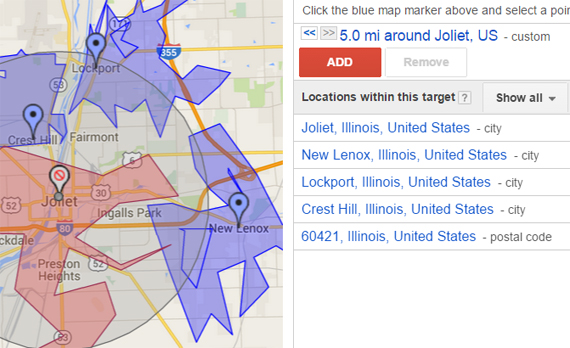
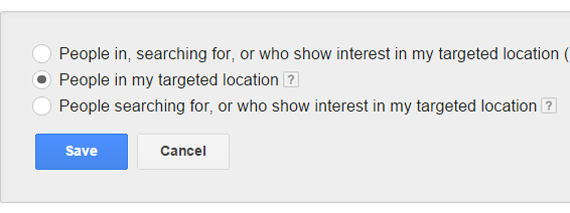
If you are a local business, I recommend going through all your individual neighborhoods and townships and making a list of all the places in your area likely to bring in profitable customers by type and category. You should manually select each area individually via Google’s location settings. Also, ensure your location targeting settings are set at “people in my targeted location” to prevent leakage.

google-adwords-manual-locatoin-targeting

google-adwords-Manual-location-targeting-in-my-location

The Automatic Way

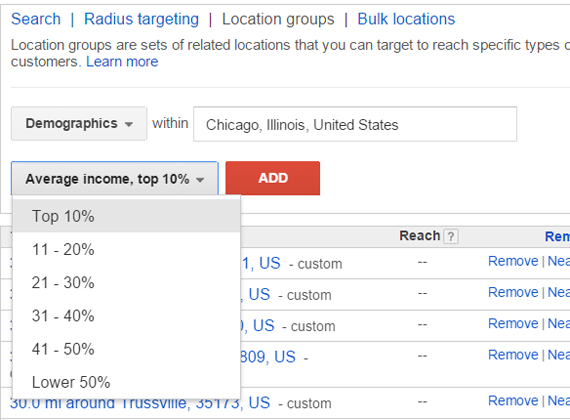
For national campaigns, you can break out your targeted audience by income bracket easily via the campaign’s “location groups” settings menu.

google-adwords-targeting-income

Tiered Bids by Income Bracket

For most products and services, there will be income classes that are more profitable than others, so we can’t automatically eliminate any one income class target right away.

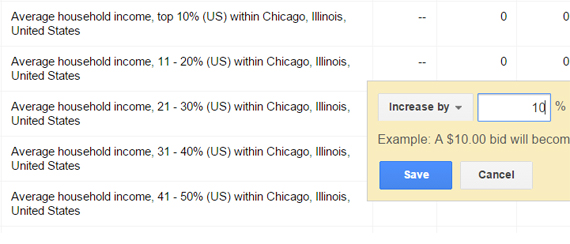
Break out, test, and review conversion numbers for each income bracket individually to make decisions about whom to target, and compare this with what your CRM tells you after the fact to make your front-end bid adjustments.

income-targeting-adwords

Set Bids for Each Income Bracket Individually and Only When Statistically Significant Data Is Available

Don’t Forget about Remarketing

Remarketing campaigns that lump together audience members from all traffic sources can also be cleaned up significantly by filtering out unprofitable income brackets. There is no need to market to those cheap contest entry contestants from your latest trade show; they are likely not worth the clicks.

How Income Bracket Filtering Really Helps You Make Money

Spending the time to figure out who is buying doesn’t just affect your campaign ROI on the front end. When salespeople spend less time providing quotes (over the telephone and/or in person), that will reduce not only overhead but also strain on the salespeople.

Similarly, when salespeople spend less time chasing bad leads, that will allow you to divert more of your sales department’s budget to better, more affluent salespeople, which will then translate into a higher lead-closure rate.

2. Try Dynamic Keyword Insertion in Ad Headlines

DKI, or Dynamic Keyword Insertion (which automatically matches your ad headlines with the user’s search query), is a highly controversial topic among us Google account managers. While it can often bring in the worst of leads, it does usually bring in many more leads overall, especially in cases where tightly grouped keyword sets are hard to assemble.

The method for making DKI work extraordinarily well for your business lies in figuring out how to disguise them. DKI that actually works tricks the web searcher into thinking they are normal, highly relevant ads. If there is no false reality created, then it’s not worth your time to implement.

dynamic-keyword-insertion-3

This DKI ad example looks fairly non-generated but could be even more convincing with a stronger “Description Line 1.”

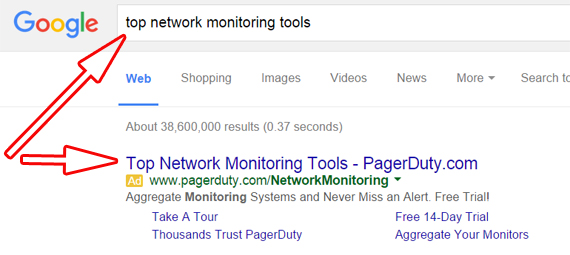
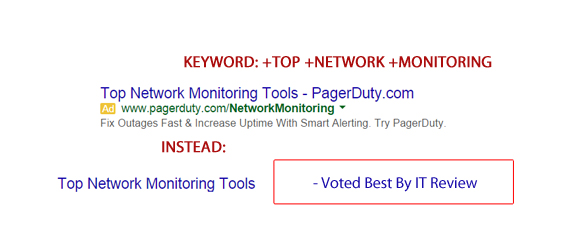
dynamic-keyword-insertion-6

Here is a better DKI ad example. General search intent around “top network monitoring tools” is met with an offer to view what looks like an industry-reviewed product.

This ad would work fantastically well for most of the long tail traffic generated on this ad group’s keyword.

Proper keyword selection and match types work hand in hand with DKI ad copywriting to make DKI ad strategies highly profitable.

How to Decide If DKI Should Be Used on Your AdWords Accounts

Rule #1 – Do not use DKI on any ad group that is not converting well. DKI is known to make poor converting ad groups perform even worse.

Rule #2 – Evaluate all your AdWords ad groups individually when evaluating whether or not DKI will work for them.

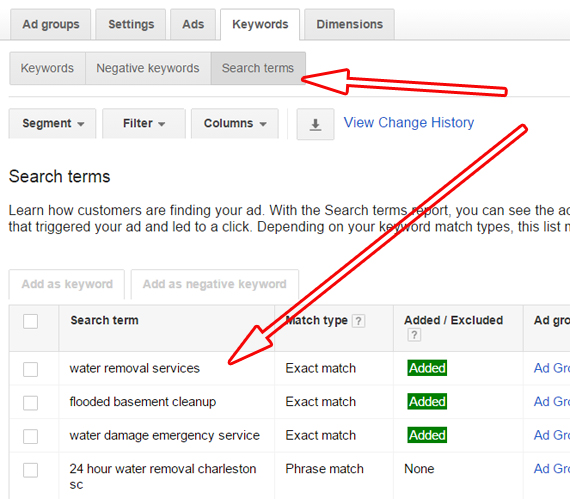
If the ad group you are evaluating is already converting well and you wish to gain a nice boost in converted clicks, then you should check to see if there is a high disparity in the way people are searching for your products or services in that ad group by monitoring your keyword search term reports from within your keywords tab.

dynamic-keyword-insertion-4

If you find there isn’t a way to effectively target all common search queries with a laser-targeted, static-based ad, then it is time to run a DKI split test on that particular ad group. (If there is indeed an alternative way to target each keyword individually and effectively with a static headline, then it is time to silo the keywords in question into new ad groups, as they will actually perform better that way.)

Testing DKI on Applicable Ad Groups

Landing pages used in conjunction with DKI-generated PPC traffic will often not behave the same as landing pages handling traffic from static ads, so pay particular attention to your engagement metrics when you initially make the switch to DKI. It may be that you will have to set up a whole new landing page type to convert your DKI traffic well.

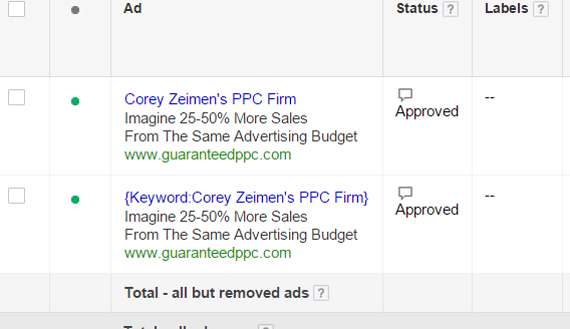
dynamic-keyword-insertion-1

Example DKI Ad Split Test

dynamic-keyword-insertion-1-5

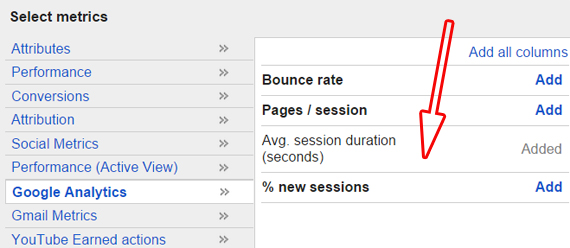
Quickly Monitor Engagement Metrics from within AdWords by Modifying Columns

dynamic-keyword-insertion-modify-columns

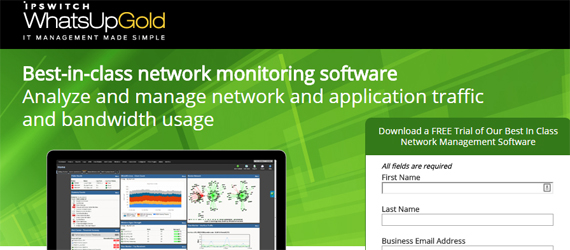
In general, landing pages with less copy and simple forms work the best with DKI.

whatsupgold-landing-page

Example of a Landing Page That Will Convert Well with DKI Traffic

Mirroring DKI on Your Landing Pages

Once you have found the best DKI headline and supporting description strategy to grab the attention of as many prospects as possible and maximize qualified traffic to your landing pages, it’s time to replicate this strategy in each of the ad group’s landing pages in order to maximize conversion rates on that traffic.

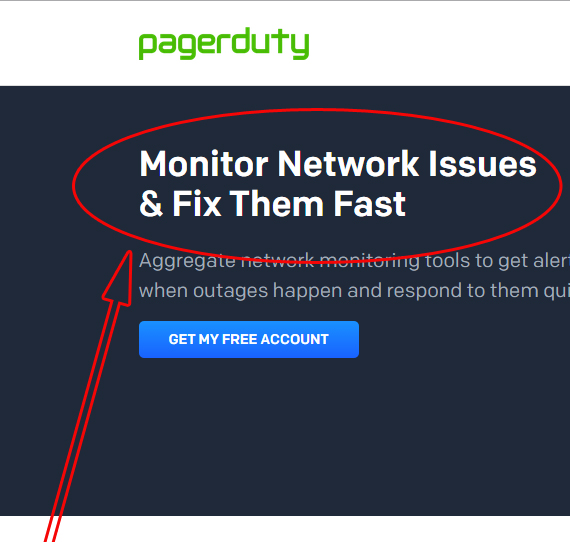
With a little bit of scripting, we can automatically pull the user’s search query from our referrer and plant this as the h1 headline on each of our ad group’s specific landing pages.

pagerduty-landing-page-headline

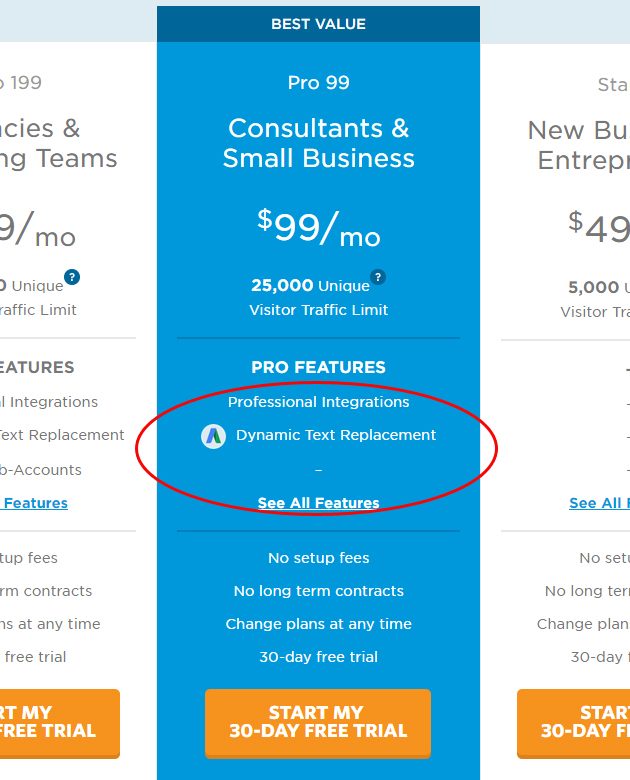
Third party services, such as Unbounce and others, have this as a premium feature if you are using outside technology as a pre-made solution and to simplify your life (which is well worth the extra money if you are already using it).

unbounce-dynamic-text-replacement-pricing-page

3. Employ a Reminiscent Remarketing Display Ad Strategy

I don’t know how many times I’ve seen people using remarketing display ads in a way that creates a huge disconnect in the way people identify with the solutions they offer.

2wheel-remarketing

Example of a Remarketing Ad Done Wrong

Your Goal Is to Meet Users with Your Remarketing Display Ads

Remarketing display ads are there to remind the user of the copy they read on your site or the conversation they had with your sales staff. With the proper amount of follow-up, you can ensure a commitment is made.

Users will have multiple uninitiated conversations with themselves, which is key for effective remarketing results.

Here is a realistic and entertaining remarketing example sequence your visitors should follow:

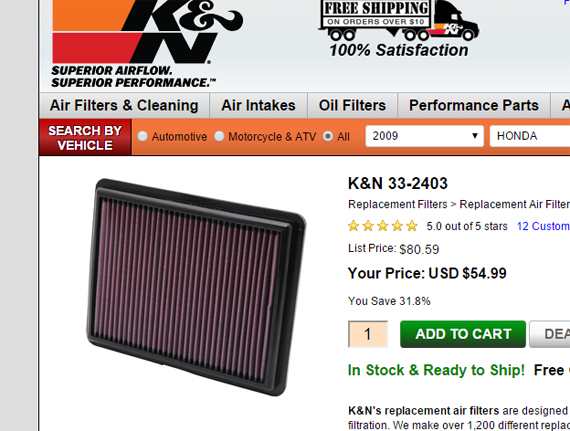
k-n-air-filter

Visitor first browses K&N’s site for a high performance air filter for their vehicle.

k-n-advertisement

Visitor sees the above ad and thinks, “Okay, this ad makes me want to stop reading the site I was on. I definitely remember the benefits of the product they listed. I am, however, not motivated enough to get my credit card out of my wallet right now, but maybe later.”

k-n-air-filter-advertisement

Visitor next sees this ad and thinks, “There is the air filter I want to buy for my Honda. Heck yes, I want my car to run better. Maybe I will buy it when I get home.”

k-n-air-filter-ad-chevy

Visitor then sees this ad and thinks, “Wow, I have been telling myself I was going to buy this thing for a while now, but 27 more horsepower, really? Okay, K&N, you got me.”

Segmented Remarketing Works Better Than You Think

By segmenting your landing pages and remarketing message sequences as already mentioned, you will make a much stronger impression on your visiting audience as a whole.

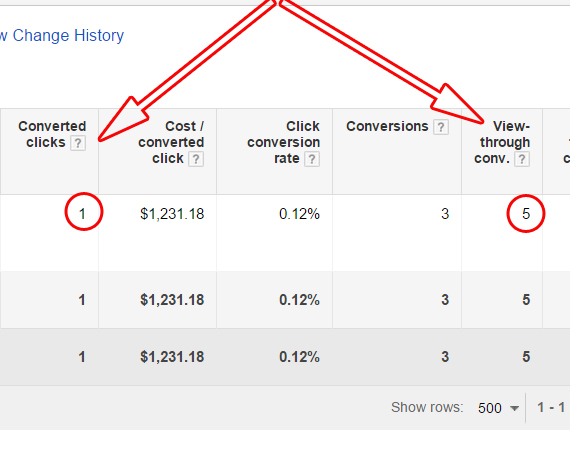
Take a look at your view-through conversion reports in AdWords after you finish siloing your remarketing campaigns and see how well your view-through conversions are trending. If executed properly, view-through conversions will have spiked sharply across the board for all your remarketing related ad groups.

view-through-conversions-adwords

Again, Modify Columns to See Your View-Through Conversions Reported Directly within AdWords

How to Properly Calculate Remarketing Follow-up Length

Leads that do not result in an immediate close almost always require a good remarketing strategy to generate ROI. The only real question to ask yourself is how long you should follow up with visitors.

You can check your CRM sales reports and/or your Google AdWords and Analytics sales time lag reports to find the length of cookie window you should be setting for your remarketing campaigns.

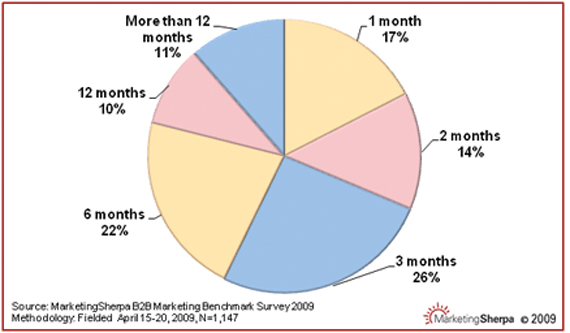
The following data and screenshots should put things into perspective regarding how long you should really be setting your AdWords remarketing list cookie windows:

average-b2b-sales-cycle

The average B2B sales cycle length – Image Source

adwords-conversion-time-lag-report

Example B2C AdWords Conversion Time Lag Report That Shows Most Revenue Coming in Much Later

For B2C, the general rule of thumb is that the higher the item ticket price, the longer the sales cycle.

You should set your cookie windows in Google Analytics to match the length of time it takes your slowest customers to convert.

remarketing-follow-up-window

Remarketing List Follow-up Window Setting Location in Google Analytics

Summary

As with everything in marketing, ad frequency is more important than reach; Muhammad Ali did not beat his opponents with one punch! This is a game of subtle subliminal messaging. We are playing with our prospects, and it works well only if it’s incrementally spaced out like other branding or direct response campaigns.

Leveraging These Remarketing Results

Once you have set up your hyper-targeted remarketing campaign and know it’s working well for you, it’s time to leverage what you have built.

Replicate every ad you have made in every allowable ad size Google AdWords accepts. If you are not aware, Google allows up to 17 different ad types. Only half of them are used by most advertisers so that gives you a great competitive edge and sharp discount if you use them.

adwords-supported-ad-formats

Google’s 17 AdWords Display Ad Sizes

Animated Ads

If you have created ads in all the sizes Google allows but still wish for an even greater response, try animated varieties. I have seen CTR lifts of two or even three times on remarketing campaigns when an animated and/or interactive ad strategy was employed over a static one.

You’re Not Done Yet

Once everything is established, it’s important to mix up the ads so that they will continue to be noticed, as with Facebook Ads. Once your prospects have viewed your ads seven or more times, each additional impression will be less effective.
Produce and swap out new remarketing ads every quarter to ensure the maximum response from your new remarketing strategy.

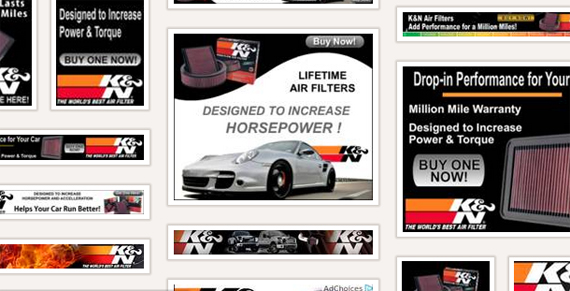
k-n-ad-groups

Check out K&N’s diverse set of ads found on Moat.com for inspiration; they have a really good example of what you can do to mix up your ad strategy.

This Is a Lot of Work

Because most other advertisers in the display advertising space run ads for thousands of unique products or services together, custom designed ads and manual tagging are a great edge over the competition.

Marketers who do what everyone else is doing get everyone else’s results.

4. Turn Off Automatic Audience Targeting Expansion

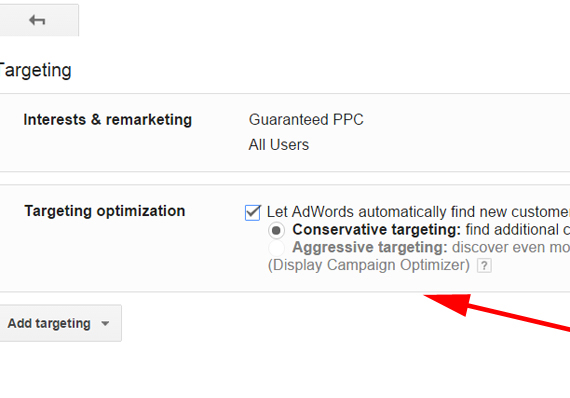
Some of you are in such a hurry when setting up your new AdWords display campaigns that you don’t notice Google has taken the liberty of deciding who your customers are for you.

automatic-audience-targeting-adwords

When setting up any Google display campaign with a predefined audience list as a targeting option, Google gives you the choice (selected by default) to automatically expand its reach past the finite list given to them. While I have seen this feature of AdWords work successfully before, this feature by default likely won’t provide any value to your campaigns unless you are first giving them a huge audience list to work from.

If you are running new campaigns or smaller lists and make the mistake of leaving this default campaign feature on when creating your marketing campaigns, you will likely double or even triple your advertising costs without increasing the amount of revenue your marketing campaigns generate.

The only products I have seen work with automatic audience expansion are those with general mass appeal and/or extremely low commitment offers (think free).

culligan-advertisement-free-water-analysis

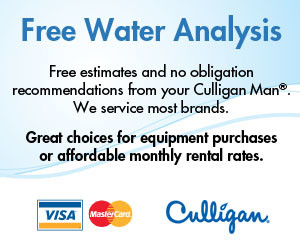
A Possible Good Ad Candidate for Automatic Audience Expansion – Maybe

5. Turn Off AdSense for Mobile Apps

Any good manager already knows about this one, but I wanted to include it just in case you haven’t checked into it yet.

For Google display campaigns, Google by default allows us to advertise on mobile apps unless we specify otherwise (thanks, Google).

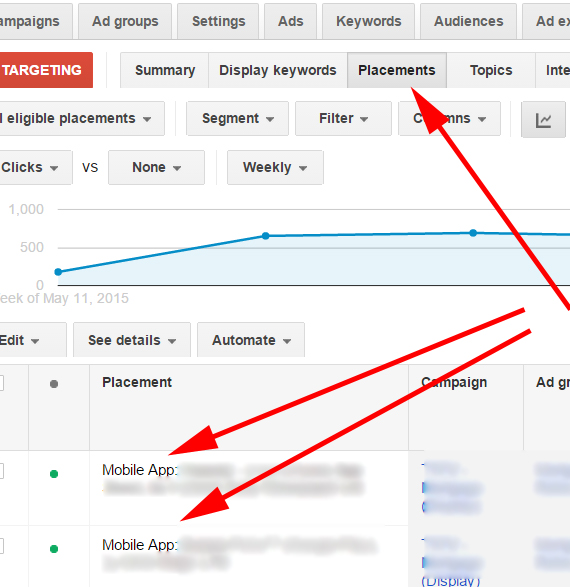
By checking your display campaign placements report today, you can see evidence of mobile ad clicks coming through your campaign if mobile app targeting has not already been deactivated in your account.

google-adwords-placements

As a rule of thumb, mobile app clicks almost never provide good quality leads because most people accidentally click the ads or are not in the right frame of mind to take commercial offers seriously.

There are two places you must look to deactivate these pesky display ad featured placements; make sure you check both of them to prevent any further mobile ad clicks from coming through to your display campaigns.

ad-group-campaign-exclusions-adwords

Though I haven’t personally seen AdSense for mobile apps traffic produce quality leads on any campaign I’ve worked on, I could see it working for advertisers offering other comparable mobile apps, since ad inventory is so inexpensive on mobile apps.

Conclusion

If you think you have overlooked one or all of these techniques, then go check your account right now. Even one of these practices can result in double digit changes in your campaign’s ROI numbers.

About the Author: Corey Zeimen, CEO of Guaranteed PPC, offers performance-based PPC consulting advice and execution that results in 25% more revenue or his work is free. He is currently accepting B2B and B2C clients.