
Miyerkules, Hulyo 29, 2015
Foreign crooks are laundering billions in London real estate
Criminals are laundering billions through London prime real estate but the British government is promising to get tough.


Tackle Marketing Automation to Drive Conversions
According to Aberdeen Group’s research study, “companies using marketing automation receive 53 percent higher conversion rates than non-users and an annualized revenue growth rate 3.1 percent higher than non-users.” Businesses notice the value of this technology and are taking advantage of its benefits to deploy successful campaigns.
Marketing automation helps companies increase workplace productivity by effectively eliminating repetitive manual processes with an automated solution-oriented substitution. Then, human error becomes less of an issue with these routine tasks.
Moreover, Gartner Research “predicts by 2020, customers will manage 85 percent of their relationships directly with companies without human interaction.” Thus, requiring efficiency in how we interact with our prospective clients online.
Marketing automation strengthens customer relationships, scales marketing campaigns, and gives businesses a competitive advantage. It makes it easy to integrate lead generation efforts to create a manageable sales cycle.
Save your company time and resources by automating lead nurturing programs and creating convenient drip marketing campaigns. Marketing automation does the habitual tasks, while your marketing and sales team can focus on more complicated projects.
Let’s explore the benefits of marketing automation, the strategies you can implement, and the results achieved from forward-thinking companies.
The Benefits
Based on the study “Marketing Automation Strategies for Sustaining Success,” 91% of successful users believe that marketing automation is “very important” to the general success of their marketing.
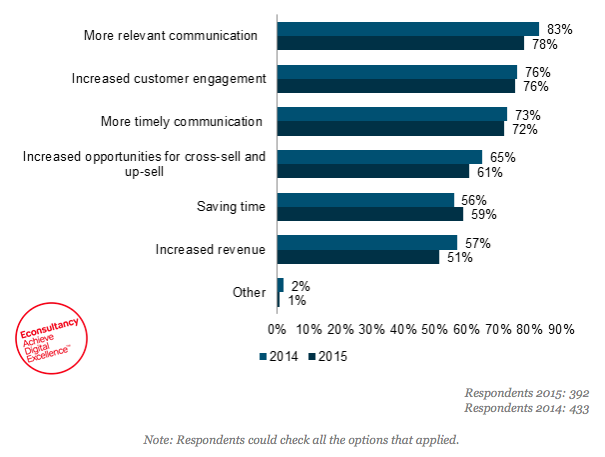
Companies perceive more relevant communication to be one of the main benefits of marketing automation, followed by increased customer engagement and more timely communication.
Marketing automation is similar to a nerve center, “combining the management of marketing efforts and sales across all channels from lead to close.”
Back in the day, a customer representative’s job duties included following up with all leads that entered the sales system. Now, marketing automation software can identify leads that are qualified and ready to be approached by the sales team.
This technology eliminates the time spent on unqualified leads. It brings valuable insight to help your team members understand the needs and wants of the customer. How did they learn about your services? How did they land on your website? Which email newsletters have they subscribed to?
Here are the results of a March 2014 study by Regalix, reporting a staggering percentage of B2B marketers experiencing improved lead management and nurturing from marketing automation:

Ever desired to align your sales and marketing goals? Well, here’s your opportunity. Marketing automation makes it easier for your teams to collaborate and focus on the customer life cycle.
As a result, you can create targeted buyer personas, content, and programs, leading to a more effective process for closing sales. If your desire is to maximize conversions through cross-selling and upselling opportunities, marketing automation reports offer analysis of customer data.
When customers are more informed–receiving the right information at the right times–they are more likely to spend more. Businesses mastering this process “generate 50% more sales-ready leads…[and] at a 33% lower cost per lead.” Therefore, companies receive higher revenues, while cutting marketing overhead costs.
Just because customers don’t purchase today, doesn’t mean they won’t ever buy your product or service tomorrow. Let marketing automation revitalize previous leads that have gone inactive. Through retargeting email campaigns, automation can periodically send informative content to leads that previously went cold.
The Strategy
Marketing automation streamlines your marketing activities, in order to turn visitors into loyal buyers. From lead generation to sales-ready leads, marketing automation equips you to grow your business. Here’s an infographic that cleverly explains the process:

LinkedIn highlighted a list of the hottest skills in 2014, where statistical analysis led the pack and business intelligence held the sixth spot. Marketing campaigns rely on these talents to gain insight on user persona. Without market research and real-time prospect tracking, we wouldn’t gain accurate information to customize the customer’s buying journey.
Learn what your customers are clicking on. Improve your engagement rates by building upon what’s already working in your marketing strategy. Custom redirects let your employees see which links are receiving the most love and which ones are being ignored. Use this data to develop content and campaigns that will resonate with your prospective buyers.
One of the most effective marketing strategies is to create and deliver personalized experiences to customers. Personalization involves really getting to know your customer behaviors to execute content that is relevant and meets your client’s preferred timing and mode of communication.
To create effective, personalized follow-up sequences, understand the specific interests of your customer and the customer’s stage in the buying process.

Drip campaigns let you set up a series of timely emails to your audience. Case studies reveal a 98% conversion rate from these types of campaigns. These targeted communications educate your clients about product benefits and features, welcome incoming customers, and warm up new leads.
Plus, drip campaigns can assist with long sales lead-times. You can stay in regular contact with prospective clients. Here’s an example email I received in my personal inbox from a SaaS business:

When setting up your drip campaign, remember to measure engagement and know the best time to engage directly. Lead scoring can help you automate the perfect time to do so.
Investing in analytics is the best marketing automation strategy to execute. When you implement marketing plans, “knowledge and information ensure your adoption of the right approach, right channel, and better results.”
Marketing automation software serves specific business purposes. Research companies to see how they can meet your company’s needs. Here are a few suggestions:
- Hubspot
- Marketo
- Pardot
- Act-On
The Results
When executing your marketing automation strategy, remember that success takes time. Don’t expect a huge jump in productivity in one week. Technology doesn’t automatically mean success. How your team effectively uses the software will produce the results.
Cincom Systems
Cincom Systems is an enterprise software solutions company. It’s challenge was identifying newsletter subscribers in the sales process.
With the help of Eloqua, Cincom launched a five-phase, behavior-based content campaign.
Phase 1: When a newsletter subscriber clicked through to an article, Eloqua would grab their information and begin to track them.
Phase 2: Tag each article by subject matter. Then, use these tags as signals that subscribers may – or may not be – interested in Cincom.
Phase 3: Conduct content audits that analyzed Cincom’s newsletters, website, blogs, ebooks and podcasts to look at what content worked best for their readers.
Phase 4: Gain a better picture of their readers through progressive profiling.
Phase 5: Pursue those leads based on the information that had been gathered.
Look at the results:
- 256% improvement in the campaign open rate.
- 1941% increase in the click-to-open rate.
- 1513 potential opportunities identified.
- An average of 18 new sales leads every week.
Paper Style
Paper Style offers personalized invitations and announcements for special occasions. The company’s open and click-through rates suffered because they were sending the same message to visitors, despite their demographic or specific interests.
SilverPop helped walk Paper Style through segmentation of the wedding planning process. First, they created a typical timeline of a bride’s buying behavior. For example, assuming brides would more likely buy wedding invitations before thank you cards.
Once a bride entered their sales funnel, a series of messages were sent to identify whether the person was a bride or a friend of the bride. This simple question determined which sequence of emails the individual would receive.
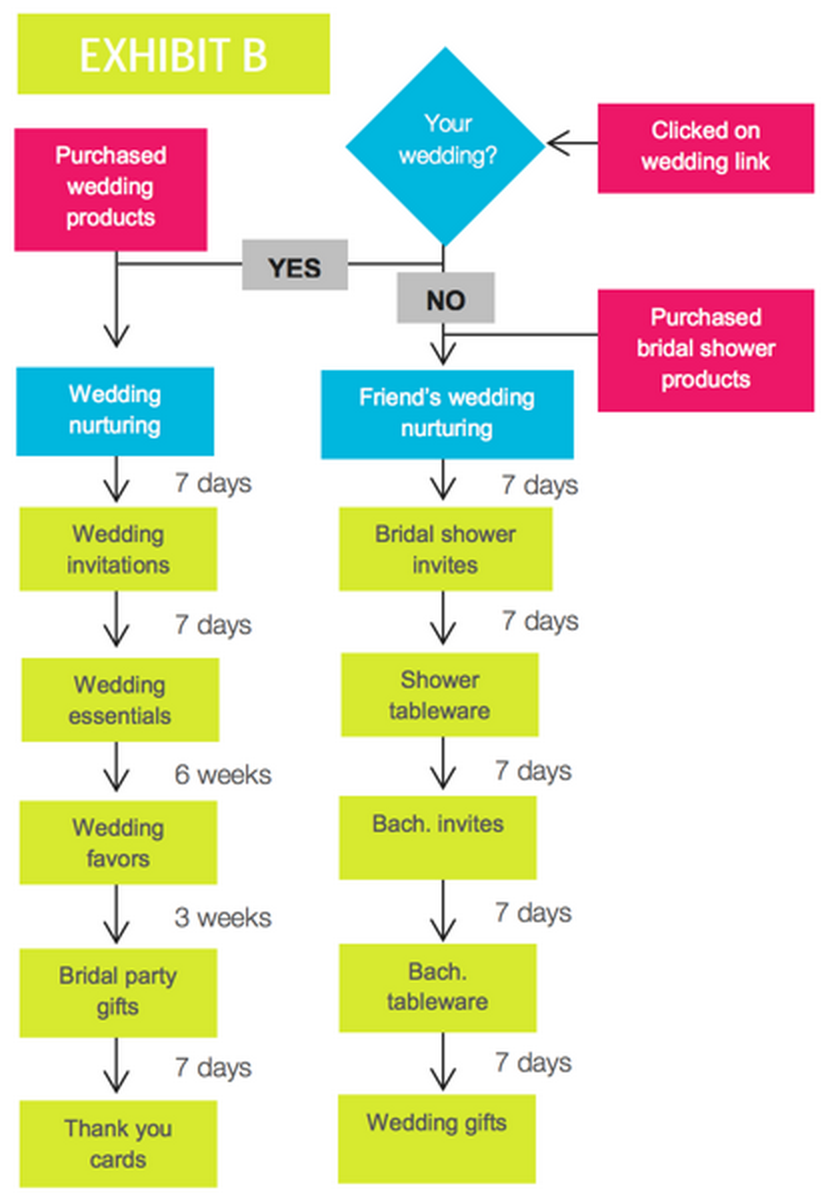
Changing from a generic newsletter to personalized marketing automation produced amazing results for Paper Style. Their open rates increased by 244%, email click rates by 161%, and their revenue per mailing increased by 330%.
Strengthen Your Customer Relationships
Marketing automation works to automate your communication programs. It integrates key elements of marketing into one system. Making it easier to create timely, structured campaigns with all of your prospects.
Now, your marketing and sales teams can automate and optimize your programs from initial contact through the entire sales process.
Prioritize your outreach. Streamline the process. Boost conversions with marketing automation.
About the Author: Shayla Price lives at the intersection of digital marketing, the law and social responsibility. She inspires a new breed of innovative attorneys at Hearsay Marketing. Connect with her on Twitter: @shaylaprice


Martes, Hulyo 28, 2015
Donald Trump sells Manhattan penthouse for $21 million
Donald Trump sells his 24th floor penthouse at Trump Park Avenue in New York City for $21 million.
Lunes, Hulyo 27, 2015
5 Ways to Become a Better Headline Writer
Article headlines make the Internet go round.
Ask any marketer, any writer, any reader, anyone. They’ll tell you: Article headlines are super important.
How important, really, are headlines? Experience, data, and history all point to the fact that headlines are the single most important component of an article, bar none. You’ve heard the statistics repeated ad nauseum — 80% read the headline, 20% read the article, ten seconds to gain someone’s attention, and all the other scary and data-driven statistics.
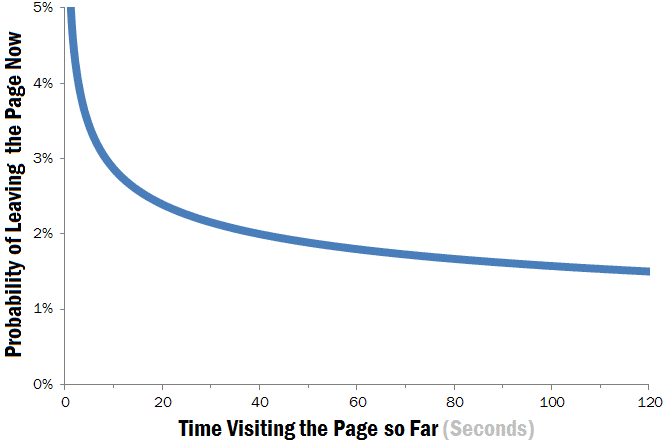
Recognize this? I thought so.
You know all this. More relevant to you is your own experience with headlines. Why are you even reading this paragraph right now, at this point in the space/time continuum of your mortal existence?
You were beckoned by the headline, formula-driven and hackneyed as it was, right?
Even though we’re Buzzfed up, Upworthyized, Viralnovaed, and Clickholed out of our minds, we can’t shake off this all-important reality: Headlines are freaking important.
In fact, the word “important” isn’t strong enough.
I’ve summed up the X ways that are guaranteed to turn you into a better headline writer. No matter who you are, what language you speak, or your final grade in composition class, you can develop white-hot skills in headline creation. Starting now.
Once you reach this level of awesome, you’ll reap the rewards in traffic, audience, readership, engagement, conversions, and, hey, even feeling really good about yourself.
1. Know Your Audience
I hate to lead off with a boring one, but it’s critical. You have to know your audience.
Let me give you an example to explain what I mean.
Look at this headline: “Neuropeptide Y—a novel brain peptide with structural similarities to peptide YY and pancreatic polypeptide.”

Is that not magnetic? Did it not capture your attention in two seconds? Will you not read the entirety of the article with rapt attention and owl-like eyes?
You might find this headline uncontrollably entrancing if you are a peptide researcher, are a neurobiologist, are K. Tatemoto, or have a side hustle researching pancreatic peptides.
This headline might just be the most electrifying headline in the whole world. Why? Because it could be exactly what some people are interested in. A good headline is relevant to the audience.
Get it? Okay, now, here’s another example: “He Thought He Just Found A Regular Fish, But When He Looked Closer, He Couldn’t Believe It.”

Is that appealing? Absolutely. It has a wider appeal than polypeptides, which is cool, because ViralNova isn’t concerned about targeting a narrow slice of the human population. They are concerned with getting as many eyeballs on their content as possible. Who wouldn’t want to find out about a guy who couldn’t believe it when he thought he just found a regular fish?
What is the difference between the peptide headline and the mind-blowing fish headline?
Audience.
It all comes down to audience. The Nature Science Journal has identified the audience that they want to attract (scientists), and ViralNova has identified the audience that they want to attract (warm bodies with a proclivity for clicking).
The right headline is only the right headline for the right audience. (Yes, I used the word “right” three times in that sentence, and I’m not apologizing.)
So, what’s the takeaway for you who desire to be a better headline writer?
Know your audience.
Once you figure it out who your audience is, really and deeply, and discover what they want, you can create the best headline for them. A good headline is only as good as it is relevant to your audience.
2. Practice
You only get better at something by doing it. A lot.
Improvement gurus call it deliberate practice or DP. Why is Kobe Bryant so good at basketball? How did Misty Copeland become a star ballerina?
Talent is overrated. Practice is everything. It’s no different with writing headlines. You’ve got to do it again, and again, and again, and again to the power of 100.
Sims Wyeth, an Inc. contributor explains, “to get better at almost anything” you have to practice. That practice, deliberate practice to be precise, “consists of endless repetition and excruciating boredom.”
Did you get that? Endless repetition. Excruciating boredom. Getting better at headline writing is an attractive destination, but the path to get there is agonizing. You’re not going to love it. You’re going to loathe it.
Coschedule recommends writing at least 25 headlines per topic/article in order to come up with the best one. After you come up with 25, you eliminate over half, narrow it down to the best five, and poll your friends on the best of the survivors.
25 headlines is a lot of headlines. But it’s not just the number that is important. It’s the practice that goes into writing headline after headline after headline.
Practicing writing headlines produces perfect headlines.
3. Follow Patterns
I’m skeptical of formula-driven headlines. How many “things you didn’t know,” and “7 ways” (oops), and “you’re doing it wrong” articles can a single human being take in during a single lifetime?
But here’s the thing. Headline formulas and patterns become formulas and patterns because of their proven past success. Even though you’ve already read eighteen “how-to” articles and nine list posts today, you’ll probably give in and read another six or so before 5pm.
For example, Brian Clark of Copyblogger wrote an article a while back called “10 Sure-Fire Headline Formulas That Work.” His headline? It worked.
And his formulas? Heck, they work, too!
One of the reasons why they work is because they are psychologically appealing (more on that later) and audience specific.
Let me show you one of Clark’s formulas as an example.
Formula: Here is a Method That is Helping [blank] to [blank]
The title here is ready to be tailored to a specific audience. Here are Clark’s three examples with my description of the intended audience.
Here is a Method That is Helping Homeowners Save Hundreds on Insurance
Audience: Homeowners who want to save money
Here is a Method That is Helping Children Learn to Read Sooner
Audience: Parents and child educators
Here is a Method That is Helping Bloggers Write Better Post Titles
Audience: You
The formula-driven technique is only as effective as the titles are relevant to the audience. Go back to point number one and read it again if you’re not entirely clear on this concept.
If all else fails and you simply cannot come up with a good headline, use a formula. They’re like training wheels. The more you write, the better you’ll get. And then you can branch out on your own.
4. Split Test
Split testing is the key to unlocking the potential of your website. I test everything. Images, kerning, headlines, post length, social media frequency, load time, navigation changes — everything.
Why? Because split testing produces improvements.
If you aren’t split testing your headlines, you’re missing out on a major source of knowledge. The better you know how your headlines perform, the greater ability you possess to produce killer headlines.
Let’s say you produce a headline for an article, publish the article, and it gets shared and liked. Good. But what if you had written a different headline? Would it have gotten more shares and more likes? You won’t know unless you test.
In a study released by Unbounce, one website tested three headlines, leading them to discover the winning headline with a 41% boost in conversions.
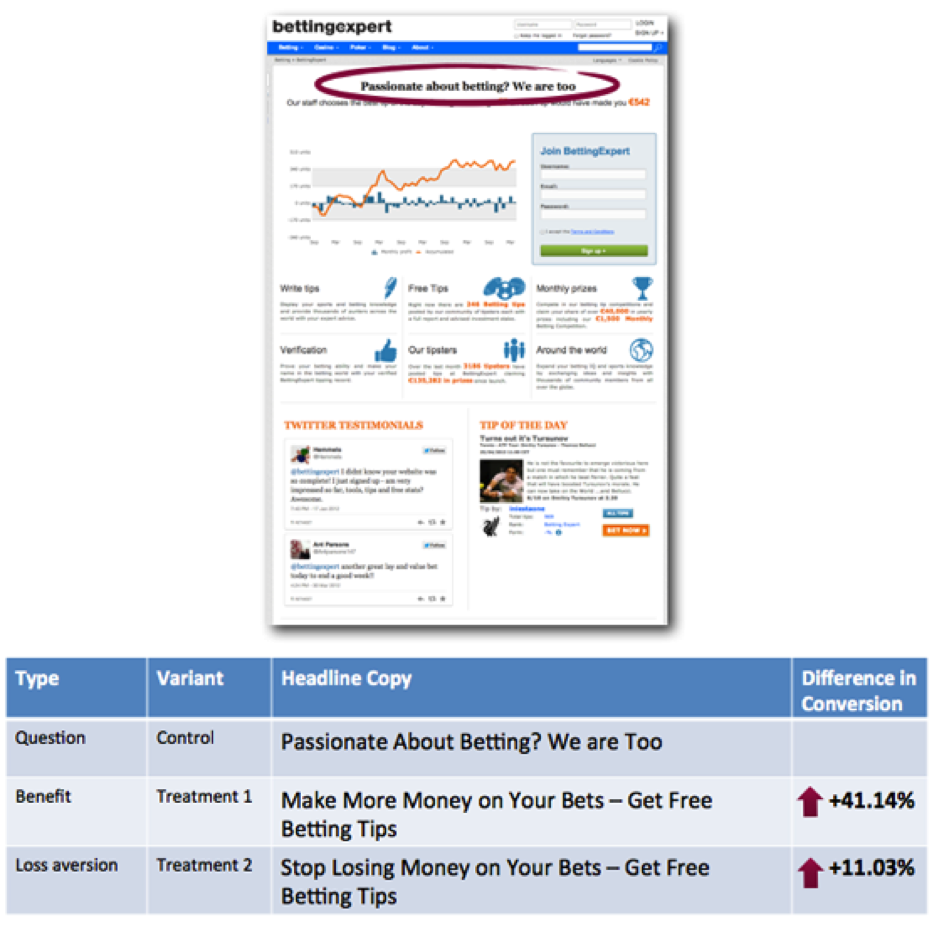
Another single headline change produced a 68% higher CTR.
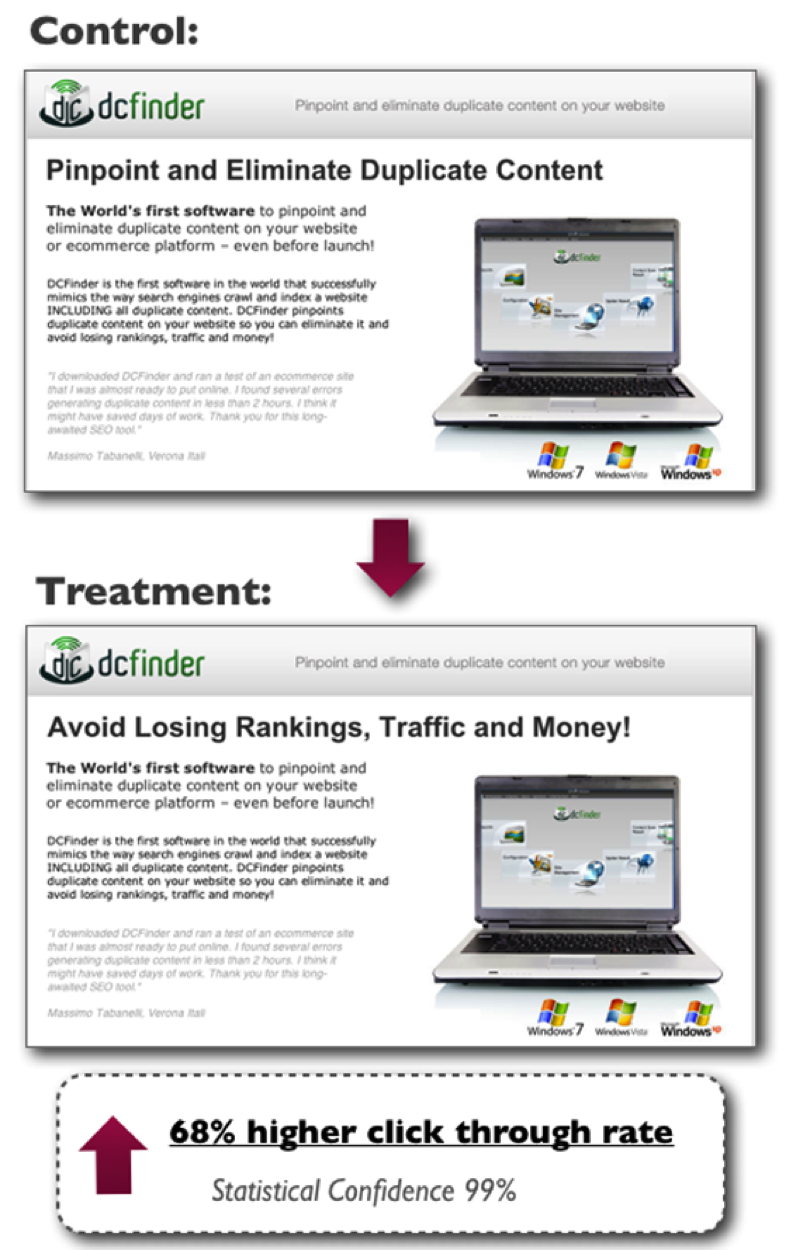
Testing is a scientifically sound and rigorous method of determining the actual best headlines. By running these tests and uncovering the comparative success of your headlines, you can’t help but get better.
A less scientific way to test your headlines is with simple polls. When you come up with a series of headlines, send them to your colleagues and let them vote on which one they think is best. Although it’s not quite as sophisticated as running a split test, you’ll still be able to learn what best resonates with people.
By polling and testing, you overcome one of the greatest roadblocks to writing effective headlines: Your own flawed assumptions. Assumptions are like a rut. You get stuck in it, don’t know you’re in it, and your conversions and clickthroughs are dying as a result.
Kick yourself out of the rut with a little good old-fashioned testing, and you’ll race lightyears ahead in your headline creation skill.
5. Study Human Psychology
This final point sounds a bit weird, but it’s incredibly effective.
Human psychology is the study of the mind — how it works, how it is motivated, how it processes information, etc. By unlocking a few common thinking methods, cognitive biases, and tendencies, you will be able to learn powerful ways of writing headlines that people deeply crave on an elemental level.
For example, are you aware of the self-reference effect? According to the self-reference effect, the human mind interprets events and experiences in a different way if the information is related somehow to themselves. Memory works better when the information being remembered is related to the self.
When this mental effect is applied to headline creation, it lets us know that we need to relate the headlines to the audience. More specifically, the self-reference effect informs us that using the word “you” or equivalents in a headline may improve the memorability and attractiveness of a particular headline.
There’s no reason why issues like the self-reference effect should be locked away in volumes of peer-reviewed cognitive neuroscience medical journals. You should be using such knowledge to enhance your own article titles.
Conclusion
Becoming a better headline writer is the good life. When you can unleash great headlines with skill and ease, everything in online marketing gets better. Conversions. Engagement. Clickthroughs. Shares. Traffic.
It’s all there.
“Getting better,” however, isn’t an accident. It requires intentional and sometimes mind-numbing effort. Remember the whole “endless repetition and excruciating boredom” bit? Yeah, it’s going to feel like that sometimes.
Don’t stop. Success is in the offing. Let’s go make headlines that turn heads.
How have you improved your ability to write great headlines?
About the Author: Neil Patel is a lifelong evangelist of Kissmetrics and blogs at Quick Sprout.


Sabado, Hulyo 25, 2015
Is Your Winning Variation Actually Leading to More Cancellations? How to Use Data to Find Out
Imagine this: you just found a huge win on an A/B test. Your variation doubled signups over the original. So you launch your variant to 100% of visitors. Pop the cork! Here come the signups.
Fast forward six months, and you have a surge in cancellations. Your customer support team can’t figure it out, and there have been no major changes in your product. You are left puzzled and frustrated.
Then you realize something. For the past six months, people have been signing up through the variant. Could this be the cause of the cancellations? If you use Kissmetrics, you can get the answer.
Identifying Whether a Variant Led to More Cancellations
Using Kissmetrics, you can find out if an A/B test that initially delivered more signups ultimately led to more cancellations. It doesn’t matter if the test was six months ago. You can still go back retroactively and see how the test performed and whether the variation brought more cancellations. Here’s how we do it.
The Funnel Report
A funnel report is used to track how many people move from one step of your website to the next. Marketers traditionally use a funnel report to see where visitors are dropping off in their path to purchase.
But we can use the Kissmetrics Funnel Report for other purposes, too. One of them is to see which test variation led to more cancellations. To do this, we’ll create a funnel for just two steps – signed up and cancellation. When you use Kissmetrics, you may name your events a little differently, but if you’re a SaaS company, you’ll need to know when people sign up and when they cancel.
Here’s how our funnel looks:
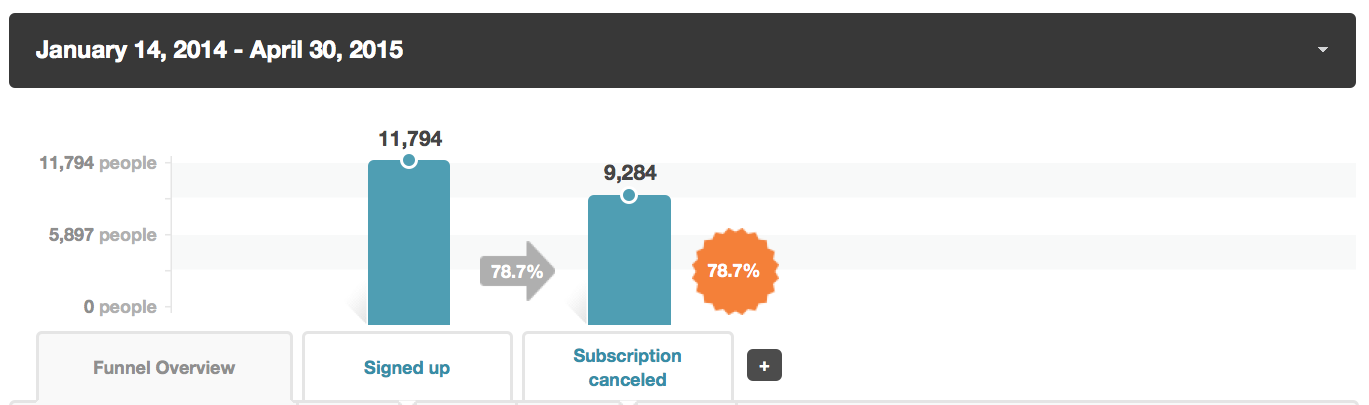
During our selected time range, we had 11,794 signups. Of those 11,794, nearly 9,300 canceled. To see how each variant performed, we’ll have to segment our traffic. “Segment” is a fancy, analytical way of saying “group.” So if you came to our site and saw the variant, you’d be put in the variant group/segment.
Here’s the funnel, segmented by the A/B test:
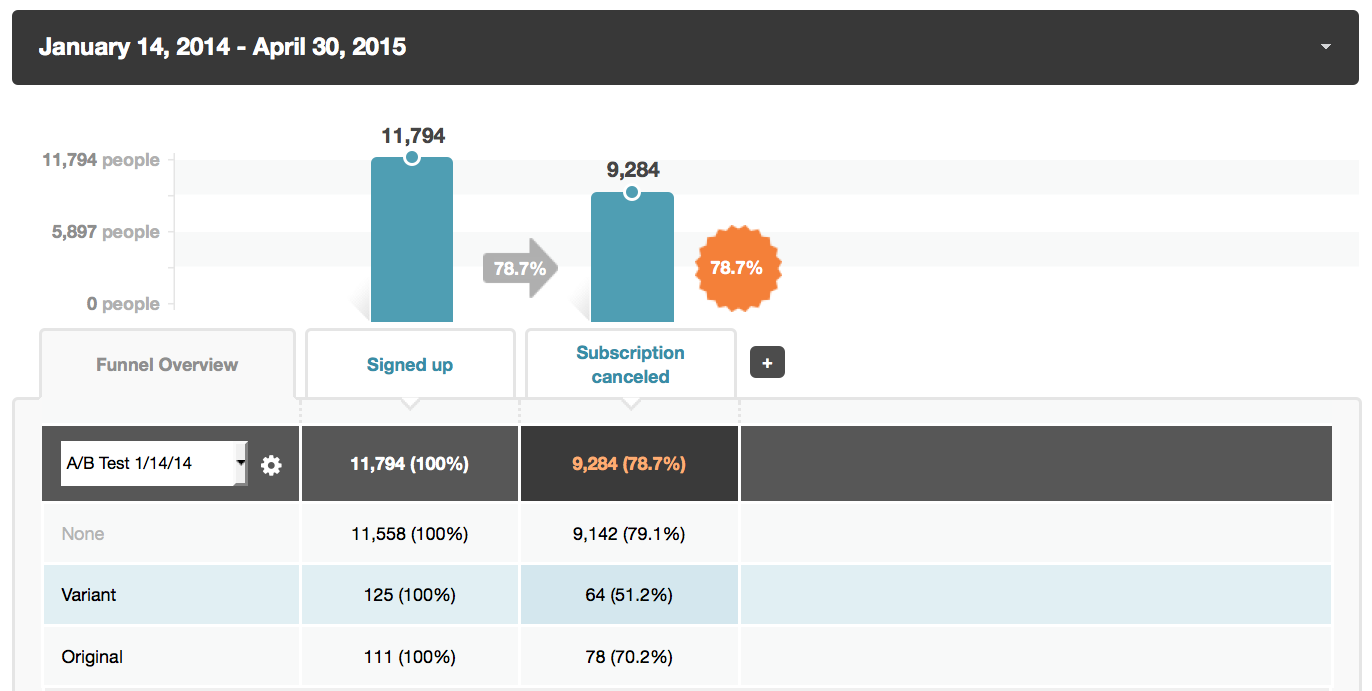
We can ignore “None.” These are people who were not in the A/B Test. They didn’t see the variant or the original.
Underneath “None” are our A/B test pages. We have our variant and the original. The variant page generated 125 signups, while the original delivered 111 signups. Also, the variant delivered a much smaller percentage of cancellations.
Before we can say the variant is a winner, we’ll need to make sure this data is statistically significant. We can use the A/B test significance calculator to get this data. Here’s how it looks:
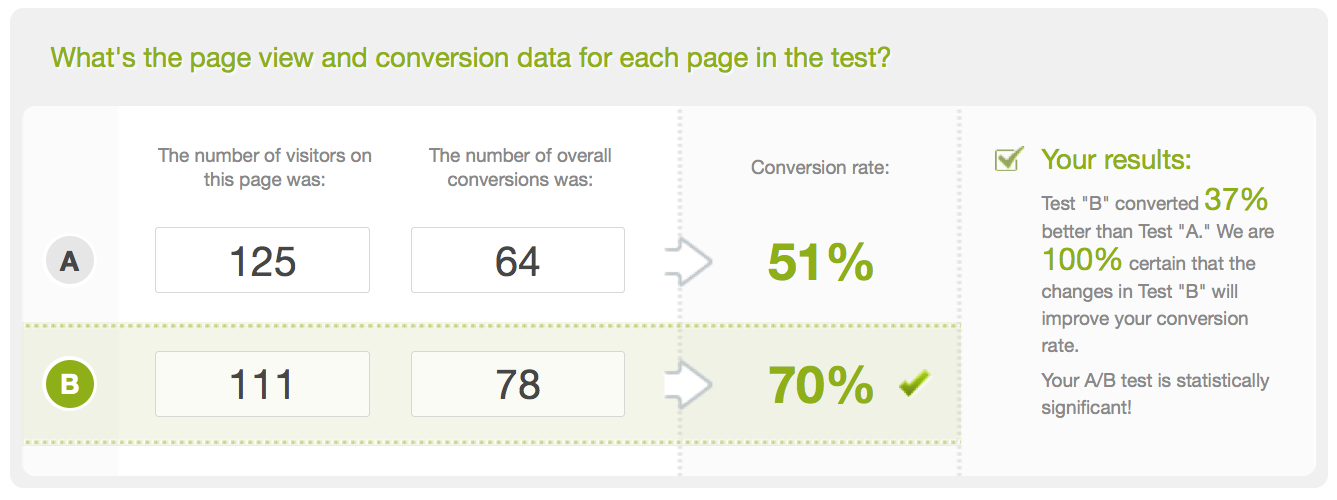
On the right, we see that this data is statistically significant. We can move forward with full confidence knowing that the variant page is the real winner. Customers who saw this page will be less likely to cancel later on down the road.
A Word of Caution
While this data is valuable, it’s important to be careful with the conclusions you reach.
While the original/variant page did lead to more cancellations and it is statistically significant, can we be 100% no-doubt-about-it absolutely sure that this is the reason more people canceled? No, we cannot. Correlation is not causation. It could just be happenstance that those shown the original/variant page canceled at a higher rate than those shown the variant/original – and the original/variant page should not be blamed.
This also doesn’t mean the data is worthless. Perhaps the original/variant page made a promise that the product couldn’t live up to. Or maybe the original/variant page attracted the wrong audience. To find this out, we can collect data from our canceled customers and see if we find trends. If not, it may just be coincidence.
We can find the canceled customers in Kissmetrics. Here’s how:
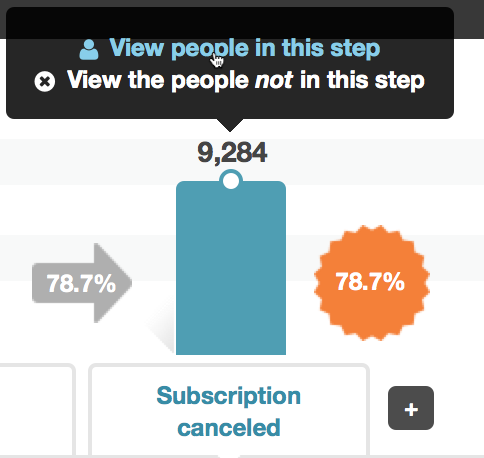
We’ll click to view the people in the “Subscription canceled” step and view the people in the variant segment. From there, we’ll get our list of people, and we can contact them to learn why they canceled.
Track Tests with the A/B Test Report
Kissmetrics has a report that tracks your A/B tests. It’s called the A/B Test Report, and it has some unique features.
This report does not create tests for you. You can still use Optimizely, VWO, Unbounce, etc. for that. It does track the test, report the results, and import the data into your Kissmetrics account. There are a few additional benefits of using this report:
- The statistical significance calculator is built in. You’ll see the amount of data that came in, and the Report will draw a conclusion for you (e.g., variant beat original). Its calculator will ensure the results are statistically significant, which can reduce the odds of false positives.
- You can see how an A/B Test impacts any part of your funnel. Want to see how a homepage headline test impacts signups? No problem, just set “signups” as your conversion event. You aren’t limited to testing only to the next conversion step.
Here’s how the report looks:

You’ll get multiple metrics for each variant, and even be able to see every person in each variant.
Click here to watch a video demo of the A/B Test Report.
Get the Whole Picture with Kissmetrics
It would be impossible to get this kind of data if you weren’t using a tool like Kissmetrics.
A benefit to using a people-tracking platform like Kissmetrics is that each visitor to your site is recorded as what they are – a person, not a session. This makes your data accurate.
If you’re running an A/B test, each person gets tagged with the pages they saw, and you’ll be able to go back and see which pages/steps they went through, as we just did. With Kissmetrics, you can see the entire customer journey, from when the prospect first visited (and which variant they saw) to the customer’s most recent action. As long as you have the tracking in place, you can get the important data you need.
To see how Kissmetrics can benefit your marketing, signup for a personal demo today. To get right into it, you can signup for a 14-day Kissmetrics trial.
About the Author: Zach Bulygo (Twitter) is a Content Writer for Kissmetrics.


4 Simple Reasons Your Blog Still Isn’t Getting Traffic
Here’s the number one complaint after starting a new blog: Why aren’t we getting traffic?!
I’ve heard this complaint once. I’ve heard it a million times. Eager blog writers get burned out, discouraged, and quit. The decline is simple: They start a blog. The traffic does not materialize. The blog fizzles and dies.
The why-am-I-not-getting traffic question basically sums up the entire industry of SEO, so that doesn’t provide much of a focus for a helpful article. Instead, I want to focus on one angle.
This is my angle: Why isn’t my new blog getting any traffic?
New blogs are the ones at the greatest risk for vanishing in a puff. Without a sturdy understanding of the blog basics, a business’s content marketing may get derailed.
Let’s set a few things straight for the record
In the interest of setting expectations, let’s deal with a few common misconceptions. Having a long-lasting blog doesn’t just require just the teeth-gritting endurance of writing something every day. To have an enduring blog, you need to understand a few principles.
Just because you have a blog doesn’t automatically mean you’re going to get traffic.
Blog does not equal traffic.
Here’s what a lot of people think will happen after they launch a blog:

Unfortunately, that’s not always the case.
In reality, there may be no increase in traffic or a gradual increase in traffic.
You don’t simply need traffic. You need the right kind of traffic.
And what if you do get traffic? Life is good, right?
Yeah, sort of. But what’s the point of having a blog? Is it really just traffic?
I’d argue that the answer is no. Most of the time, a business starts a blog in order to serve a higher purpose — marketing, brand visibility, more clients, higher conversions, etc. A blog does not exist for the sole purpose of publishing more content. The web doesn’t need more content.
A blog exists for conversions, revenue, information, etc. Traffic is simply an indication that your blog may be achieving its real goals.
Gaining traffic is not a good thing unless your blog is also achieving its other purposes. What if you’re getting traffic from all the wrong sources? That traffic is not going to convert, and your blog becomes essentially useless.

Did you know? The Kissmetrics Funnel Report allows you to segment your traffic so you can see where your highest converting traffic is coming from. For more info, check out our blog post or sign up for Kissmetrics today!
Instead of frenetically grasping for traffic, you need to be pursuing the right kind of traffic. What is “the right kind of traffic”? Look for it in point two below.
Maybe a blog isn’t the best strategy for you.
I’m writing this as a die-hard content marketer. I get content marketing. I do content marketing. Heck, I helped write the most extensive and detailed guide of advanced content marketing techniques that exists today.
In spite of this, I’m willing to admit that content marketing may not be the solution to your woes.
Every business is different. Most of the time, content marketing works. That’s why more than 90% of B2Bs and B2Cs use content marketing as part of their overall strategy.
The lingering 10% who don’t utilize content marketing may be doing so intentionally and strategically. There are plenty of other ways to do marketing, and even to do so effectively. Some of the businesses that are doing content marketing might be wasting their time and resources.
I didn’t write this article to help you diagnose your business’s particular situation. I’m simply raising the question. Is content marketing really the best strategy for you?
You have to decide.
Now, let’s dive into a few of the specifics. Remember, we’re asking the question, why isn’t my new blog getting any traffic?
Here are the answers.
1. You Aren’t Sharing it Socially
Issue: Social Signals and Visibility
We’re in the era of the social web.
The social web refers to the fact that the Internet is a place of social interaction and collaboration. As proof, consider this: 74% of all American adults use a social networking site.


When people “go online,” they are likely to do several things — research, email, etc. — but increasingly all these activities are integrated socially.
For example, someone doesn’t simply read an article. They share it, comment on it, tweet it, etc.
It naturally follows that an online strategy devoid of social sharing is missing out on the vast and viral potential of the social web.
Solution: Promote your content
Writing content is only half of content marketing.
The other half is spreading that content. Don’t expect the traffic to come flooding in after you click “publish.” Publish your content, and then promote it.
Here are some tips:
- Add sharing buttons to your blog article.
- Share content at the peak times for your audience’s social activity.
- Share your article on Twitter with images.
- Share content multiple times on every social site.
- Keep up with your content as it circulates on social, and be sure to participate in the conversation.
- Encourage blog authors, contributors, and team members to use their existing social networks to share the article.
2. You Aren’t Focusing on Any One Keyword or Subject
Issue: Keyword Optimization
Much of SEO is fairly common knowledge by this point. Most people are at least aware of keywords, and title tags, and have at least a vague idea of how it all works together.
But in spite of the widespread knowledge, it can be hard to strategically apply it to one’s own blog.
Keyword optimization is one such shortcoming.
Often, a blog writer starts by assembling an editorial calendar, which is basically a list of blog articles with dates. She may select these article titles based on the fact that they are interesting or perceived to be relevant to the target audience.
Solution: Research and target long tail keywords
This approach described above is misguided. Content marketing should not start with articles. It should start with research.
- Understand your marketing persona.
- Understand what they are searching for.
- Understand the intent behind their queries.
- Understand the keywords that would gain traffic from these queries.
At this point, you can come up with a list of longtail keywords.
From the list of keywords, you can develop a list of articles. Using the list of articles, you can create your editorial calendar.
Each article should use the selected longtail keyword in the 1) page title, 2) article title, and 3) one or two times in the article itself. Be sure not to stuff the article with the selected keyword.
3. It’s Boring as Heck
Issue: User Experience
I’m convinced that user experience is the sine qua non of Internet marketing. It trumps all other marketing techniques, and stands as the supreme methodology for gaining and retaining customers.
Obviously, user experience is an extremely broad subject. It effectively encompasses nearly every other aspect of digital marketing — from conversion optimization to search engine optimization.
Content marketing falls within the broad realm of user experience. When a user goes to visit your blog and read your content, what is he experiencing? Does it satisfy his needs? Does it answer his questions? Is it easy to read? Does it match his expectations?
One of the reasons why user experience in content marketing is such an issue is because Google says it is.
According to the document, the Quality Rating Guide, Google rates content based on expertise, authoritativeness, and trustworthiness. Human raters review selected content on the blog in order to refine and streamline the algorithmic formulae behind content quality grading.
Low quality content gets downgraded. High quality content gets upgraded.
Only high quality content will get the ranking improvement that will produce higher traffic levels.
Solution: Improve quality
This is why the quality of your content matters. I’ll point out a few of the issues that are considered low quality — i.e., boring.
- It’s all about you. Content marketing should not be exclusively about your business, your products, your awesome sauce, and your employees. It should be about subjects that are relevant in the industry. For a great example of B2B content marketing for a company not tooting it’s own horn, check out TopTal’s blog.
- No images. If your blog doesn’t have some sort of visual engagement like pictures, graphs, charts, or videos, it’s boring. Sorry.
- Not relevant. If you are producing articles that aren’t relevant to your target audience, you lose. No one cares about content that doesn’t answer a question, solve a problem, or meet a need. For example, on the Kissmetrics blog we aren’t going to write any articles about parenting. Would it get traffic? Probably, but it doesn’t target our audience. And it would alienate our readers.
What happens when you commit these content marketing mistakes?
Your bounce rate rises, your dwell time drops, your clickthrough rate sinks. Google measures these metrics and reduces your site’s rank accordingly.
Read up on what Google views as quality content. It’ll only take 2 minutes to read, and you’ll have a good set of guidelines to follow. You can also read up on what Bing views as quality content.
The better your quality, the better your traffic.
4. Your Blog Design is Horrible
Issue: User Experience
Another user experience issue is blog design. Why does it matter? The way your blog looks, feels, and functions affects how users engage with your blog.
If the design is awful, then your users will not engage with the blog.
Solution
Based on my research and analysis, here are the ingredients of a great blog design:
- Your website should be responsive. If your website is not mobile optimized, it won’t be featured in mobile search results. Use this tool to see if Google views you as mobile-friendly.
- Feature blog snippets on your main blog page. Snippets are brief excerpts of a main article that people can skim through at a glance.
- Make your main content prominent. Place it on the left side, where users are most likely to look first.
- Use scrolling social buttons to encourage social sharing at any point in the article.
- Use an 11px font or larger for the body text.
- Use a 17-25px headline font.
- Use a sans serif font.
- Use a light colored background with dark colored text.
- Use headers and short paragraphs to break up the content.
- Use plenty of images.
- Use headers, bullet points, short paragraphs, and easy vocabulary.
- Include the name and possibly a brief bio of the author.
- Provide a CTA for users to subscribe to the blog.
Improving your blog’s design can dramatically improve your blog’s quality, readability, and traffic.
Conclusion
If you want your blog to not die, you may need to make some improvements. The reasons your blog may not be getting any traffic are pretty simple. Thankfully, the solutions are relatively simple, too.
Keep in mind that traffic may be slow in coming. Content marketing isn’t a sprint; it’s a marathon. If traffic doesn’t spike overnight, don’t be dismayed.
Be patient. Give it a few months; things will improve. If not, read this article again.
What’s your experience with blog traffic, and the reasons for growth or decline?
About the Author: Neil Patel is a lifelong evangelist of Kissmetrics and blogs at Quick Sprout.


Mag-subscribe sa:
Mga Post (Atom)