Biyernes, Marso 4, 2016

The 4 Most Overlooked Factors in Your B2B E-Commerce Success

There are many similarities between B2B and B2C when it comes to e-commerce. Some of these overlaps are easy to spot: key elements like intuitive search, high-quality product images, and the need for simple navigation.


However, due to challenges such as longer buying cycles, higher volume sales, lower price points, and multiple decision makers, the path to B2B success requires a subtly different approach than plain-old B2C strategies.


In fact, there are at least four commonly overlooked factors that — if harnessed correctly — can elevate you to B2B e-commerce domination.


Not surprisingly, each of these factors is rooted in B2C best practices. But what matters is how you augment, correct, and — in some cases — supercharge those B2C building blocks for a B2B audience.


1. Personalization


It’s a universal truth that people don’t buy from companies … people buy from people.


Personalization — or perhaps better, positioning yourself like a real person in relationships with other real people — is the number one overlooked factor in B2B e-commerce. This is because B2B businesses fear coming off as unprofessional, amateur, or “small time.”


Behind this fear lies a misconception that’s seductive precisely because it’s rooted in the very real difference between B2C and B2B transactions.


As Glenn Taylor explains, “B2B marketing, unlike B2C, is primarily account-based, which means that buyers are purchasing on behalf of an entire company. In enterprise, this process rarely involves one individual, but does make qualities of buyers at the account level more predictable.”


However, just because “this process rarely involves one individual,” does not mean that your B2B efforts involve no individuals. In other words, B2B doesn’t remove the need to address those individuals … individually.


The truth is that having a light, personalized, and casual tone in your communications actually boosts conversions and brand loyalty.


Even more to the point, Gartner predicts that by 2018, “B2B companies with effective personalization on their e-commerce sites will outsell by 30% competitors without the same level of personalization.”


Why?


Because humans not only want to connect with other humans … we all want to be treated like humans. And that means businesses buy from business they connect with — not stuffy organizations that appear cold, lifeless, and run by robots.


The primary way B2B violates personalization is by falling into the trap littering their communication and messaging with impressive-sounding words that are empty of meaning and detract from encouraging interaction with their brand.


Forbes’ list of the “The Most Annoying, Pretentious And Useless Business Jargon” — which includes impersonal phrases like “core competency,” “move the needle,” and “bleeding edge” — is a phenomenal resource to check your own communication against.


Providing a personalized experience also applies to lead generation.


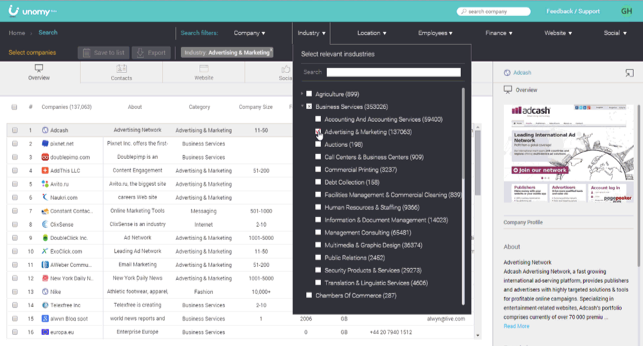
For instance, Unomy specializes in building lists of targeted prospects — not just companies with their comprehensive profiles, but the names and contact details of real decision makers. This allows you to learn everything about the company in seconds and reach out to them in a personalized and informed manner.

unomy-screenshot


Image Source


One powerful feature is the ability to upload lists of email addresses or URLs and Unomy will instantly create a complete 360 degrees view about these entities. This will save you research time so you can prioritize leads and focus on the most important ones.


Lastly, do not overlook the power of personalization when it comes to user-generated content, especially testimonials. As Yotpo recently reported, Facebook ads that feature user-generated content on average deliver a 300% higher CTR than “brand-only content ads.”


Regardless of the tool or tack you choose, remember … personalization means one thing: humans connecting with humans.


2. Shipping


With so much time spent optimizing for the wide-end of the funnel, many B2B e-commerce stores overlook the glaringly obvious process of shipping, fulfillment, and order satisfaction.


The level of service you provide in this area plays a critical role in not only maintaining your B2B relationships, but on establishing those relationships in the final stages on an initial purchase.


In other words, your shipping can make or break your conversions both in the short term … and the long term. As UPS discovered in a case study on online shopping generally:


  • 61% of respondents said they have abandoned a cart because shipping costs made the total more than expected.

  • 50% reported abandoning a cart because their order wasn’t large enough to qualify for free shipping.


In fact, shipping charges — namely “unexpected shipping charges” — are the number one reason for shopping cart abandonment across the board.


While those are striking number in the big picture, how does shipping affect B2B e-commerce in particular?


The most prominent challenges facing B2B shipping comes from the fact that B2B models operate predominantly in the wholesale market. As a result, not only is drop shipping incredibly common — which involves multiple touch points that B2B companies themselves do not have direct control over — but international order fulfillment as well.


This means that finding “an affordable and reliable shipping company, monitor[ing] shipments, and fil[ing] the proper documents for customs clearance” are top priorities for B2B growth. To address that need, Chinese e-commerce giant Alibaba Group built its own shipping-meets-financing solution called OneTouch.


As Internet Retailer pointed out in a profile on OneTouch, “By consolidating resources of shipping companies as well as financing services, OneTouch earns a profit while providing its service for free to exporting companies.”


Unfortunately, such a large-scale, in-house solution isn’t always possible. Naturally, everyone aspires to provide customer fulfillment like Amazon, but taking care of the whole shipping process yourself is time consuming and resource intensive.


Outsourcing the shipping process can be a smart way to save the headaches of shipping while ensuring a top-notch shipping and fulfillment process for your customers. Using a tool like Temando can help you reduce costs, increase sales, and grow your business. This means lower cart abandonment and direct integration with e-commerce platforms like Shopify, Netsuite, Magento, WooCommerce, and more. That you can focus on sales and growth, and leave the order details to the pros.


temando-screenshot


3. Segmentation


Hand-in-hand with the first factor — personalization — goes segmentation. In fact, segmentation is a key step behind personalization.


Segmentation means dividing your leads, prospects, customers and overall market along lines like demographics, business needs, size and order volume, specific products, or length of relationship. To complete an in-depth segmentation of your market, Business2Community outlines a number of other key characteristics particular to B2B like sale complexity, purchase risk, and buying cycle.


You can also characterize your B2B buyers based on “why” they purchase (that is, the driving motivation that ultimately closes the sale). The dominant influence behind each buyer’s “why” should be categorized into easily divisible types such as, price, timing, and relationship.


Whatever method you choose, segmentation allows you to adjust and tailor your approach to both existing customers and prospects.


However, the need for segmentation is especially acute if you’re an e-commerce business that has mixed B2C and B2B audiences.


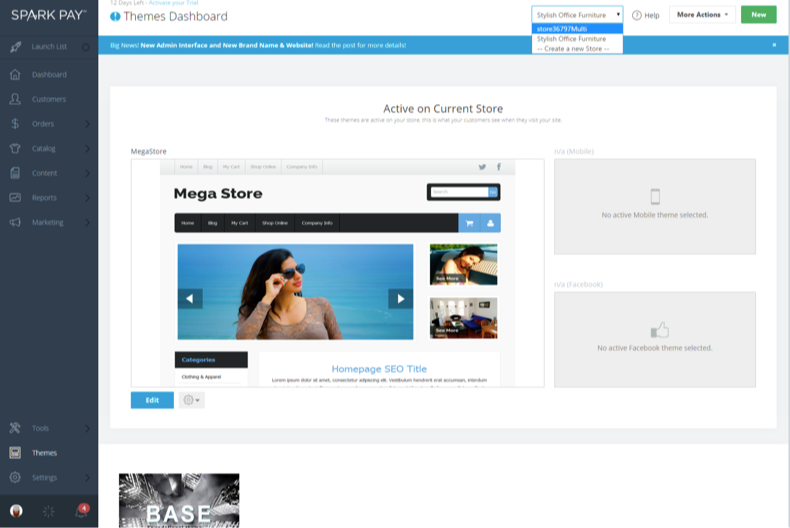
The answer to this need lies in what are known as “multiple storefronts.” Opening multiple e-commerce storefronts allows you to create segmented user logins, URLs, product lines, pricing structures, and even designs and layouts … all with a centralized backend.


In fact, Capital One’s e-commerce Spark Pay lists multiple storefronts as the number one B2B e-commerce best practice. Their reasoning — just like other e-commerce platforms that offer the service — is clear: utilizing multiple storefronts enables you to consolidate your product catalog and especially your CRM within one admin console while at the same time customizing key B2B elements like discounts, products grouping, volume pricing, SEO, and widgets. Simple drop downs menus allow you to toggle between storefronts while maintaining the same behind-the-scene resources.

sparkpay-screenshot


4. Trust


If success in B2B is all about reaching people, then trust is a crucial factor in making that happen. Trust the glue that makes your relationships stick. And this applies to first impressions as much as it applies to ongoing interactions.


So what exactly are B2Bs overlooking it comes to communicating trust in the online world of e-commerce?


In a word, simplicity.


You’ve heard it before — simplicity is everything.


On the design front, Oli Gardner emphasizes the importance of “designing experiences that achieve a single business goal. Create experiences that guide the visitor toward completing one specific action by using persuasive design and psychological triggers as devices to increase conversions.”


First impressions are even more cutthroat.


According to ConversionXL, people form an opinion in about 50 milliseconds, and the majority of it is design related.


The study by Consumer WebWatch showed how people associated interface design with the company’s credibility, based solely on visual design (and less focus on content), meaning the layout, colors, and fonts. In Peep Laja’s words, ”great design gets people to trust you and to stick around. Poor design creates mistrust and makes people leave.”


Design your website so that every piece of copy, image, and pixel are formed with your goal in mind; to direct your prospect into your funnel — and nothing more.


Cut the fat and focus.


Think of simplicity the way Joanna Wiebe does:


Every single line of copy and element on the page is responsible for its own job. Like on an assembly line, every element on your page and in your funnel has 1 job to do to keep a conversion moving forward. Failure to do one job stops the line.”


It’s essential not only to design for conversions, but also to effectively eliminate all else that could distract prospects from taking the desired action.


Also make sure that your company is intentionally communicating safety and trust. A simple (wink, wink) way to do this is by following Kissmetrics’ Roadmap for a Trustworthy E-Commerce Website.


For B2B audiences, this means most importantly investing in trust signs signals like multiple payment options, endorsements and certifications, and multiple, secure logins created specifically with multiple decision makers and purchase levels in mind.


The same … but different


B2B e-commerce success requires slightly different strategies to be successful.


We’ve covered four commonly overlooked factors that can help you dominate the industry:


  1. Personalization

  2. Shipping

  3. Segmentation

  4. Trust


While these are all universal principles in any e-commerce game plan, knowing how to augment, correct, and supercharge them for a B2B marketing is what separates the winners from the losers.


About the Author: Nadav is a veteran online marketer and the Founder & CEO of InboundJunction, an Israel-based content marketing company. Nadav helps well-known brands in boosting their online visibility through PR, SEO and Social Media.


You can buy a house in Flint for $14,000

It looked as if Flint's housing market was finally starting to recover from the Great Recession, but then the water crisis hit.


Huwebes, Marso 3, 2016

The Ultimate Guide to Removing Google Analytics Referral Spam

It started out simple enough with semalt and buttons-for-websites. Then the ilovevitaly attacks began. Pretty soon Ranksonic began mocking us with fake events and organic search terms. Before we knew it there was a full-frontal assault of fake referral spam masquerading as legitimate website visitors compromising the accuracy of our Google Analytics reports. We all knew Google was working on it, a definitive solution just never came.


The problem was, and still is, most marketers don’t know what referral spam is, how to spot it, or how to remove it. This presents a major problem when businesses and marketers begin using these inaccurate Google Analytics reports to make conversion rate optimization decisions on A/B tests, landing page optimization, and more.


Worse yet, many marketers are unknowingly presenting traffic numbers to bosses and stakeholders that could be off by up to 60%!


Thankfully, there are a few proven strategies to eliminate Google Analytics referral spam. In this article we’ll discuss what referral spam is, how to identify it in your reports, and I’ll show you a few tried and true methods to clean up historical reports and prevent referral spam from effecting reports in the future.


What Is Referral Spam?


The majority of referral spam never actually visits your website which is why some marketers refer to it as “Ghost” spam. Even though this traffic never visits your website it still appears in your reports as legitimate traffic affecting total sessions, bounce rate, time on site, conversion rates and more.


On a major website where hundreds of thousands of sessions are recorded on a daily basis this traffic isn’t a major concern. On small business websites, this traffic can account for over 60% of daily sessions which causes major problems in month-to-month reporting, A/B testing, or other conversion rate optimization tests.


If this traffic never visits your website, why does it show up in Google Analytics? Google provides a developer tool called the Measurement Protocol. Among other legitimate uses, this allows developers and businesses to track behavior of their customers from a wide variety of different offline data sources and send that raw data to their Google Analytics account.


Unfortunately, this also opens the door for crafty spammers to force raw data into Analytics accounts by randomly attacking UA tracking codes, completely bypassing the website.


referral-spam


How Do I Identify Referral Spam?


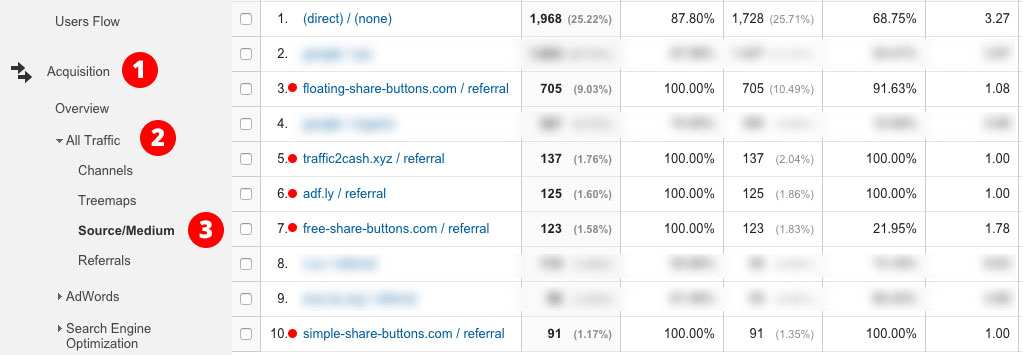
There are a lot of ways to identify referral spam but the quickest is to review your traffic reports by clicking Acquisition > All Traffic > Source/Medium.


source-medium-report


If the referring domain URL isn’t a big enough giveaway of the traffic source being spam, simply visiting the URL should remove all doubt.


Though some of these spammers have gotten more sophisticated, looking at % New Sessions, Bounce Rate and Pages/Session metrics are also a good indication. These metrics will usually be 100%, 100% and 1.00 respectively, another sign that this traffic never visits the website.


How Do I Remove Fake Traffic From Google Analytics?


Let’s be honest, there are thousands of blogs on this topic. Many are out of date, a lot include workarounds that simply don’t work, and others only eliminate some of the spam. What I’m going to outline below will work 100% of the time on new and old accounts. The only catch is you will need to update these filters as new spam domains continue pop up. Unfortunately, until Google provides a solution, there is no permanent “set and forget” fix for this.


Let’s get started.


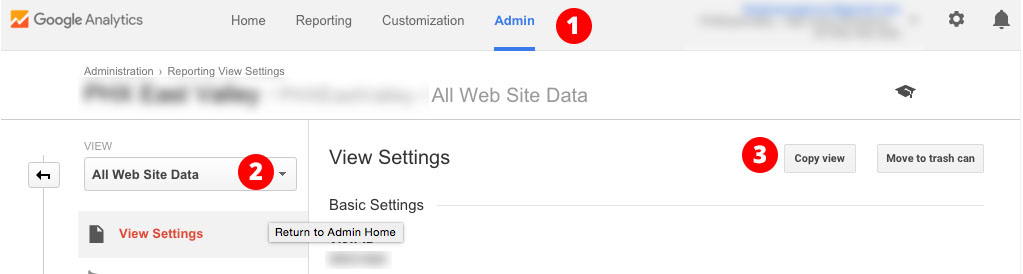
My first recommendation, and I strongly recommend this, is to create a copy of your existing view. This copied view will remain untouched and unfiltered. This is a good safety net in case one of your filters begins filtering out legitimate website traffic.


To copy your primary view, click the Admin tab, select the view you’d like to copy and click Copy View.


copy-analytics-view


The first three filters we’re going to add will block all future traffic from domains which are currently known to send referral spam.


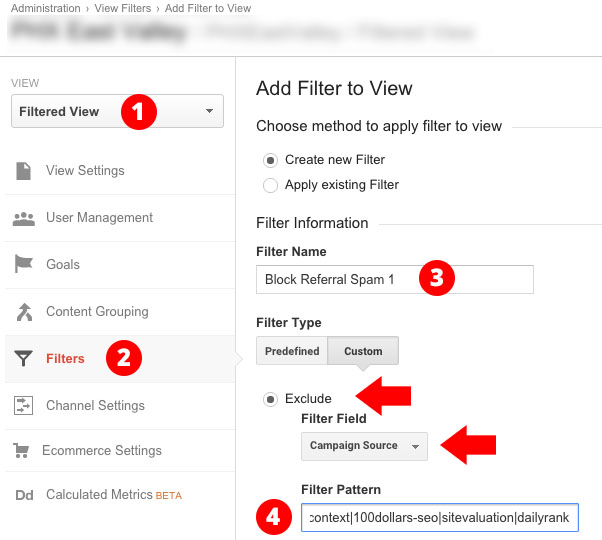
To add our first filter click the Admin tab, select your Filtered View, click Filters, and enter a name for your filter keeping in mind there will be several.


Now this step is very important. You must select Exclude and choose Campaign Source. Many people fail to choose Campaign Source and can’t figure out why their filters aren’t working.


In the Filter Pattern field, copy and paste the string below:


dailyrank|100dollars-seo|semalt|anticrawler|sitevaluation|buttons-for-website|buttons-for-your-website|-musicas*-gratis|best-seo-offer|best-seo-solution|savetubevideo|ranksonic|offers.bycontext|7makemoneyonline|kambasoft|medispainstitute


add-referral-spam-filter


Since there is a character limit to the Filter Pattern field, we need to create a second filter the same as the first, except in the Filter Pattern field paste:


127.0.0.1|justprofit.xyz|nexus.search-helper.ru|rankings-analytics.com|videos-for-your-business|adviceforum.info|video—production|success-seo|sharemyfile.ru|seo-platform|dbutton.net|wordpress-crew.net|rankscanner|doktoronline.no|o00.in


… and a third filter like the previous two using:


top1-seo-service.com|fast-wordpress-start.com|rankings-analytics.com|uptimebot.net|^scripted.com|uptimechecker.com


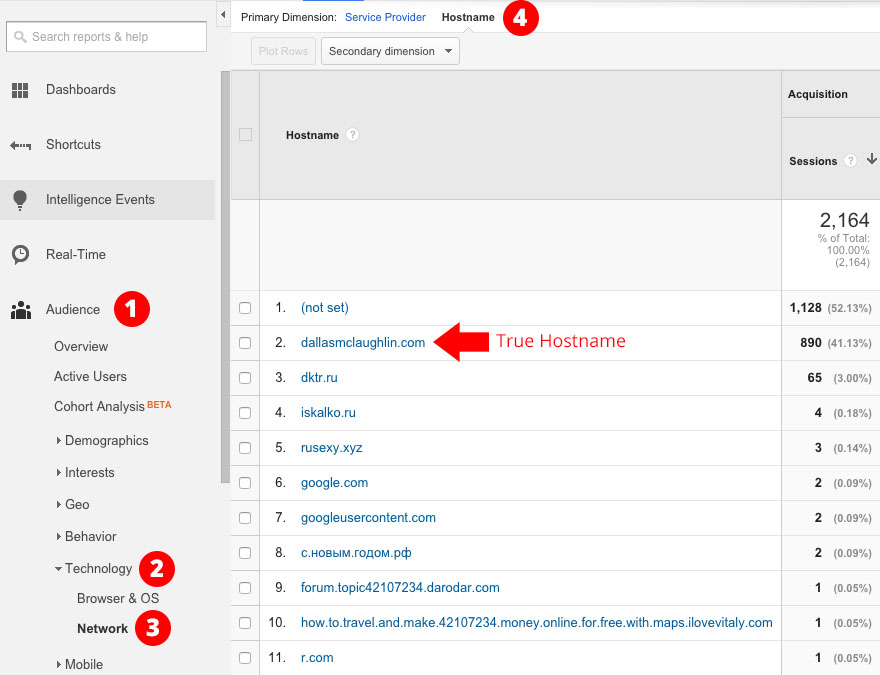
The fourth and final filter we are going to create is a Hostname Filter. I mentioned that the far majority of this traffic never actually visits your website, thus, it never requests your actual hostname which is the URL used to reach your website (typically your domain name).


This can be seen in your Network report by clicking Audience > Technology > Network and selecting the Hostname tab.


true-hostname


Any traffic in the above screenshot that is not visiting my actual URL is spam. Almost 60% of all traffic! The Hostname Filter eliminates this spam from your reports by including only the traffic that reaches your website by requesting your actual domain name.


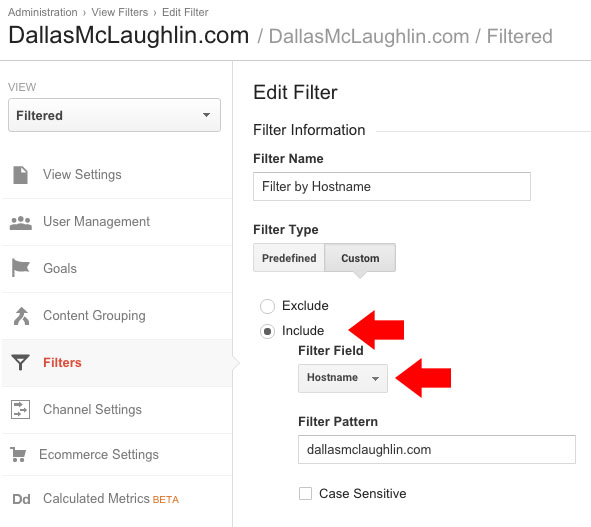
You create this filter much like the previous three. The difference here is you must select Include, choose Hostname for the Filter Field and enter your hostname in the Filter Pattern.


creating-hostname-filter


Congratulations! These four filters have just eliminated 99.9% of all referral spam from your future reports! Routinely adding new domains to the referral spam filters will keep this traffic under control and keep your future reports clean.


How Do I Clean Old Google Analytics Reports?


While the above mentioned filters will only fight future referral spam, you can still remove spam from historical reports using a single Custom Segment.


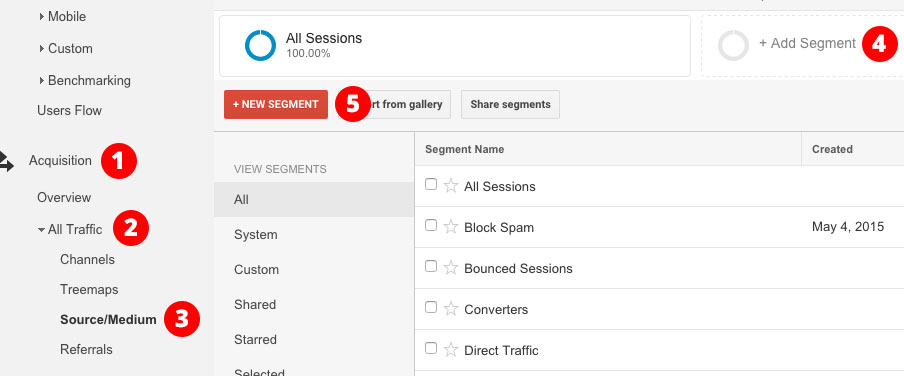
You can create a Custom Segment from any report, but I’d recommend going to Acquisition > All Traffic > Source/Medium. Once there, click + Add Segment > + New Segment.


create-custom-segment


Essentially we’re just going to recreate the four filters we created above, but as a single Custom Segment.


Click Conditions, and on the first filter select Hostname > Matches Regex and enter the hostname(s) you used in your fourth filter above.


Now we want to click the + Add Filter button.


Custom Segment filters default to ‘Include’, but it is very important that your second set of filters be changed to ‘Exclude’.


In the set of drop downs select Source > Matches Regex and paste the same list of spam domains from the first filter you created. Click the OR button and repeat this filter two more times with the respective list of spam domains.


custom-segment-detailed


If the Custom Segment you created matches the screenshot above you’ll notice the circular graph to the right reflect a smaller amount of traffic. This is the amount of site traffic that remains after all referral spam has been removed.


Once you save this filter, you can apply it to any report and any time frame.


Taking The Fight To The Spammers


Nothing can compromise an otherwise successful A/B test quite like inaccurate reporting. With these four filters created and your Custom Segment applied, you can ensure that the data you are basing important marketing decisions on is truly accurate.


Until Google releases a definitive solution to referral spam, bookmark this article and reference this as the most accurate and up-to-date guide on how to finally remove Google Analytics referral spam from your marketing reports.


About the Author: Dallas McLaughlin is a Digital Marketing Specialist at The James Agency, a full service advertising agency in Phoenix, Arizona. He blogs frequently at DallasMcLaughlin.com about Search Engine Optimization, Pay-Per-Click, and Social Media Marketing trends. If you have any questions, you can tweet him directly at @BossDJay.


Miyerkules, Marso 2, 2016

Home prices in this city soared 25% in a year

Vancouver property prices soared 25% last year, more than in any other major city in the world, according to a new research by Knight Frank.


Commercial Price Growth Expected to Slow in 2016

U.S. macroeconomic momentum dropped during the fourth quarter of 2015, buffeted by global economic slowdown and financial volatility. Payroll employment offered a bright spot, closing the year with a total of 2.7 million net new jobs, boosted by private service industries. Rising employment drove demand for commercial space across the property spectrum. Vacancies continued declining in the fourth quarter of 2015, as rising rents improved cash flows.

The Little-Known Metrics Your SaaS Company Should Be Measuring (But Probably Isn’t)

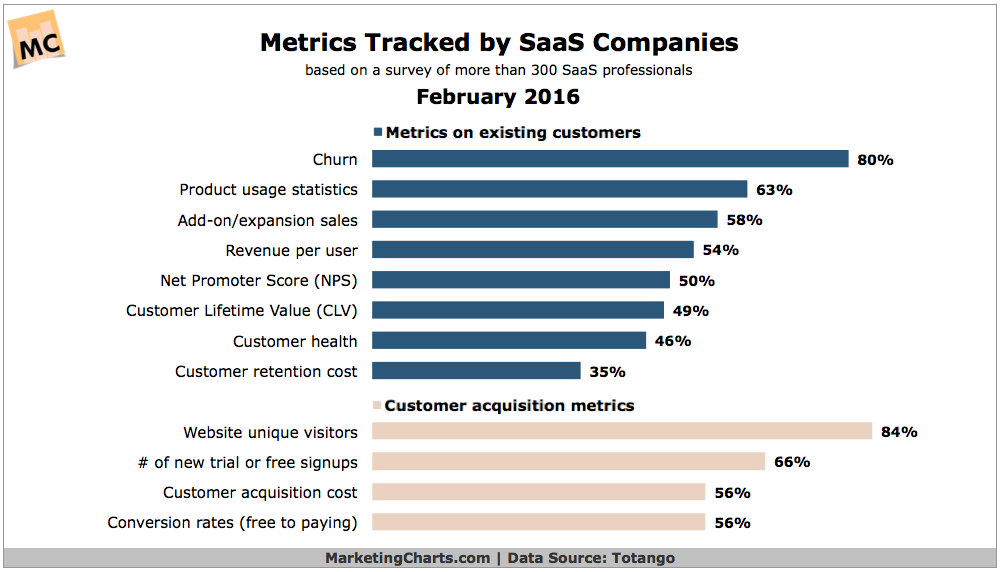
When it comes to SaaS metrics, you’re well-acquainted with all the usual ones: churn, revenue per customer, customer lifetime value. But a new survey by Totango, released as part of their annual State of SaaS Metrics report, is showing some insights into what we’re measuring, and what still needs to be incorporated. So the question then becomes – are you measuring the right stuff? And what’s missing from the metrics puzzle? Let’s take a look:


saas-tracking


There are a few telling concerns with this chart. First, it proves we’ve got churn, customer usage and expansion/add-on sales locked down. We’re using that information to make intelligent and confident decisions, but there’s more work to be done.


Understanding Customer Health as Part of the Lifecycle


For example, what’s meant by “customer health”, a metric that 46% of respondents planned on adding this year? It’s much more than just measuring the levels of customer satisfaction. It’s also about getting in touch with customers who may be signed up and established, but have yet to truly use the service to its fullest. There are reasons why their account has turned stale – and it’s your responsibility to find out and act on those reasons.


Lack of understanding on how to use the system efficiently? Not sure about implementation? How can you make the process easier or guide them through the first steps?


And that’s not even counting new users, who need a more helpful, user-friendly onboarding system. They’re short on time and need direction – fast. And of course, we’re not neglecting loyal customers – those who use and advocate for the service. We need to work to keep them that way.


In short, we have different ways to measure and adapt to customer health levels as their use and understanding of the service grows. Lumping all of these people into a single funnel or list is doing them (and yourself) a serious disservice. To put this kind of metric into action you’ll need to measure tangible things like how many sites your product is used on, how many projects your customers have running and so on. Being able to segment them based on usage (or lack of it) is vital to creating a process that gets them more involved and encourages even greater brand awareness.


How Much Does it Cost to Retain Customers?


You likely already know how much it costs to acquire customers – but what about retention? There are plenty of formulas out there to guide you, but one of the most overlooked areas where you can find a goldmine of information is your subscription payments and processing. Sure, you may have looked at that information to see how well your latest promotion is doing – but have you looked at how well it reflects your ability to keep customers subscribed?


Let’s say your average product price is $49/month and your customer lifecycle is two years. That’s $1,176 per customer. But if your customer unsubscribes after six months, that means you’ve only earned $294, leaving $882 in profits on the table.


And that’s just for one customer.


When you look at subscription length and compare it to overall churn rates, you’ll likely find a lot of hidden areas where retention rates can be improved and revenues can be increased.


The Weird Little Secret that’s Driving New Business


Here’s another interesting finding from Totango – a surprising way to generate new business for your service:


The freemium.


freemium


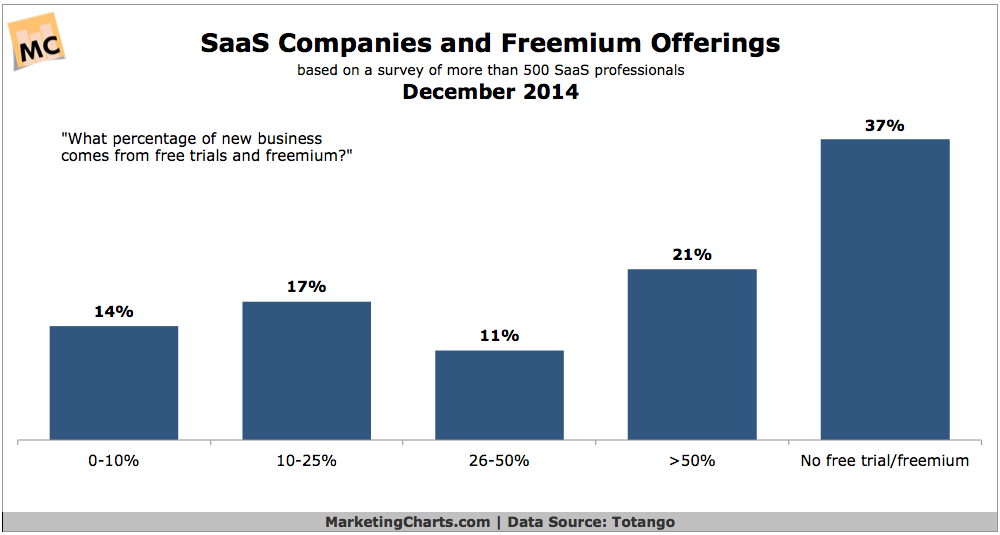
A little over a third of respondents in the survey stated that they didn’t use the freemium model, but one third of those who did saw most of their new business from it. That’s a significant amount of new income that simply wouldn’t have exist had they gone straight to paid status.


How to Make Freemium Work for You


For the uninitiated, freemium (free + premium) involves providing the basic services of the app or service for free, with the ability to upgrade or access additional features for a fee. Well known companies leveraging the freemium model include Dropbox, LinkedIn and Hulu to name a few.


Of course, one can point out equally unsuccessful freemium-based companies (particularly news companies that use paywalls) – and judging what to give away versus what users should pay for is a delicate balancing act at the very least.


The first step is to make your offer abundantly clear to new users.


Let’s look at Dropbox as an example. Dropbox gives everyone 2GB of storage for free just by creating an account (more if you recommend a friend and they sign up). If you want more, you’ll have to pay for it. Easy to understand and act on.


Contrast that to Hulu (formerly known as Hulu Plus), the video streaming service. Hulu initially started its subscription service by promising no commercials. Then it changed to “some commercials” and offered a newer, pricier tier with “absolutely no commercials, we promise”. Customers frequently ask why they’re seeing commercials if they’re paying for the service in the first place. Time will tell how well this strategy will work – especially when compared to competitor Netflix’s ad-free paid streaming service.


Deciding what’s free and what needs to be paid for are two important questions you’ll need to ask yourself when considering the switch to a freemium model:


freemium-modelsImage Source: Harvard Business Review


Holding On for the Freemium Rollercoaster Ride


It’s also worth noting that if you decide to test the waters on the freemium model, you’ll want to hang on for the ride.


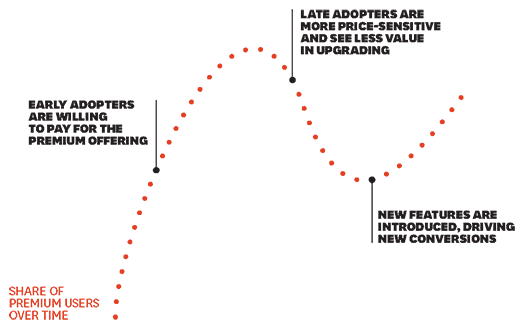
lifecycle


In this example, from the Harvard Business Review, the conversion rate lifecycle gradually rises and dips as early adopters and price-sensitive users ebb and flow in their use of the product. Being able to understand that this is a normal, typical cycle for freemium helps you prepare in advance by looking for ways to entice free users to upgrade, and reminding them of all the benefits they get as a result.


And as the report above notes, you don’t need to stay mired in your original offer. Times change and trends change with them. Dropbox was originally just a backup service, not a collaboration tool. LinkedIn was targeted to job recruiters but has blossomed into a business social network. If old mission statements are no longer relevant, feel free to update and revise – the rest of the Saas industry certainly is!


Now It’s Your Turn…


What are your thoughts on these little-known but incredibly important SaaS metrics? Are you taking steps to measure them in your own company? How is it working for you? Share your stories and perspectives with us in the comments below.


About the Author: Sherice Jacob helps business owners improve website design and increase conversion rates through compelling copywriting, user-friendly design and smart analytics analysis. Learn more at iElectrify.com and download your free web copy tune-up and conversion checklist today!