Marketing technology is moving at a rapid pace that is enabling businesses to reach more potential customers and better engage existing ones. So, if you are still stuck with excel sheets and manual outreach processes, it’s time to reexamine how you can bring in the much required marketing efficiency to your business.
Automation doesn’t necessarily have to be an advanced AI capable of solving complex riddles, predicting and magically running your show. Nor does it mean that you should be able to automate the complete chain of activities in a process. Using marketing technology to reduce manual effort and intervention itself can save a ton of time and improve conversions.
WSJ published a great article recently on how companies are using automation (paywall) to boost their marketing efforts and reach their customers better. The author describes marketing automation as an ever-expanding area with a big focus currently on automating activities such as website and content management, email marketing, customer segmentation, lead filtering, digital advertising and social media marketing.
While digital has opened up a ton of opportunities for marketers, the increasing amount of noise and activity online makes it really tough to be heard and seen. For a business, this means two things:
- Every lead is precious and worth fighting for
- The marketing effort required today is several times higher than it was 10 years ago
Deploying marketing automation is just as important for SMBs as it is for large companies to have a competitive edge. You can identify activities for automation by looking for repetitive tasks that are backed by some data or specific logic. Often such activities involve simple decision-making or are rules-based.
Below are five examples of marketing processes where automation can bring immense benefits. You can automate parts of these processes by using off-the-shelf solutions or building some small tech in-house. The decision of choosing one over another should be based on cost-effort-time analysis.
1. Lead tracking and nurturing
Like I said before, the battle today is open for every lead. However, it is impossible and probably stupid to nurture leads through manual processes. Whether you are working with 50-100 leads a month or several thousands, a CRM is must in your marketing technology arsenal.
Most CRMs offer automatic lead capturing from contact forms. There are several cloud based CRM SaaS providers, and some even offer access for single user for free. And if you are a SaaS company, most likely your CRM would be heavily integrated within your product.
Salesforce is the big daddy of the CRM software world, and while a bit pricey, it offers valuable integrations with key software products you are likely to use now or in future like Pardot, Hubspot, ExactTarget and Marketo. Salesforce also allows for a lot of flexibility to configure, but its user interface is not one of the friendliest to work with.
Other popular CRM solutions include Close.io, Pipedrive, AgileCRM and Zoho – all of these are modern and easy to get started with.
Close.io has a clean interface, and is great for logging email and call interactions, bulk emailing, calendar integrations and reporting.
Zoho does most of this and is cheaper, maybe not as elegant.
Pipedrive is a good low cost basic CRM.
AgileCRM is interesting and goes beyond regular lead tracking and management. It has a bunch of marketing automation features, which SaaS companies will find useful. These include user onboarding with rule-based emailing, in-app messages and guided tours, social media monitoring, and web engagement tools.
Getting the data in order is just the beginning. Using this data to drive conversions is the big battle. This starts with mapping your sales cycle, identifying the various touch-points and opportunities for follow–ups, and then automating the follow-ups themselves or the reminders for the personal ones (depending on the kind of business you run).
In a typical SaaS scenario, you generally have 30 days or less to get a user engaged and convert. A series of well-planned emails, sent on an automated schedule during the period, based on the user activity pattern can improve conversions significantly. It also allows you to create the much needed touch points for user interaction, early problem resolutions and feedback.
While setting up the email follow up plan, be sure to customize it to the existing engagement of the user with the product, using the activity data of the account. For example, if the user account has not registered any trigger activity, following up with a demo suggestion is a great idea. But if the user is already primed and active, sending in a congratulatory note praising the activity might be more in order.
While it is always possible to set up such rule based email campaigns on your own, considering the option of using one of the many email marketing automation solutions is always worthy of exploration.
Some popular email marketing automation software:
- Customer.io – It is a smart app for sending your customers email messages at just the ‘right’ times. You can set up simple day based email schedules or activity-based emails. Also supports A/B testing and conversion tracking.
- Drip – It’s a simple tool for creating drip campaigns. Drip offers blueprints or pre-set drip campaigns, which can be customized to your case. The app can pull emails from your website and other sources.
- Sendloop – This app gets closely integrated with your website, monitoring user activity, allowing you to create personalized drip email campaigns.
- Pardot – This is the best choice if you’re using Salesforce as your CRM. They integrate together seamlessly (Salesforce owns Pardot). Set up marketing emails and drip campaigns easily. All the data is shared with your Salesforce account.
Marketing automation tools and email marketing apps:
- Marketing automation tools – AgileCRM, Hubspot and Infusionsoft – These are more multi-purpose software, which gives them a unique edge, as they are powered with more data about your users or customers. AgileCRM lets you create visual flows of the rules to send your messages. Infusionsoft also allows you to create rules-based visual maps of interactions including emails. Hubspot is powered with a lot of web analytics, which is great assistance creating targeted email campaigns.
- Newsletter and email marketing apps – MailChimp and Campaign Monitor – These are more traditional email marketing tools, popular for sending newsletters. Mailchimp gives you some powerful email marketing automation options by giving you access to data such as who opened emails and clicked links. Campaign monitor can be armed with personal customer data such as birthdays, anniversary to personalize email content to engage better.
2. Social media marketing
Social is a busy business – engaging thousands of fans and followers is no easy task. There are 3 critical components of social media engagement and marketing:
- Posting content on social accounts
- Conversations on social
- Community building
Of these, no. 2 should never be automated. However, the other two do have a reasonable scope of automation, and between them, content more than the community.
Posting on social every couple of hours is a good idea, as the content is so fast moving that if you are not there every few hours, your account will have very poor visibility. To create this amount of content real time and posting can be extremely time and effort intensive. This is why you’ll need something like Buffer, which makes it easy to schedule posts and send them out on customized times. All social media platforms are included, as well as some analytics to tell you the engagement each post/tweet receives.
I think the real big win comes from partially automating your content generation process. As it’s expensive and very difficult to generate this volume of new content, curating thought leadership stories for your social accounts is a great alternative. Most businesses rely heavily on sharing content from sources other than their own web properties.
Community building is largely difficult to automate, and should ideally be driven by effort from real people. I’m personally strongly against automated direct messages, likes and retweets – these go against all principles of social media and are also against the policies of social platforms. However, if you use a tool to find people who’d be interested in your social accounts and follow them – that’s a perfectly okay partial-automation boost.
Social media automation has been a topic of much debate, but as long as the basic principles of social media are respected, technology can bring in the much-needed efficiency to reach out in the crowded space.
3. Content marketing
For the most part, content marketing is a tough one to automate. But time consuming activities like content research and idea generation can be technology enabled. Similar to the use of content curation tools for social media, the same apps can be used to monitor the trending content thematically, getting a personalized content feed for idea generation, research or curation.
Having been in the content industry for over 6 years now, I have seen content creators spend close to 30% of their time in these activities. Even partial content research automation can save hours of energy spent Googling for relevant stories or material. The trick to partially automating content research is to use tools to track your industry news and trends – basically let some cool technology do the content discovery and filtering for you. Below are some handy apps you can use:
- Feedly – Feedly took off with the shuttering down of Google Reader, as a popular alternative to reading RSS feeds. Today Feedly boasts of an impressive collection of blog and publications feeds, which can be subscribed to create your own custom news and trends feed. It’s a handy app to stay abreast of the latest in industry, research by broad keywords and generate ideas for your content pieces.
- Buzzsumo– Buzzsumo is a great tool for finding the most socially trending content in your space. It’s great for content idea generation, research and finding influencers to involve in your content marketing efforts.
- Google Alerts – Google Alerts is a simple, basic tool to get email alerts on recent content published with some keywords mentioned. It’s different and cleaner in output from the Google search, which makes it high utility. Great for tracking content trends and idea generation.
- Storify – Storify is a great tool to curate content for your blog posts. You can search content by keywords and use the app’s editor to draft your post. For your occasional curated posts, it is plenty useful.
You can also use some free tools to help discover what your target audience wants to read.
Similarly, a lot of energy is spent in planning and coordinating content generation and publishing. As content marketing involves multiple process stakeholders (freelance and in-house content creators, content managers, graphic designers and sometimes more), a project management platform is in order. There are project management platforms solely dedicated to managing content marketing efforts, but the popular multi-purpose project management platforms do the job as well. Not using any workflow automation can easily create a lot of process and communication redundancy, and even lead your content marketing efforts astray.
Good multi-purpose project management platforms include Asana, Trello, Basecamp and Teamwork. I particularly like Asana – it has a neat interface that makes tracking tasks and team conversations a breeze.
4. User onboarding, engagement, cross- and up-sell
Converting a user is half the battle won. Retaining the user, ensuring that she stays engaged and finding opportunities for expanding the relationship are the next big and important challenges. The good news is much of this can be managed by smart automation backed by data.
Onboarding a user is a critical part of SaaS sales. It starts when a user creates an account.
A well-crafted automated email campaign for the defined conversion cycle is required. It should start with a welcome note and then lead into emails/in-product messages about usage-prompts (based on the user activity), offering of support and resources, and a few reminders about paid plans and trial periods nearing end (if the case be). Once the user converts to a paid plan, continuing to lend a helping hand with resources, tips and gentle notification nudges to encourage activity, can go a long way in ensuring user retention. Khuram Hussain of Fileboard has written a step-by-step on how to follow up with leads.
Intercom.io also has a great blog post on several good examples of converting emails.
Smart use of data is the building block of awesome marketing. Segmenting users by activity data and classifying them in buckets will allow you to create personalized automated marketing campaigns for cross and up-sell. For example, your most engaged SaaS users can get prompts for discounted upgrades or add-ons, while relatively low activity users can get emails about tips to better use the software or cross-sell of the add-ons that can bring more value.
For e-commerce, previous e-commerce purchase history can be used for selective product cross-sell (complementary products) or up-sell (better/newer versions of what customer previously purchased).
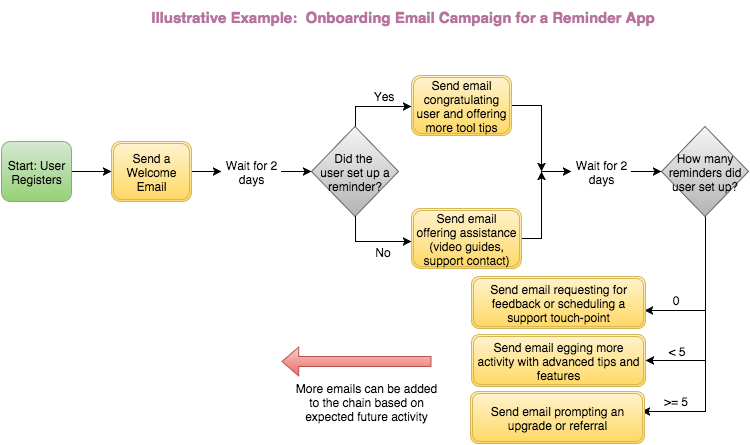
Below is an illustrative example (simplified) of an email campaign based on customer segmentation:

5. Website/App operation and optimization
Your web and mobile interfaces are your most important marketing assets, and offer many opportunities of improving conversions and capturing users. Well-placed and timely prompts to engage users can be very valuable on these assets. Several off-the shelf solutions are available to A/B test and implement changes. Similarly, several marketing tech solutions are also offered to measure performance and recommend changes for search engine optimization or on-site or app user engagement.
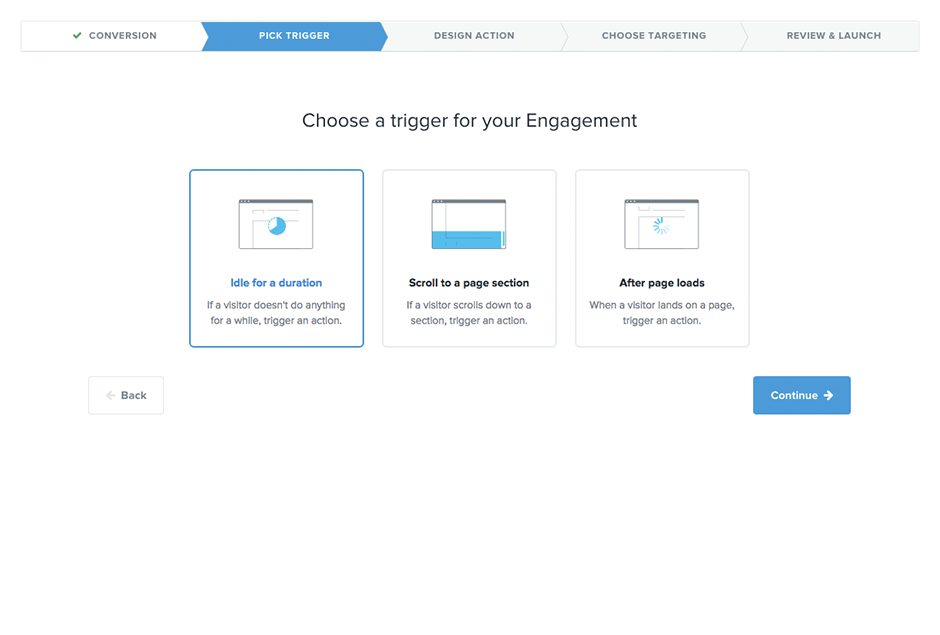
Automation solutions that track visitor or user activity real-time and present timely prompts to take desired actions can significantly improve conversions. When configuring such tech for your app or site, it is important to make sure you don’t over-do the prompts and that they are thoughtful to bring about desired results. Too many disruptions in a user’s experience with your product will irk the user to moving away from it. Tools like Kissmetrics, Intercom.io, SumoMe and Hubspot can be very handy in achieving such high quality user interactions.

E-commerce businesses can especially benefit a lot from marketing tech that allows them to assess real-time user behavior and allows them to give smart recommendations to convert a sale. Cart abandonments also should trigger timely reminders or feedback requests, both of which can be very valuable.
Conclusion
Marketing technology offers a lot of opportunities for bringing in new customers and doing more business with existing ones. Large companies are using it on a big scale to drive more efficiency in their marketing processes, and better engage with their customers. But marketing automation is not just the dominion of large businesses, smaller businesses need it just as much to drive down marketing costs and convert more to have a competitive edge.
Automation doesn’t necessarily mean complex systems running large processes on big data. Even smaller hits with partial process automations can bring in significant wins. What’s most important is structured thinking about marketing processes to identify areas of opportunities and implementing automated systems to run the show for you.
About the Author: Sophia Solanki is a co-founder of DrumUp, a social media and content marketing automation app and Godot Media, a content services firm. She has over a decade of experience in content and social media marketing, entrepreneurship and business consulting. Sophia is an ardent supporter of technology to improve efficiency in all aspects of life and business. You can also follower her on Twitter @sophiasolanki.