Miyerkules, Hulyo 8, 2015

How to Use Social Proof to get Better Results from Facebook Ads

Today’s article is a guest contribution by Aimee Millwood.

Facebook ads provide enormous potential to grow traffic and sales. But knowing how to create ads that get results isn’t easy. Many businesses fail to grow traffic on social because they don’t know how to create ads that grab attention.

Here’s the bottom line: To sell on social media, you must use social proof, and it has to be the right social proof.

Don’t just take our word for it.

What the Data Has to Say about User-Generated Content (UGC) Facebook Ads

We ran A/B tests to compare how Facebook ads with customer content performed against ads with only brand content.

We saw that cost per acquisition dropped significantly, while conversion rate and average order value shot up.

On average, Facebook ads with UGC had:

  • 300% higher click-through rate (CTR)
  • 50% lower cost per click (CPC)
  • 50% lower cost per acquisition (CPA)

Why the great results?

For one thing, selling on social has traditionally been difficult for many brands. Social is a place where people go to connect with their friends and networks, not to look for things to buy. As Gilt’s Susan Lyne put it, trying to sell on social is like trying to sell at a bar.

She may have a point, but done correctly, selling on social is possible. You’ve just got to join in the conversation rather than interrupt it.

By integrating content created by customers (and Facebook friends), people see a recommendation from a person they trust, not an ad thrown at them by a brand.

These results are great, but they don’t mean you should run off to Facebook and start putting your customers’ UGC on ads.

It’s not enough to simply plaster a customer-submitted Instagram photo or product review on an ad. You need to know how to integrate customer content intelligently in order to tap into its potential.

How to Get the Best Results from Facebook Ads

We’re here to teach you what the data showed us about how to drive the best results from Facebook ads.

We sat down with our Director of Advertising and took a look at insights gained from testing thousands of customer-content Facebook ads. Here are our conclusions along with insider tips on how to get the best results from Facebook ads.

These tips and statistics deal specifically with using reviews in Facebook ads, but the advice applies regardless of what type of UGC you’re using.

1. Take Advantage of Ad Copy

The review (or other UGC) is obviously the most important part of the effectiveness of the ad. But the ad copy is a key element as well. Some tips:

  • Keep it short. Shorter ad copy performs better.
  • Though it may seem counter-intuitive, don’t use the word “reviews”! It comes across as too salesy. Ads with the word “reviews” in the copy don’t perform as well.
  • Make sure the voice in the copy matches your brand voice and message, not the customer’s. The review is where you let the customer speak. The top of the ad should stay on brand.

For example, in the ad below, notice how the ad copy is short and to the point, in the same tone as the review itself. Also, the copy is concise but comprehensive, making it easy for people to understand the message instantly.
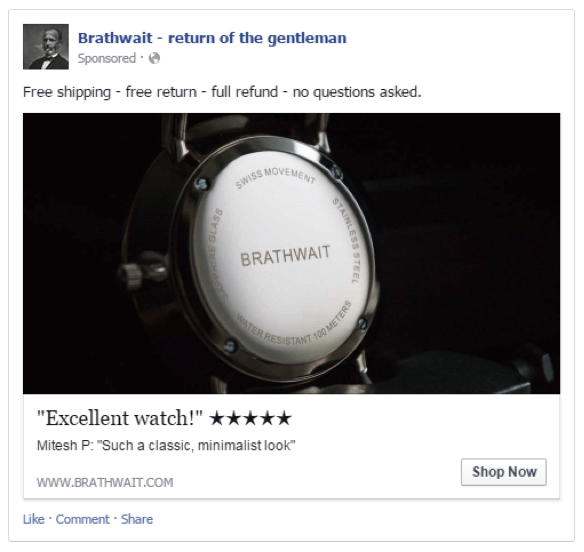
brathwait-return-of-the-gentleman

However, the following ad copy refers to the review; and because of this, it comes across as too salesy and forced. Additionally, the tone is much more formal than the review, so it doesn’t work as well. Also, it’s too long, so it doesn’t have the same impact that short, snappy ad copy does.
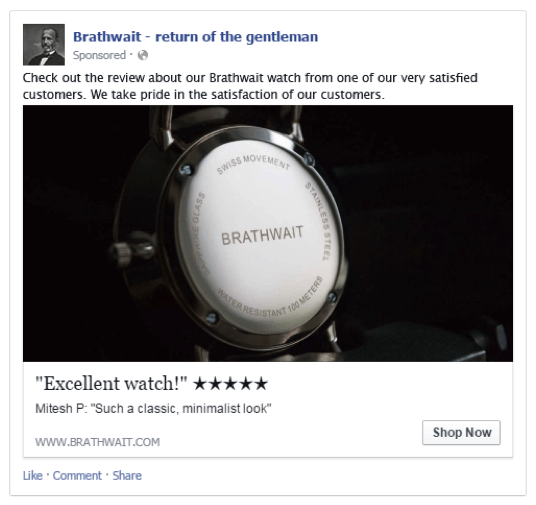
brathwait-return-of-the-gentleman-2

2. Use Product Reviews for First-Time Visitors and Site Reviews for Re-targeting

In social advertising, it’s vital to target the right person with the right message at the right time.

When it comes to Facebook ads, this means you should use a specific kind of review, depending on whether people are familiar with your store or they are first-time visitors. When you’re trying to gain clicks and traffic, it’s better to use product reviews.

Use reviews of top-rated, top-selling products to attract first-time visitors with specific items.

nations-photo-lab

Once someone has clicked through to your site, seal the deal by re-targeting them with ads containing site reviews.
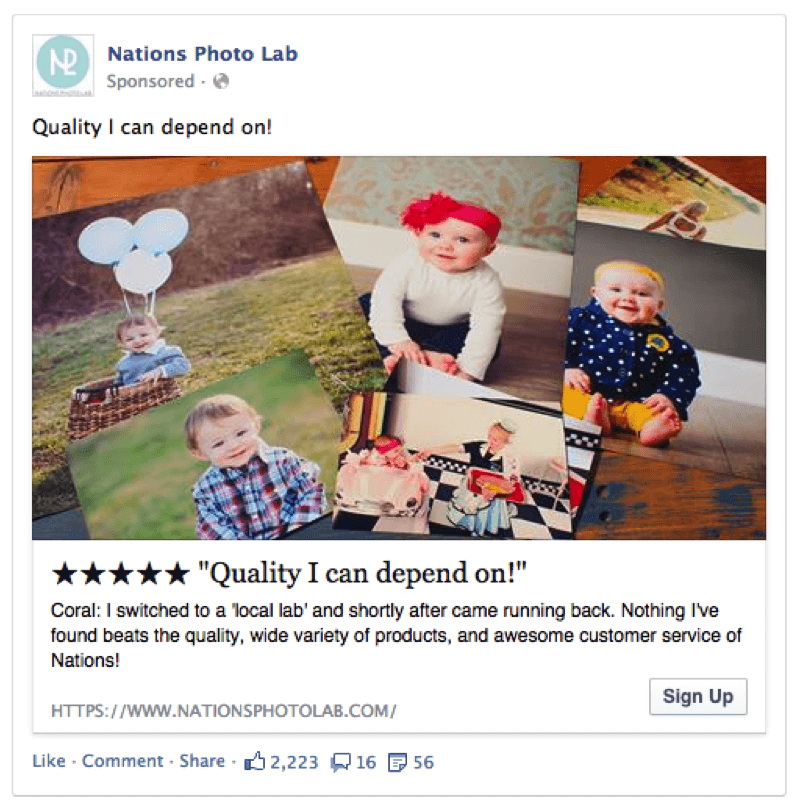
nations-photo-lab-2

Why? Top-rated, top-selling products will attract new visitors, but after they visit the site and don’t buy the product, it’s more effective to re-target them with site reviews. Site reviews emphasize the authenticity and strength of the brand, not a specific product, so the reviews will reinforce your brand even if the visitors don’t want to buy the specific product.

3. Include Personal Key Words

You might be proud of a review that says “Great shipping and excellent service,” but that doesn’t mean it makes good copy for an ad. Especially on social media, people want to read about real experiences. Using personal pronouns is a psychological cue that the stories are authentic.

Because of this, reviews that have words like “I,” “my,” or “we” are much more effective than reviews that don’t refer to personal experiences.

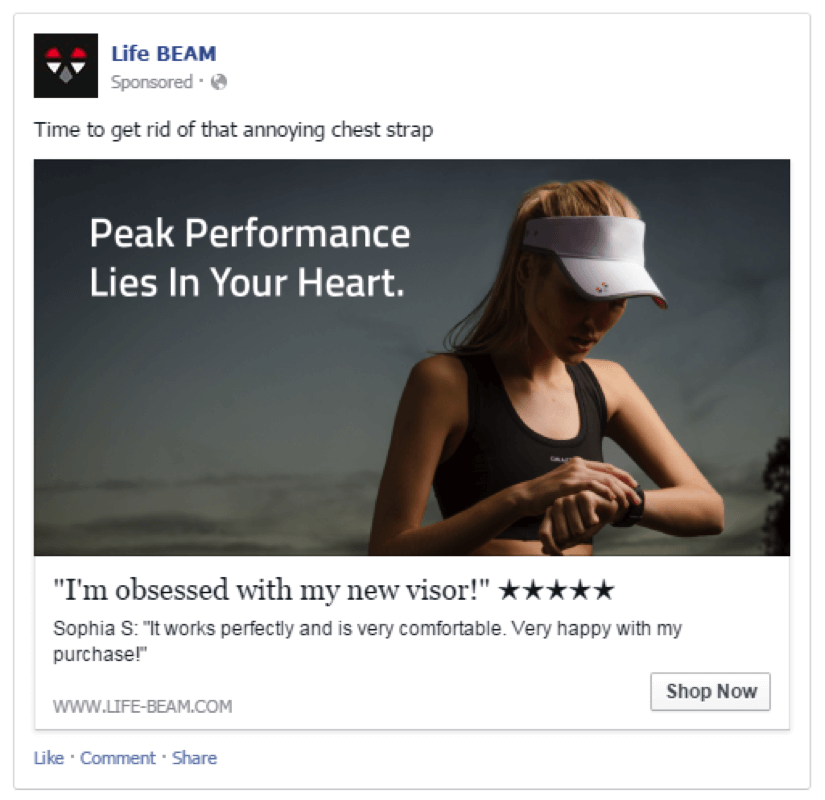
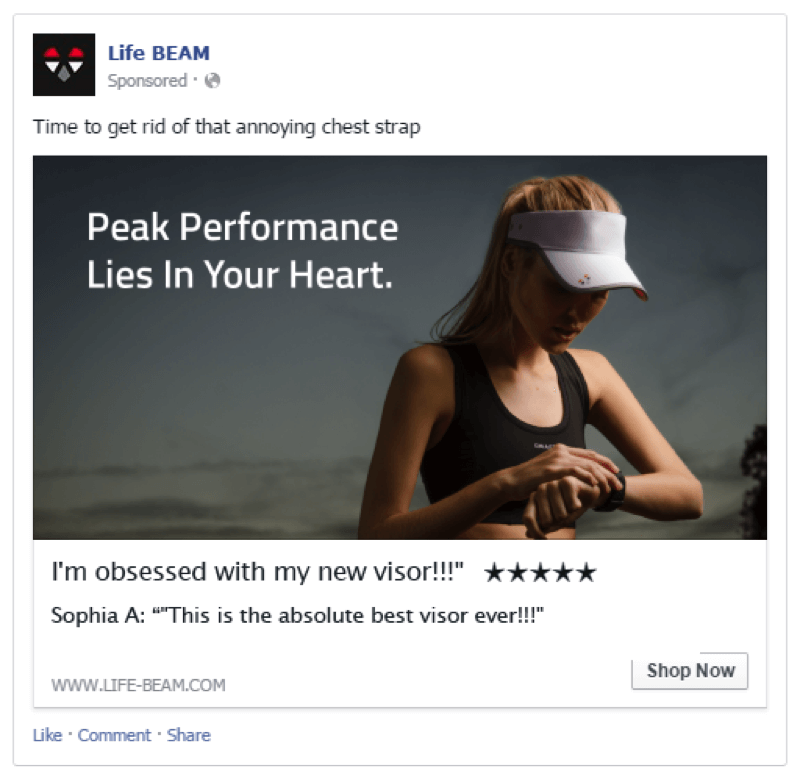
4. Avoid Reviews with Multiple Exclamation Points

The beauty of using UGC as ad creative is that it is genuine and credible content from real people.

However, when the copy is too enthusiastic, even if it is real, it looks fake to the reader.

Even though the overexcited review looks good to you, it is less trustworthy, which is why ads using reviews with “!!!” are less effective.

So, keep your reviews to one exclamation point maximum.

Look at the difference in the two ads below. While subtle, including too much enthusiasm doesn’t seem as trustworthy.
life-beam

life-beam-2

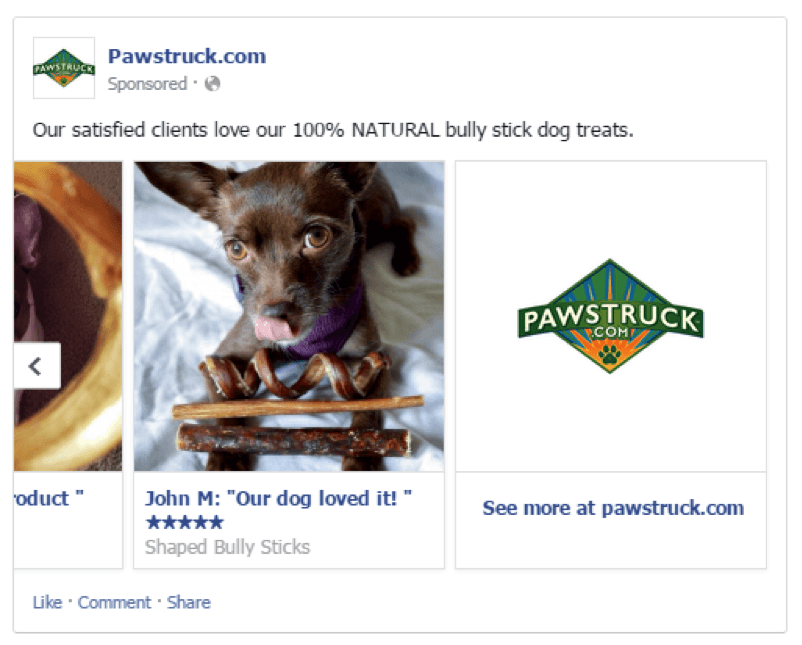
5. Focus on the Experience

It’s better to use a review in which someone talks about using the product than one in which they describe the fast shipping. Once again, it comes back to people wanting to relate to a real and personal experience.

Reviews that tell a story like “I gave these bracelets to my daughter for her birthday and she was so excited,” are more effective than something like, “The bracelets arrived quickly.”

In the example below, the carousel displays reviews with generic praise about the product and service.

pawstruck

In contrast, the following carousel contains specific examples of personal experiences, making it much more effective and relatable.
pawstruck-2

6. Test It First

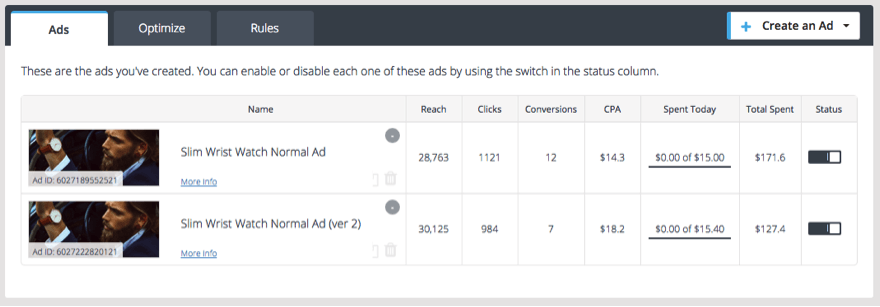
Try not to put money into anything you haven’t tested organically first. The beauty of Facebook is that you have a lab where you can test content, albeit on a smaller scale than with an ad.

Test different copy, images, and audiences to see what resonates before you pull out your money.
test-it-first

In summary, the customer’s voice is your most powerful marketing tool. Use it to your advantage by integrating customer content in your Facebook ads. These tips can help you get the best results from this effective strategy.

About the Author: Aimee Millwood (@aimeemillwood) manages the Yotpo blog, where she writes about marketing, growth, and engagement.

A Millennial, a mom and a mortgage: Ties that bind

This Millennial embraced debt for her mom's sake and also ended up with a long-term investment.

Martes, Hulyo 7, 2015

5 Essential Ways Marketing Must Change to Support Inside Sales

After years of running and advising startups, I’ve found that many businesses struggle with friction between sales and marketing. Sales often complains that marketing is not generating quality leads. Marketing, on the other hand, criticizes sales for not properly following up with prospects.

In the few companies I was involved with where marketing and sales were aligned, the difference was palpable. These businesses had a clear go-to-market strategy that translated into well-defined priorities for every employee. They also had a much stronger company culture and terrific morale across the organization.

On paper, aligning sales and marketing shouldn’t be hard. Marketing, after all, has the same goal as sales (or, as Peter Drucker said, “the aim of marketing is to make selling superfluous”). In practice, however, finding a good fit between the two departments is one of the more difficult problems in business.

This problem is all the harder in the age of inside sales. With shorter sales cycles and lower price points, there is very little opportunity for sales and marketing to collaborate on specific deals. Throw in the typical strong personalities of sales and marketing leaders, and you have an interesting challenge.

Solving the sales-marketing alignment challenge is critical to your business success. For inside sales to work well with marketing, it is imperative that marketing adopt a few key changes to its principles and processes.

Here are 5 ways marketing must change in order to become effective in a high velocity inside sales go-to-market strategy:

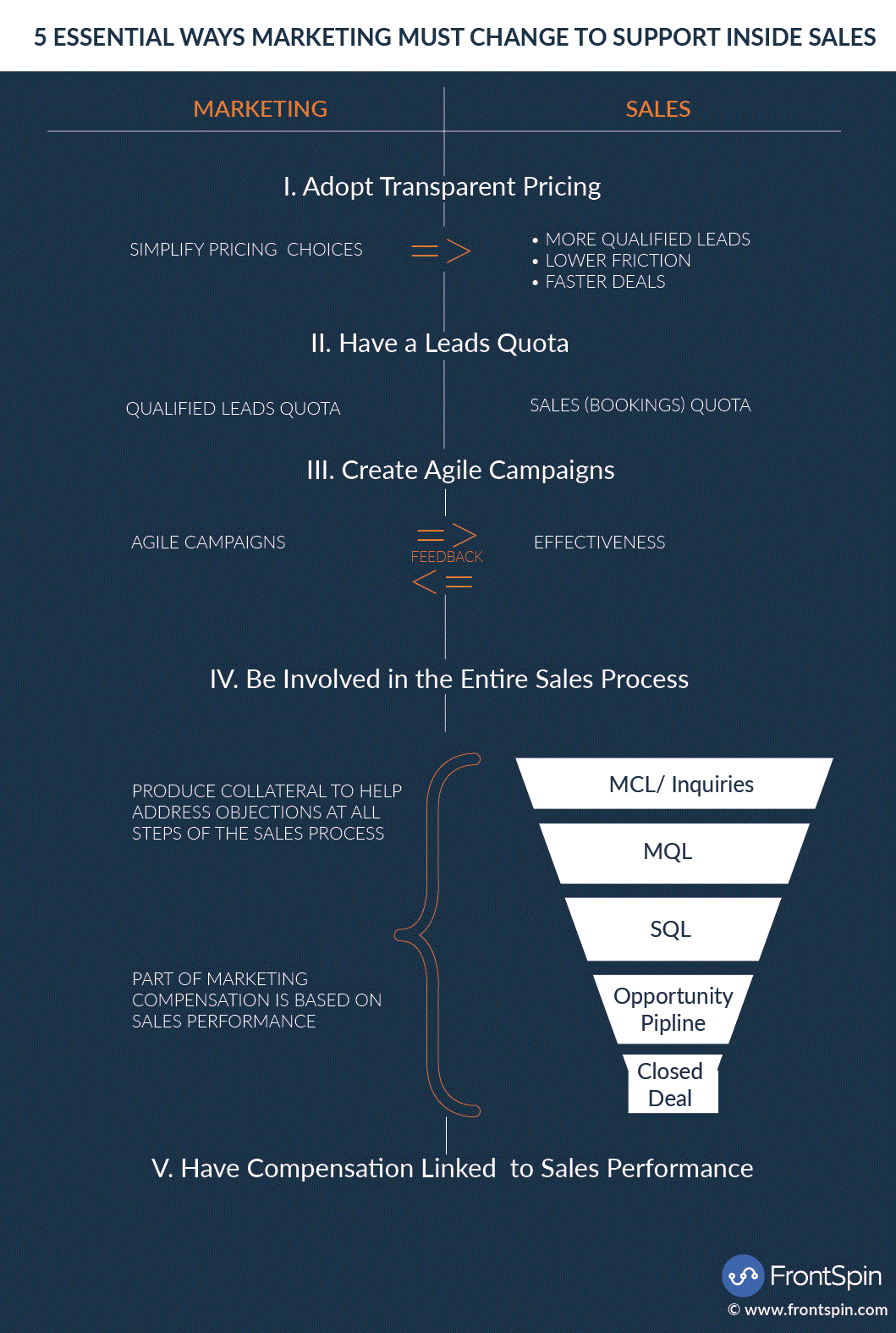
1. Marketing Must Adopt Transparent Pricing

Selling software used to involve sitting across from a prospect, showing off a product demo, and then offering a custom quote based on the customer’s requirements and input from the sales manager.

This method does not work in the present-day context. Buyers today have access to much more information, and they complete nearly 60% of the sales cycle before even talking to a rep. They demand transparent pricing in order to purchase only the products that fit within their budgets and feature requirements.

Besides being more buyer-friendly, transparent pricing offers two tacit benefits to your sales team as well:

  • More qualified leads: Transparent pricing helps buyers qualify your solution for their budgets and reach out only if there is a fit. By pre-qualifying buyers this way, you can ensure that only higher quality leads get through to your inside sales team.
  • Lower friction, faster deals: At an average of 45 days, inside sales cycles are significantly shorter than field sales. To sustain shorter cycles, you want prospects to make purchase decisions quickly. Transparent pricing ensures that your sales team spends the least amount of time possible on pricing. They can focus on the more valuable task of sharing the benefits of your solution for a specific prospect’s needs.

Ideally, you want your pricing to be as easy to understand as possible. You can vary pricing by features or users, but make sure to optimize for, at most, two variables. More than that and you will confuse prospects and lengthen the sales cycle.

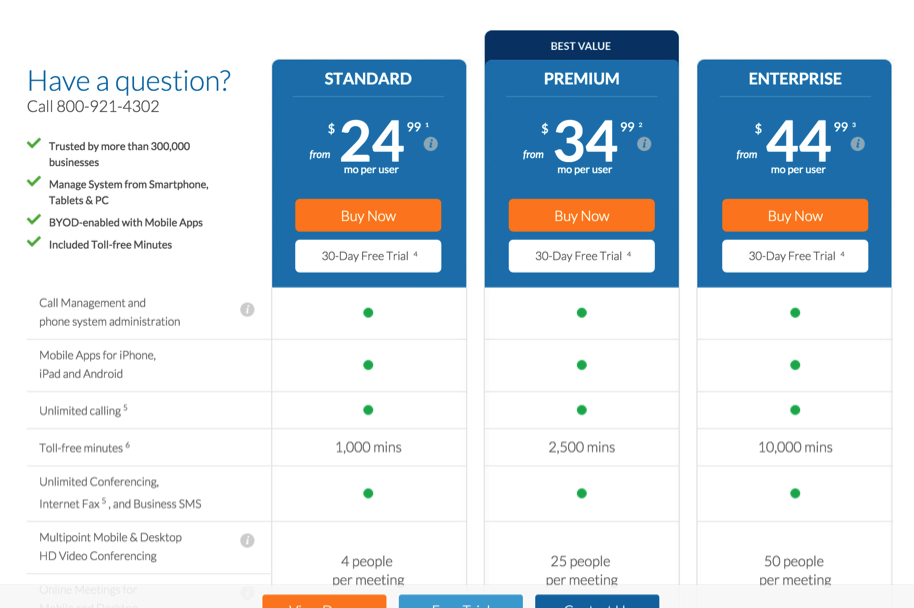
RingCentral is a great example of transparent pricing. It offers pricing based on number of users and edition (bundle) chosen. With just three different plans, prospects don’t have to struggle with choosing from endless plans and customization options. This removes friction from the sales cycle and helps RingCentral sell more.

pricing-page-6-6-15

Contrast this with their competitor ShoreTel. Although ShoreTel offers similar products, its pricing plans are confusing and non-transparent. Buyers who land on the ShoreTel website have no option but to contact a sales rep, even if the products are beyond their budget or requirements.

shoretel-pic

Key Takeaway

More options work well with enterprise sales where your goal is to maximize revenue per deal, but in a high velocity inside sales environment, limiting choice yields better results (600% better, according to one study). By directing marketing to adopt transparent pricing, you will ease the buyer’s decision-making process, thus aiding the inside sales team.

2. Marketing Must Have a Leads Quota

The performance of a sales team is a function of the total number of leads it receives each month. The higher this number, the more leads it can process, and the more it can sell.

This is true for every sales team, but is all the more pertinent for inside sales. The inside sales cycle is much shorter than field sales (around 45 days versus 6 to 9 months for field sales), and inside sales reps are not bound by physical limitations (such as taking meetings), which enables them to handle much higher lead volumes.

Thus, a high velocity inside sales team needs a constant influx of qualified leads delivered at a regular rhythm to be successful. This is the reason marketing must have a monthly leads quota. If marketing can’t send enough leads to sales even for a single month, it will be difficult for the inside sales team to meet its bookings number. This is bad for the bottom line and worse for sales-marketing alignment and morale.

Jason Lemkin of Saastr.com agrees, saying that just as a vice president of sales carries a sales quota, a “vice president of marketing needs a leads quota.”

For this idea to be successful, however, sales and marketing must work together to define what makes a qualified lead. In the past, it was common to use BANT (Budget, Authority, Need, and Timeframe) as qualifying criteria, though today more relaxed criteria is used. Once sales and marketing agree on a definition of a qualified lead, marketing can be held responsible for a monthly qualified leads quota.

Key Takeaway

Give your marketing team a leads quota with well-defined qualification metrics. This is necessary for the success of your inside sales team.

3. Marketing Must Run Campaigns That Are Flexible

Prior to inside sales, it was typical to have long lead-time marketing campaigns and not get the results of their effectiveness until months later. So, marketing heads would draw up year-long marketing plans in November, and then wait until March-April to see whether the initial campaigns worked (or not). You had little access to data, and whatever little data you did get often took months to roll in.

Compare this with marketing campaigns today, and you will see two significant changes:

  • Marketing campaigns generate more data: You can launch a brand new marketing campaign, buy some PPC traffic to test your messaging, and get tons of actionable data within hours. If the data passes your benchmarks, you can then go ahead and launch it at scale, passing the leads to your inside sales team.
  • Inside sales teams generate results faster: Once the leads start rolling in, a competent inside sales team can close them within days. Thanks to these shorter inside sales cycles, your marketing team can get constant feedback on the campaign’s effectiveness.

In this scenario, the only way to succeed is by running agile campaigns that can accommodate feedback from inside sales. Your inside sales reps should be in constant touch with marketing, telling them exactly what works and what doesn’t. Marketing, in turn, should use this data to optimize the campaigns constantly for best results.

Key Takeaway

Make sure your marketing campaigns are flexible and adapt as per feedback from inside sales. If something doesn’t work, marketing should move quickly to change course. If something does work, marketing should increase spending on it.

4. Marketing Must Be Involved in the Entire Sales Process

It is inevitable that your prospects will raise objections in the course of the sales process. How effectively your reps can answer these questions will be instrumental in determining your win rate.

Traditionally, the responsibility for addressing objections falls upon sales reps. In my experience, however, you see a lot more success by offloading this duty to marketing and involving marketing in the entire sales process. This will also save your sales reps’ time since a majority of reps spend up to 30 hours a month producing sales material.

As an example, in my last company, our customers in the healthcare industry would go through the entire buyer’s journey, but raise objections about HIPPA compliance (required by government regulation) before making a purchase decision. Of course, our reps would answer their queries, but it was usually haphazard and dependent on the individual rep.

To meet these challenges, I directed our marketing department to collaborate closely with inside sales and gather a list of common customer objections. Marketing then went to work creating detailed material for each query and distributing it across the team. Any time a rep encountered an objection, he or she could use this informational material to move customers further along the sales cycle.

Thus, whenever our healthcare customers raised objections, they received a detailed whitepaper on HIPPA compliance. Since this document was common throughout the sales team, we could also answer customer queries in a consistent manner.

The results were telling. Our win rates increased dramatically, and we quickly became the leading SaaS Contact Center Solution for the healthcare industry.

Key Takeaway

Marketing can no longer just hand over leads to sales. It has to be involved in the entire sales process, producing informational material and helping sales reps address prospects’ objections in order to nudge them down the sales process. A professionally produced marketing document will work much better than a quickly drafted email from a sales rep in answering prospects’ questions.

5-Essential-Ways-Marketing-Must-Change-To-Support-Inside-Sales

5. Marketing Compensation Must Be Linked to Sales Performance

We’ve already discussed how marketing has to carry a leads quota. In addition, for true sales-marketing alignment, marketing’s variable compensation should be based on the inside sales plan achievement.

There are two very good reasons for this:

  • Marketing gets compensated based on its role: Once marketing is involved in the entire sales process and carrying a leads quota, a part of its compensation should be linked to its role in the sales cycle.
  • Marketing works better with sales: Sales often feels that marketing gets compensated even when sales does all the heavy lifting (i.e., making the actual sale). By linking marketing compensation to sales achievement, you will ensure that marketing is more involved than ever in helping sales achieve its goal.

Key Takeaway

Once marketing is more involved in the sales process, part of its variable compensation should be linked to sales performance (around 25%). This can also help in better sales and marketing alignment.

Conclusion

Over the last decade, inside sales has been a transformative force in sales organizations, especially in B2B sales. It has changed not only the way we sell, but also the way we market our products. The inside sales go-to-market model is here to stay and is only gaining momentum.

For inside sales to be successful, it is imperative that marketing adopt a few fundamental changes. This includes bringing more transparency to pricing, linking marketing compensation to sales performance, and involving marketing in the entire sales process.

These changes may be hard, but they are critical for modern business. They will help you sell more, run better sales teams, and most importantly, create the all-important sales-marketing fit necessary for business success.

About the Author: Mansour Salame is the Founder and CEO of FrontSpin (an inside sales SaaS provider). He is a hi-tech entrepreneur with multiple successful exits. He enjoys building high performing teams and is passionate about inside sales.

Biyernes, Hulyo 3, 2015

Greece deeply divided as vote on Europe looms

Read full story for latest details.

The Top Five Kissmetrics Reports Every Ecommerce Marketer Needs

Today’s ecommerce marketers have a tough job. Their main objective: get the messaging out about the store and deliver sales. You have the website at your disposal and a mediocre advertising budget.

The challenge for you, as an ecommerce marketer, is how do you compete against a service like Amazon? They’re big, they can undercut your prices, and they can handle low margins while you cannot.

You need to optimize everywhere you can, including your funnel and your marketing channels, and you need to build a loyal customer base. Fortunately, Kissmetrics is here to help. Our software provides insights that can help visitors into customers. And once you get those customers, we provide data that can help you acquire more of the loyal ones.

Let’s see how.

1) Purchase Funnel – See Where You’re Losing Customers

Every website has a set of steps visitors need to go through before they can purchase. The Kissmetrics Funnel Report is used to help marketers identify the areas of their website where visitors depart. Once they identify those areas, they can then A/B test their way to growth.

Here’s how a funnel for an ecommerce site might look:

ecommerce-purchase-funnel

What we know from viewing this graph is that visitors have two big roadblocks to becoming customers. Of those who view the product page, only 33% convert to adding a product to their cart. And once they do add a product to their cart, only 13% of them end up purchasing. If you’re a marketer and this is your data, you know you can do better than a 13% conversion from cart to purchase. And if you do improve, you’ll end up getting more purchases for your company. Cha-ching!

To get you on your path to increased purchases, you’ll need to run A/B tests on the product pages and throughout the shopping cart checkout process (more on that later). You can create your A/B tests in whichever tool you use – Optimizely, VWO, etc. – and then track the results with the Kissmetrics A/B Test Report.

The cool thing about this report is that you can see how an A/B test impacts your entire funnel. So if you run a test on the product page, you can see how it impacts further on down the funnel, all the way to the purchase! You aren’t limited to testing only to the next conversion step.

You can also set up a funnel to view how people move through the checkout process. Let’s get into that now.

2) Funnel Report – See Where Customers Drop Off in the Checkout Funnel

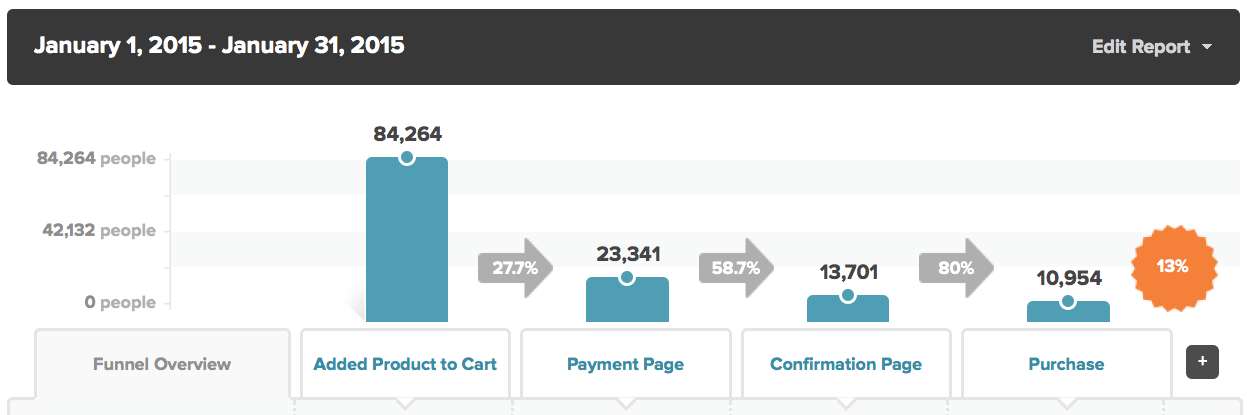
You can break funnels into two categories – macro and micro. The macro funnels take a bird’s-eye view of your site, often viewing your whole site. The purchase funnel is a lot like that. It goes from the start of the funnel all the way to the end. A micro funnel allows marketers to zoom in and see a specific flow within their site. A funnel report on the checkout funnel is one example.

Here’s how it might look:

ecommerce-checkout-funnel

Looking at this graph, where would you say drop-off is occurring?

Without question, most people who end up putting a product in their cart don’t even advance to the next step in the funnel (the Payment Page). If we can increase the people who convert from the Added Product to Cart page to Payment Page, we’ll have a pretty linear increase in purchases.

So if you’re a marketer and you want to increase conversions (who doesn’t), here’s what you do:

  • Use the Kissmetrics Funnel Report to see where visitors are dropping off.
  • Run A/B tests on those pages. Track the tests in the Kissmetrics A/B Test Report. The more tests you run, the more winners you’ll find, and the more purchases you’ll bring.

With Engage from Kissmetrics, you’ll be able to put modals on your site that can increase conversions. A lot of our customers have experienced a conversion boost by using Engage.

The best marketers are able to drive loyal customers. Lucky for marketers, Kissmetrics has a report that shows marketers where their most loyal customers come from.

Click here to watch a short demo of the Kissmetrics Funnel Report.

3) Cohort Report – Find Customers Who Repurchase

Businesses live and die on their ability to attract and retain customers. To track customer retention, marketers can create a cohort report that shows them how often customers come back and repurchase products. They can even group them together and see which products or product lines have people coming back for more.

A cohort is a group of people who share a common characteristic or experience within a defined period. For example, people who purchased from your site during April are in a cohort because they all did one thing (purchase) during a defined period (April).

Taking this a step further, the Kissmetrics Cohort Report allows you to group people by any characteristic and then segment them by any property. Let’s see this in action.

We want to track repurchase rates (i.e., people who purchase, then purchase again). We can find those people, but what do we group them by? Time? Marketing channel? Product? Product category? As long as you’re tracking the property in Kissmetrics, you can segment people by it.

Let’s use marketing channel as our example. This segments people by the channel they came from. The higher the percentages (darker shade of blue), the better.

channel-purchases-cohort-report-kissmetrics

On the left side we get the number of people from each channel who have purchased. This is not a traffic report. We’re looking at purchases. We see that most of our purchases are from people in the Social channel. The right side (all the blue shaded cells with percentages in them) shows us how many of those people came back and purchased again, by month.

Social looks like it delivers a lot of purchases and repurchases. If we can acquire more people from this channel, chances are we’ll be acquiring loyal customers. The more targeted we can make our marketing, the more loyal customers we’ll attract. And businesses that win have loyal customers.

As mentioned above, we aren’t limited to grouping people only by channel. We can group them by product (see which products get the most repurchases), product line, any UTM parameter, time, etc. As long as you track it, you can get the data that matters to you.

Click here to watch a short demo of the Kissmetrics Cohort Report.

4) Revenue Report – See Which Products Bring the Most Valuable Customers

Your revenue is probably coming from dozens (hundreds) of sources. Maybe a feature on CNN got you a ton of orders, or you get a lot of purchasers coming from Google searches.

The Kissmetrics Revenue Report is used to segment your revenue and see which sources are bringing you the most valuable customers. Here is how it could look for a company selling clothes:

kissmetrics-revenue-report-ecommerce

We’re segmenting revenue by collection (aka product category). The In-House Generic Tees bring tons of revenue (over $630k) and customers (over 9,700). The other metrics (average revenue/person, lifetime value, and churn) tell us how valuable these collections are for our business. We want high numbers on average revenue/person and lifetime value, but low percentages for churn. (Churn represents the percentage of people who ordered from that collection but did not order again within a defined time period.)

Just like the Cohort Report in the above section, we aren’t limited to segmenting only by collection. We can also segment by marketing channel, so we can see which channels bring us the most valuable customers. By the way, the channels property works automatically in Kissmetrics. There are no custom rules or custom code needed.

Click here to watch a short demo of the Kissmetrics Revenue Report.

5) People Search – Find People Who Have Abandoned Their Cart

The biggest problem for a lot of ecommerce companies is customers who abandon their cart. They view a product, add it to their cart, but never return again. They’re missing out on a big opportunity if they don’t make an effort to re-engage these people. If marketers can get them re-engaged (through cart abandonment emails) they are giving themselves a better shot at recapturing these lost orders.

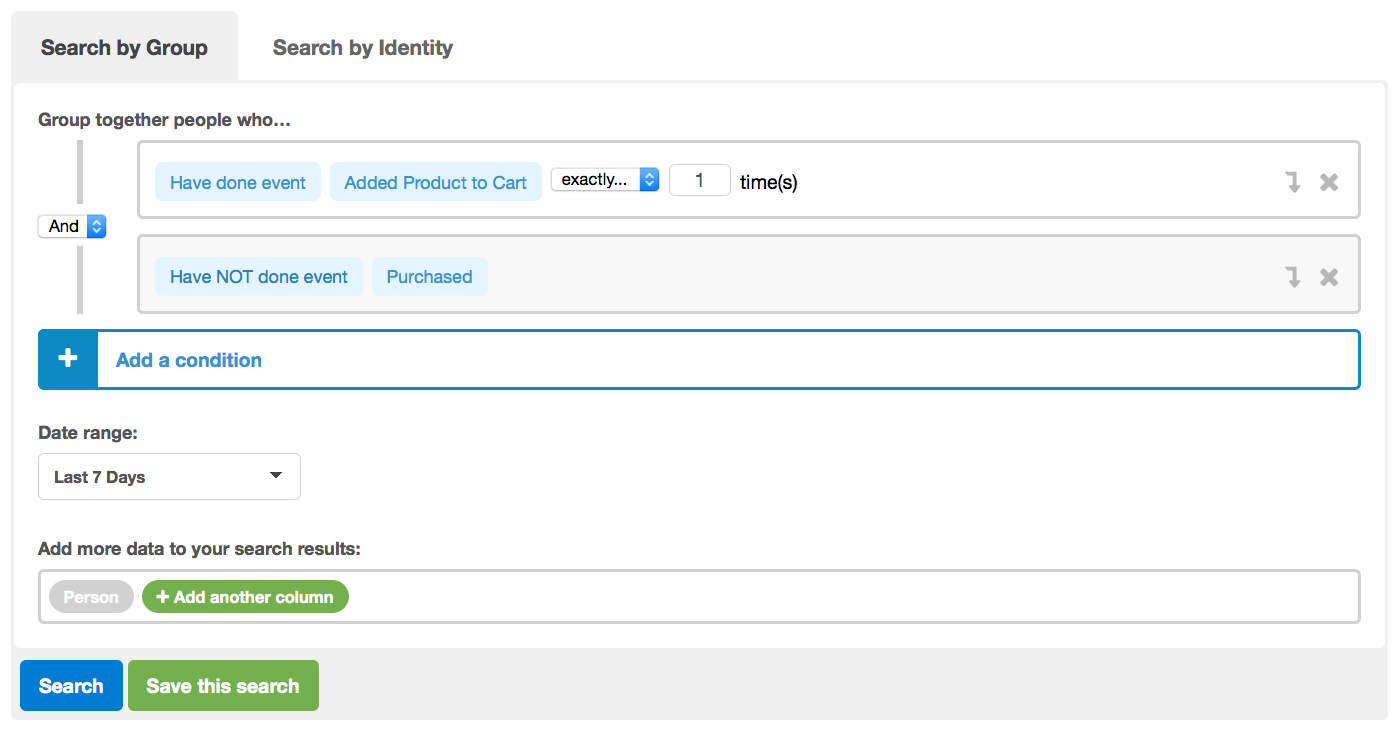
The problem for many marketers is they don’t know where to start to get a list of these people. The Kissmetrics People Search makes this process easy. All you have to do is set your criteria to get a list of people you are looking for. There is no need to bug engineers to run a SQL query.

Here’s what our criteria looks like. We’re looking for people who have added a product to their cart but have not purchased. We want to see all the people who fit this criteria in the past 7 days.

people-search-add-product-to-cart-ecommerce

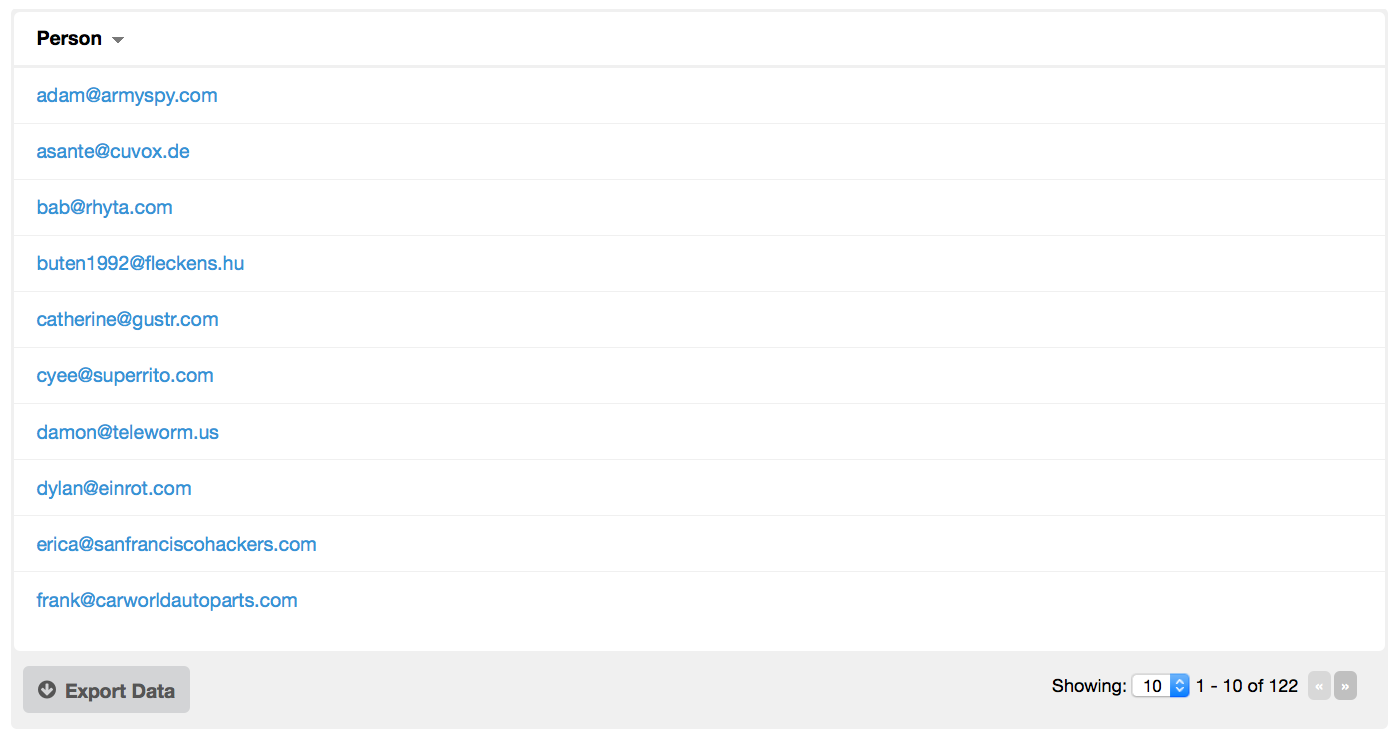
We click Search and get our list of people:

people-search-kissmetrics-cart-abandonment

There are a few things we can do with this list:

  • We can click on each person and get a Person Details report. This will show us all the events and properties the person triggered (i.e., what they’ve done on the site) as well as tell us the last time they were seen.
  • We can export the list to a CSV file and then upload it into an email service provider like MailChimp and send an email to each person to get them re-engaged and hopefully recover some lost sales.

Important note: You’ll get a list of email addresses only under certain circumstances:

Click here to watch a short demo of the Kissmetrics People Search.

Optimize Your Marketing with Kissmetrics

These are just a few examples of what Kissmetrics can do for ecommerce companies. Our reports are more than useless metrics – they provide insights into how users are behaving on your site. Once you see this data, you’ll know what needs to be improved. Once you see this data, you’ll know what needs to be improved.

Head on over to the Demo site and see how Kissmetrics works for ecommerce sites. Or better yet, schedule a personalized demo.

Ready to get straight into the action? Just click the button below to sign up for a free 2-week trial of Kissmetrics.

cta-6-11-2012

About the Author: Zach Bulygo (Twitter) is a Content Writer for Kissmetrics.

Miyerkules, Hulyo 1, 2015

6 Problems Lucid Software Solves Using Kissmetrics

As Digital Marketing Manager at Lucid Software, I can really appreciate all the hard work that has been put into Kissmetrics. It’s a valuable tool for tracking, analyzing, and optimizing our marketing efforts, which include many day-to-day tasks that go above and beyond traditional metrics. Below, I’ve outlined six marketing questions Kissmetrics is helping us answer in ways you may not have considered before.

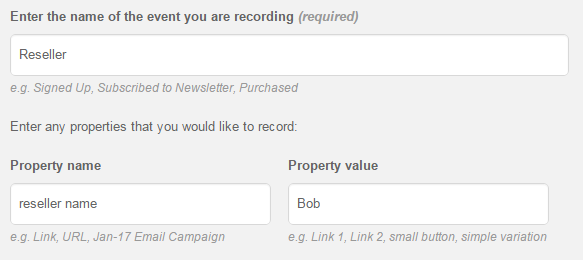
1. Where do I start with my reseller efforts?

When you are just starting up a reseller program like we are, it may not make sense to start paying for a separate tracking solution right away. We are able to credit our resellers and affiliates for the customers that they send our way through their online presence. We don’t need to deploy a whole new solution for this—we simply use Kissmetrics to track the links we provide them.

reseller

Use Kissmetrics to power your own affiliate program

2. How do I tracking content marketing ROI?

Content marketing is all the rage these days. Just as popular as content marketing are the many articles that give advice on measuring ROI. Even if a marketing effort involves multiple pages, it is easy to quickly track the impact of the campaign as a whole when you’re using Kissmetrics. I was able to put a JavaScript tag on all the pages in question with one event. I also set up a property that tracks the page name for the possibility of future granular analysis. This allowed me to group and measure the performance of different KPI metrics like registrations and payments by related content.

3. Is increasing registration conversions impacting revenue?

In the SaaS world, it is very common to offer an evaluation period for your software so that the customer can ‘try before they buy.’ From a marketing standpoint, this can prove to be a challenge because you now have two metrics that you care about:

  1. Trial registration rate
  2. Payment rate.

It’s nice to know that Kissmetrics lets me tie back-end payment information that happens after the fact to the original trial registration. At the end of the day we are interested in the test version that drives the most revenue long-term, not just the version that converts the most people to trial. Kissmetrics makes it easy to keep those two versions distinct.

impacting-revenue

Kissmetrics is great at tracking A/B tests that actually drive revenue months down the road

4. Which of my customers should I be calling to do market research?

I am often interested in learning more about how a segment of our customer base uses our products, Lucidchart and Lucidpress, or how they first learned about us.

Since Kissmetrics ties anonymous visits to our customers once they login, I can go back in time and say “show me everyone that did X events or visited Y page.” I can then use that customer list to do outreach.

This proved very helpful to our team: we were able to effectively do our homework before we reached out, which means the people we were calling actually valued our calls.

market-research

Kissmetrics allows you to do very segmented market research with your own data – no spreadsheets or having to ask developers for data dumps

5. How do I manage my marketing efforts across multiple products?

When you have more than one product, it’s nice to be able to house all your testing and analytics in one place. I personally find this important, because ideas I test on Lucidpress might come from wins we originally got through Lucidchart testing. I can open a new tab and compare the set up on one domain, then quickly set up a test on a completely different revenue stream. Managing multiple domains also allows for another handy feature, which leads into my last question that Kissmetrics helps answer.

6. How can I test my analytics implementation before pushing it live?

Testing can sometimes mean lots of moving parts, so it’s nice to be able to incorporate testing implementation into your QA cycle. We have a development, staging, and production server.

With Kissmetrics we are able to take a look at whether events and properties are being recorded properly in development and staging before they ever get released to production. This is great for me because I can get more eyes on our tests before they go out. Writing the acceptance criteria for the QA team gives me another chance to make sure that all my ducks are in a row.

analytics-deployment

You can set up Kissmetrics on multiple servers – allowing you to make sure your testing and analytics solutions are working on development and staging servers

Bonus: What’s next?

When I sat down to write out some of the possibly lesser-known advantages of Kissmetrics, I limited myself to just the few benefits I could rattle off of the top of my head and use every day.

As a bonus, I want to mention that Kissmetrics is releasing new features on a regular basis. Whether it is robust regex support or their A/B test report, they are always focused on making their product more indispensable. Lucid Software has been a client for years now and we are excited to see what features they add next!

About the Author: Brad Hanks was the first marketing hire at Lucid Software, the creators of Lucidchart, a flow chart maker, and Lucidpress, an online design and page layout tool that makes brochures, among other things.

NAR to Partner with Hogan Lovells on UAV Webinar

The Hogan Lovells Unmanned Aircraft Systems (UAS) Group has partnered with the National Association of REALTORS® to host a webinar on the regulatory and business hurdles to operating unmanned aircraft systems (drones). Learn how to integrate UAV technology into your business and how to obtain a Section 333 waiver from the FAA.

Please join us on Thursday, July 9, 2015 at 2:00 P.M. EDT to learn more about how to get approved to fly drones.